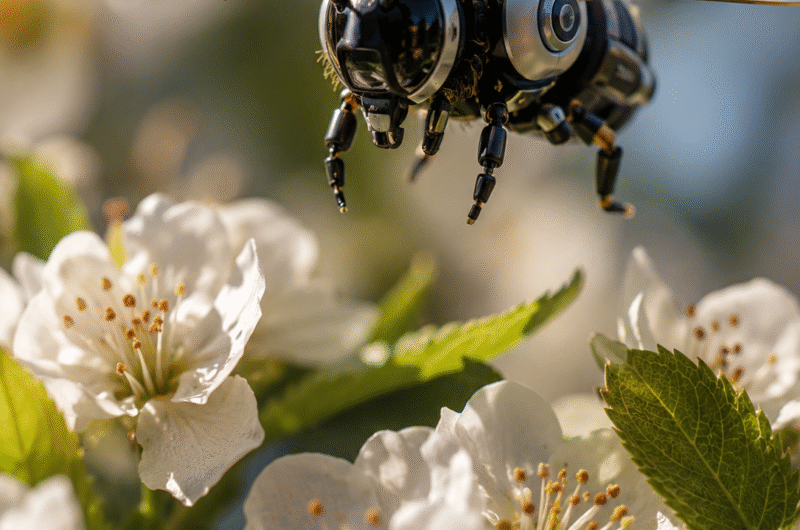

Last February I got a text from a grower I’ve sold nucs to for six years. He wasn’t asking about bees. He was asking whether I’d heard of a company flying drones over almond blocks instead of trucking in hives. I hadn’t, not really — I’d seen the headlines the way you see most tech headlines, and scrolled past. Then I looked at what he was actually paying for pollination that season, and I understood why he was asking.
That’s the real starting point for this story, and it’s not the one most robot-bee coverage leads with. The tech press writes about robot bees as a marvel of engineering. Growers are asking about them because renting hives has gotten expensive enough that a robot alternative doesn’t sound absurd anymore. Both things are true at once, and neither makes sense without the other.
What Robot Bees Actually Are Today
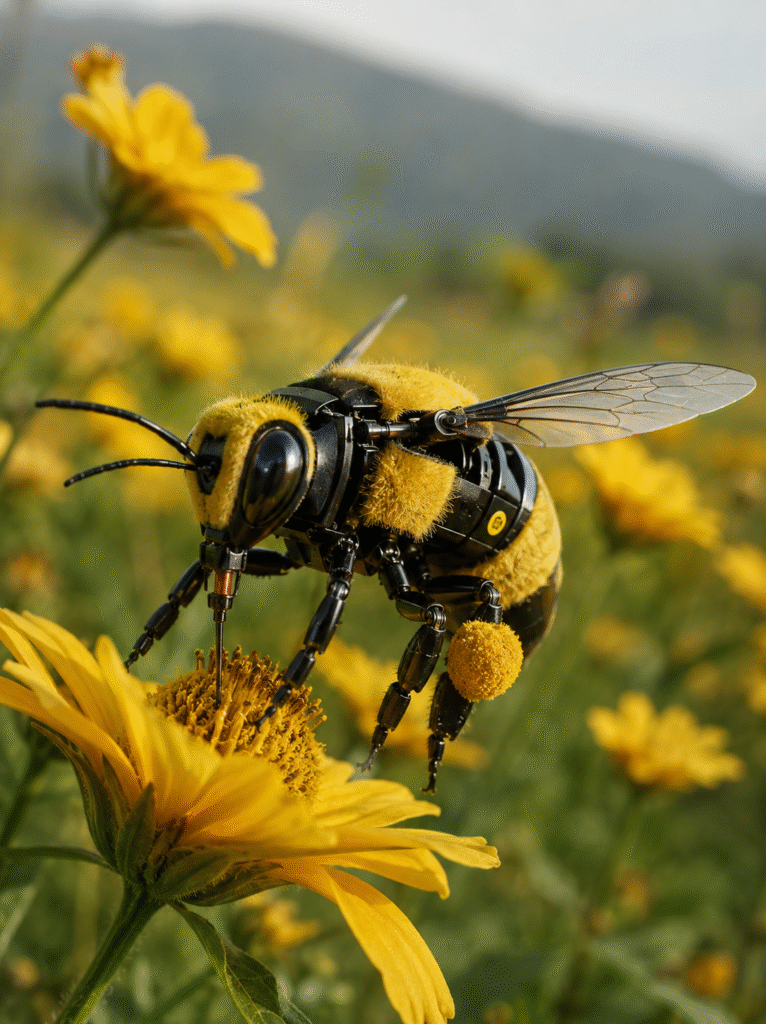
Robot bees are small, purpose-built machines — some flying, some ground-based — designed to move pollen between flowers the way an insect does, and as of 2026 several versions are already working real farmland, not just lab benches.
They fall into three rough categories, and it’s worth being precise about which is which, because “robot bee” gets used loosely enough to cover things with almost nothing in common.
MIT’s paperclip-weight flying insects
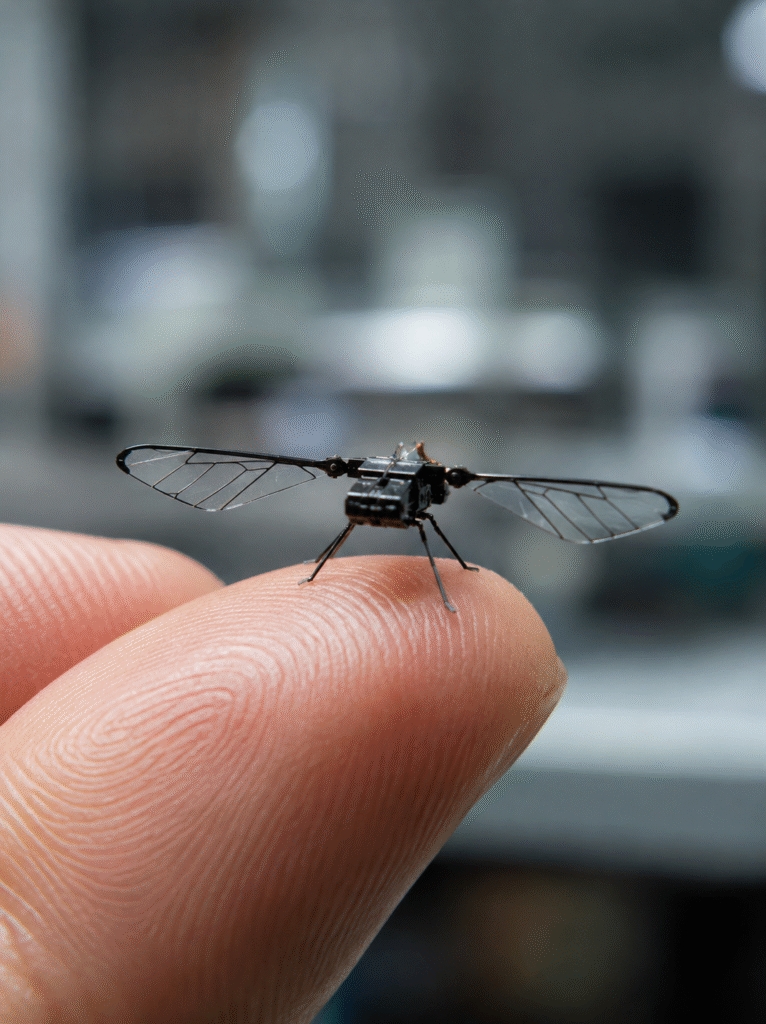
The most-cited version comes out of Kevin Chen’s Soft and Micro Robotics Laboratory at MIT. Their latest generation of robotic insects weighs less than a paperclip, flies using artificial muscles built from elastomer layers and carbon nanotube electrodes, and — this is the number that made the rounds when MIT News covered it in January 2025 — can now hover for roughly 1,000 seconds, more than a hundred times longer than earlier prototypes. It can even fly a path precise enough to trace the letters “M-I-T” in the air. Chen has been direct about the intended use case: not open-field agriculture, where real bees already do the job well, but controlled environments like multilevel vertical farms, where keeping a honeybee colony isn’t practical.
I want to sit with that distinction for a second, because it’s the part that gets flattened in a lot of coverage. This isn’t a robot built to compete with my hives in an almond block. It’s a robot built for a place my hives were never going to work in the first place.
Dropcopter — the drone that’s already earning money
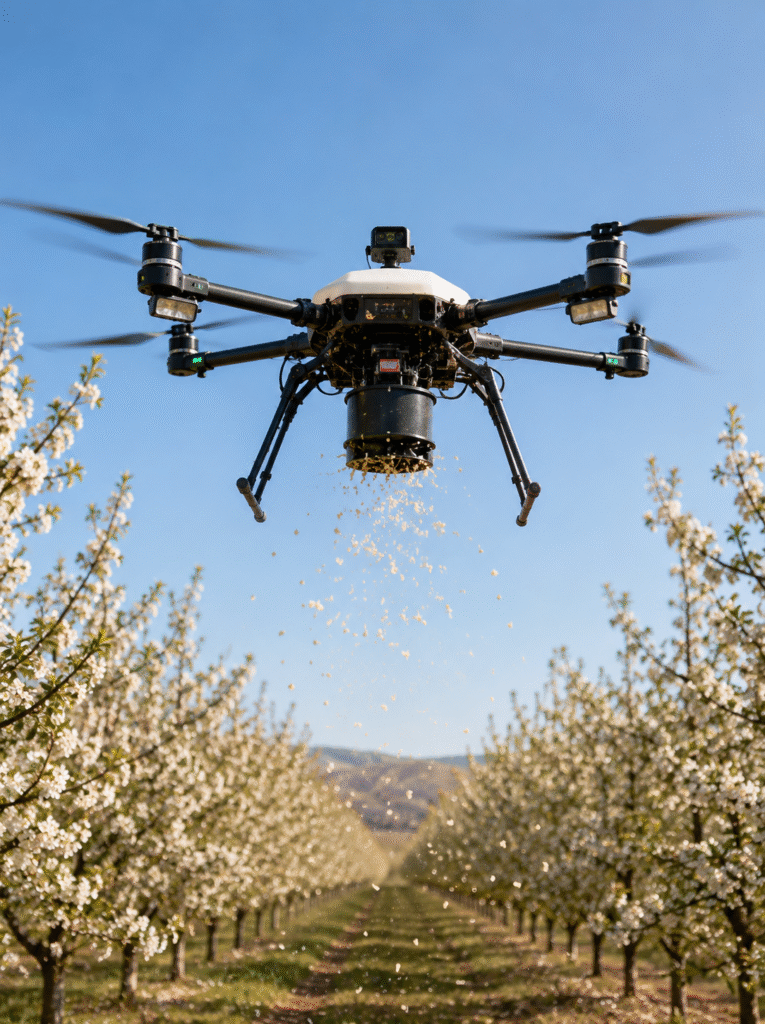
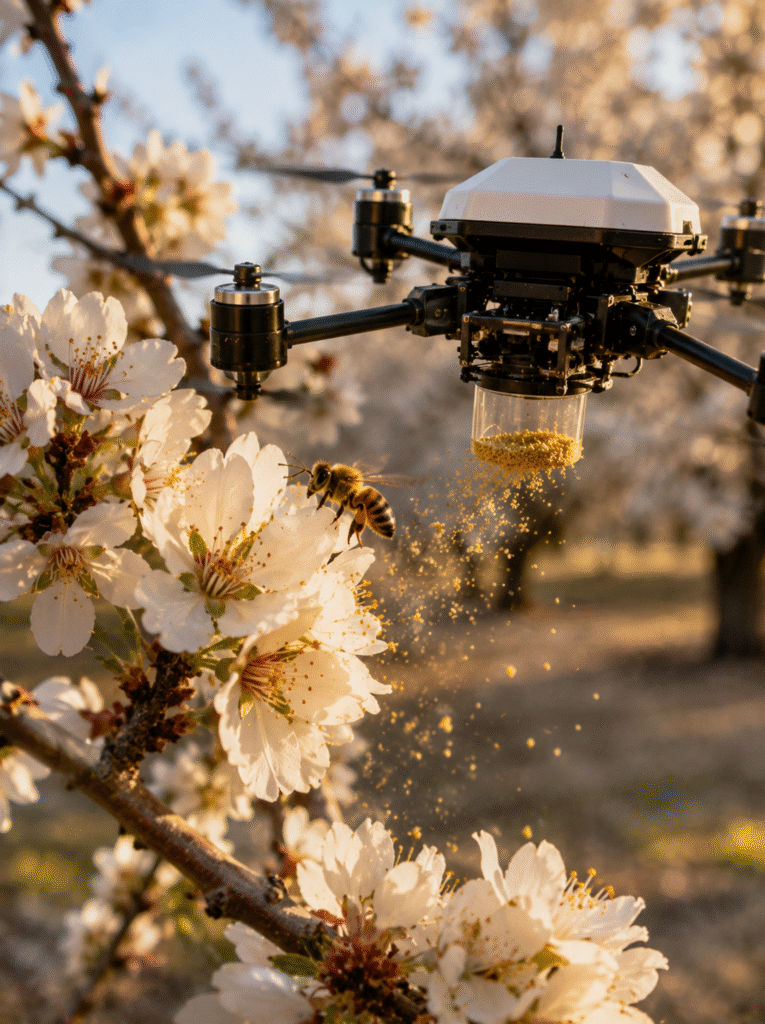
This one’s different, and it’s the one that actually matters to working beekeepers. Dropcopter is a drone system, roughly dinner-plate sized, that flies low over orchard rows and releases dry pollen from a hopper mounted underneath — reportedly modeled loosely on a WWII aircraft ball turret, which is a strange but accurate way to picture it. It’s been operating commercially since 2017, starting with almond orchards in New York, and has since expanded to apple, cherry, and pistachio blocks from California to Brazil.
The economics are the part I find genuinely interesting. One person hand-pollinating trees covers maybe five to ten trees a day. Dropcopter covers around 40 acres in four hours. Growers using it on almonds have reported yield increases around 25%, and cherry orchards have seen gains closer to 45%, according to reporting compiled by Ambrook’s Offrange in early 2026. Dropcopter rents out at up to $375 an acre — which sounds steep until you set it against what hive rental now costs during peak almond bloom.
BloomX and the ground-based approach
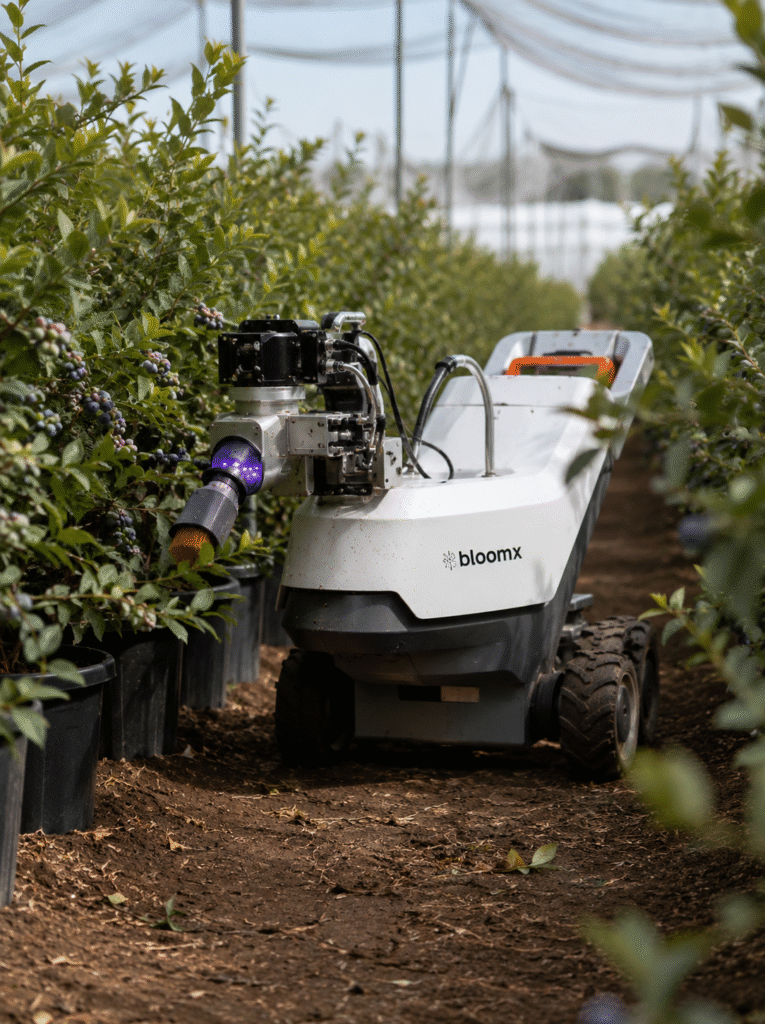
Not every robot pollinator flies. BloomX, an Israeli company (formerly branded Bumblebee AI), builds a machine that looks something like a push lawnmower and moves between crop rows using two different mechanisms — an electrostatic charge that lifts pollen from one flower and deposits it on another, and a vibration method that mimics buzz pollination, the technique bumblebees use on crops like blueberries and strawberries that honeybees can’t pollinate as efficiently. BloomX’s founder has argued this approach sidesteps a real problem with commercial beekeeping: colonies get trucked long distances between blooms, exposed to unfamiliar climates and disease pressure they didn’t evolve for.
I don’t fully agree with framing that as an argument against bees, but it’s a fair critique of how commercial pollination currently works, and it’s worth taking seriously rather than dismissing.
Why This Is Happening Now
It isn’t happening because engineers got bored. It’s happening because the economics of commercial pollination have shifted, and because certain farming environments were never going to have bees in them at all.
The real economics — hive rental and pollination demand
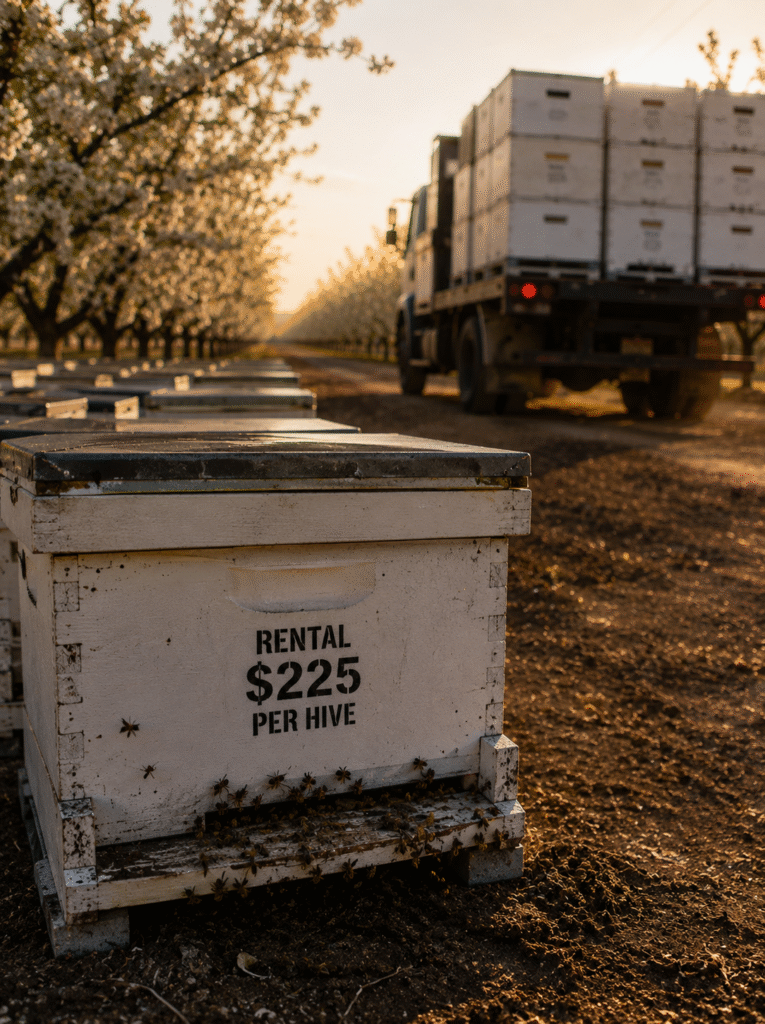
In the U.S., beekeepers move colonies on a punishing seasonal circuit — California for almonds in February, then Washington for apples, then wherever canola and sunflowers are blooming later in summer. James Strange, an entomology professor at Ohio State, has described the underlying issue plainly: food demand has grown faster than the supply of hives available to move where the blooms are. Hive rental fees have tracked that pressure upward, from roughly $150–$175 per hive a few years back to as much as $225 per hive during peak almond season by 2025.
That’s not a small shift for a grower running a few hundred acres. It’s the kind of cost pressure that makes a $375-an-acre drone service worth a serious look, especially once you factor in that commercial colony losses keep tightening supply further, pushing rental prices up in a feedback loop that has nothing to do with robotics and everything to do with the underlying health of managed bee populations.
None of this is the first time beekeeping has absorbed a wave of new technology without it replacing the fundamentals. The same skepticism greeted smart hive monitoring technology a few seasons back, and sensors didn’t end up replacing a beekeeper’s hands-on inspection — they just changed what a good inspection schedule looks like. Robotic pollination is likely to follow the same pattern: a tool that reshapes parts of the job, not a wholesale replacement for it.
Vertical farming’s unique problem
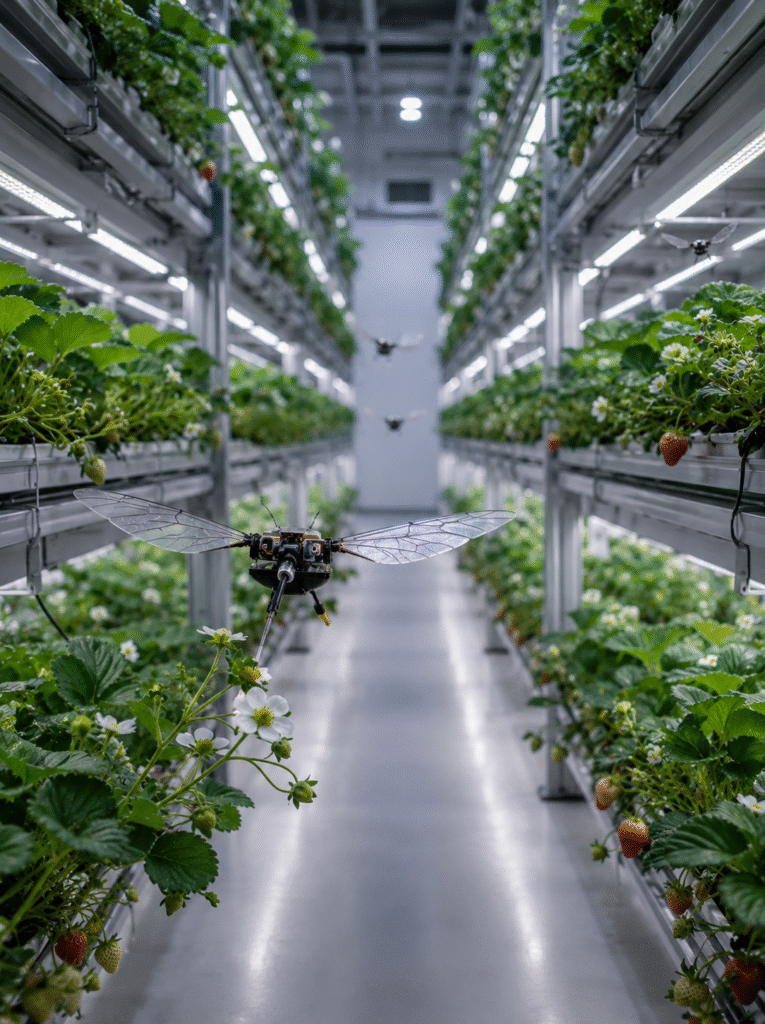
Indoor, stacked-level agriculture is growing fast, and it has a pollination problem that has nothing to do with cost and everything to do with physics. You can’t put a honeybee colony inside a sealed, climate-controlled warehouse — no natural light cues, no forage variety, no safe way for bees to orient themselves, and real biosecurity risk if they escape into a controlled environment. That’s the gap MIT’s flying robots are actually aimed at. It’s not a honeybee replacement so much as a honeybee impossibility solved a different way.
What Robots Still Can’t Do — the Honest Limits
Here’s where I’ll push back on some of the more breathless coverage. Every serious researcher working on this technology says the same thing when you read past the headline: robotic pollinators are nowhere close to matching real bees on endurance, speed, or precision, and nobody credible is claiming otherwise.
A honeybee has two wings and manages extraordinarily fine, controlled movement using a muscle system evolved over tens of millions of years. Chen himself has said as much — the sophistication of that natural system remains well beyond what current artificial muscles can replicate. Robots also can’t do the incidental work bees do as a side effect of foraging: feeding birds and other wildlife that depend on the insects themselves, not just their pollination output, or supporting the thousands of other plant-pollinator relationships that have nothing to do with commercial crops.
There’s also a quieter risk worth naming directly, one that conservation groups have flagged: if robotic pollination scales up enough to look like a real substitute, it could pull funding and public attention away from the underlying work of protecting why pollinators are struggling in the first place — habitat loss, pesticide exposure, and disease pressure that no drone fixes. A robot that pollinates an almond tree doesn’t do anything for the wild bumblebee nesting in the hedgerow next to it.
What This Means If You Keep Bees
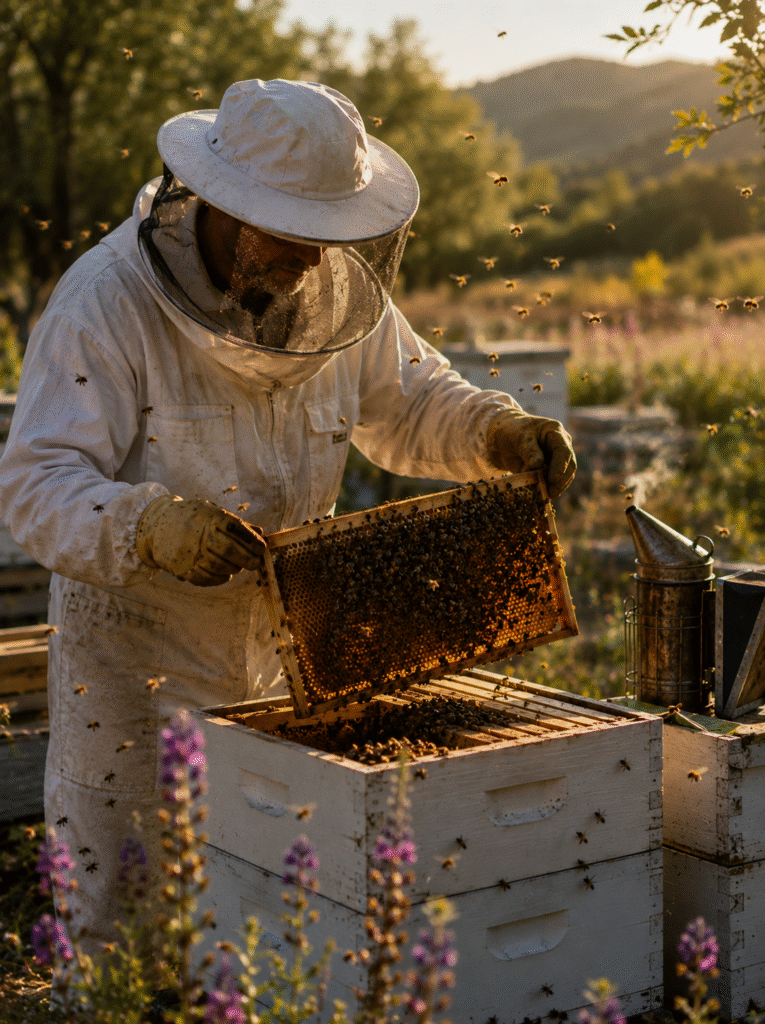
I don’t think robotic pollination is coming for backyard or small-commercial beekeeping any time soon, and the reasons are more mundane than a debate about technology versus nature. A Dropcopter contract makes sense at 40-acre orchard scale with a tight bloom window. It doesn’t make sense for the three-hive backyard setup, or for crops that need the kind of sustained, self-directed foraging that only a colony provides across a whole season, not a single flight window.
Where I do think this matters for working beekeepers is the economic signal underneath it. If robotic pollination keeps expanding at the scale end of the market, commercial hive-rental demand could soften over time in exactly the crops that currently subsidize a lot of beekeeping operations — which makes diversifying income (honey, nucs, pollination for smaller diversified farms, education) look like a more durable strategy than it did five years ago. It’s also part of why I keep an eye on colonies like the resilient, low-intervention bee populations researchers have been tracking in Southern California — the beekeeping operations that will weather this shift best are the ones building genuinely healthy, low-input colonies, not the ones running on the thinnest possible margins between rental cycles.
The Bigger Question — Replace or Support?
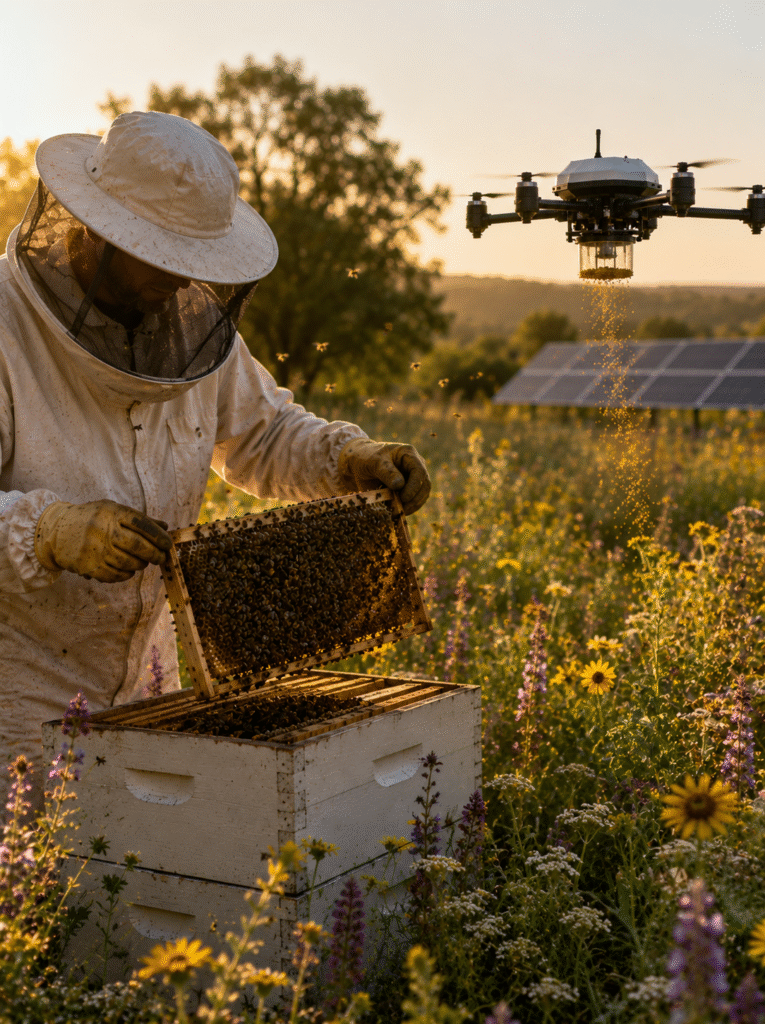
I keep coming back to something Rebecca Irwin, who directs NC State’s Applied Ecology graduate program, said when asked whether robotic pollination is the answer: maybe it works for certain agricultural production niches, but the money going into robots might do more good going into conservation practices already proven to work. I think that’s right, but I’d add a beekeeper’s footnote to it — this doesn’t have to be an either/or. The debate playing out around how we manage bee populations already shows that good intentions and good outcomes don’t automatically line up. Robots are a tool for a narrow set of problems — indoor farming, extreme labor shortages, maybe eventually crop-specific niches where buzz pollination matters. They’re not a reason to stop caring about the health of the pollinators already doing the job, for free, everywhere robots will never reach.
If you’re thinking about getting into bees yourself — robots or no robots, real hives aren’t going anywhere as the backbone of outdoor pollination — starting your own hive is still one of the most direct ways to understand why this technology has such a high bar to clear.
FAQ
Do robot bees actually exist and work today?
Yes. MIT has built flying robotic insects capable of over 1,000 seconds of hover time, and Dropcopter’s pollination drones have been operating commercially in U.S. and Brazilian orchards since 2017, covering roughly 40 acres in four hours per flight session.
Can robotic pollination fully replace honeybees?
Not currently, and not in the near term. Researchers, including the engineers building these systems, are consistent that robots still can’t match real bees on endurance, precision, or the sheer range of plant relationships bees support beyond commercial crops.
How much does robotic pollination cost compared to renting hives?
Dropcopter services run up to $375 per acre, while hive rental fees have climbed to roughly $225 per hive during peak almond season by 2025 — the comparison depends heavily on acreage, bloom timing, and crop type.
What crops are currently pollinated by robots or drones?
Almonds, apples, cherries, and pistachios are the main commercial crops using drone-based pollination today, primarily through Dropcopter’s service across California, New York, and Brazil.
Are robot bees dangerous to real bee populations?
Not directly, but conservation researchers have raised a legitimate concern: if robotic pollination is seen as a substitute for real pollinators, it could divert attention and funding away from addressing the habitat loss, pesticide exposure, and disease pressure actually driving pollinator decline.
Why are scientists building robot bees if real bees still exist?
Mainly to solve problems real bees structurally can’t — pollinating inside sealed, climate-controlled vertical farms where a honeybee colony can’t be kept, and offsetting labor shortages in specific high-value orchard crops.
What happens to beekeepers if robotic pollination scales up?
Large-scale commercial pollination contracts could eventually see softer demand in a few high-acreage crops, but backyard and small-commercial beekeeping — along with honey production, nuc sales, and diversified smaller farm pollination — aren’t realistically threatened by current robotic technology.