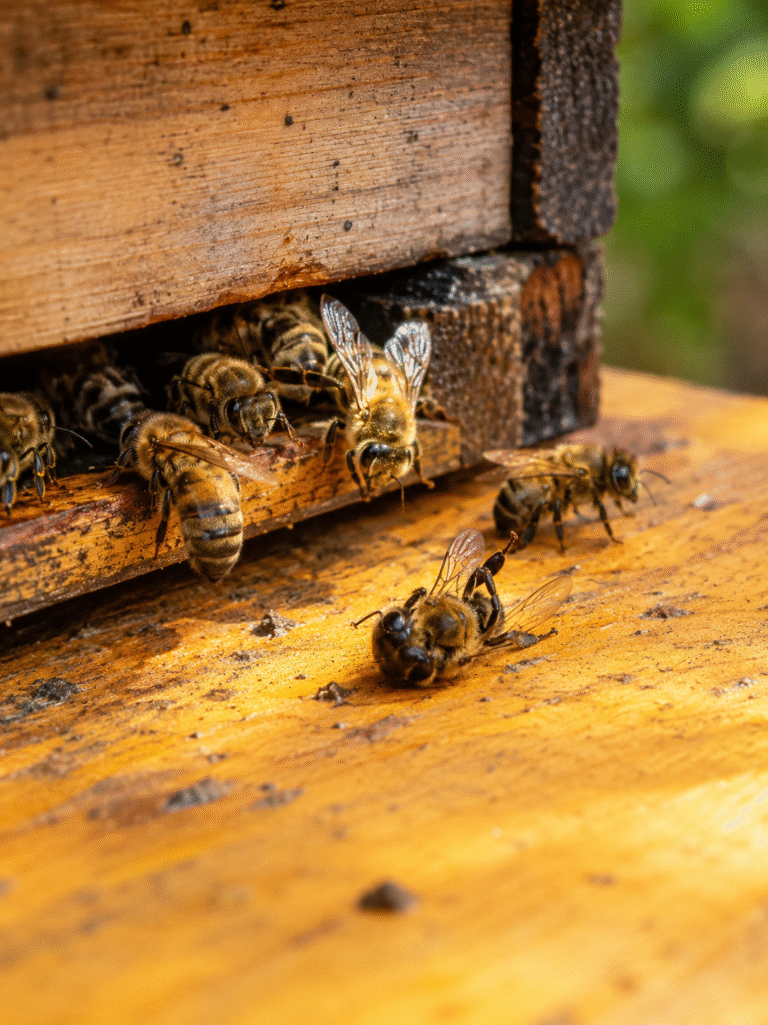
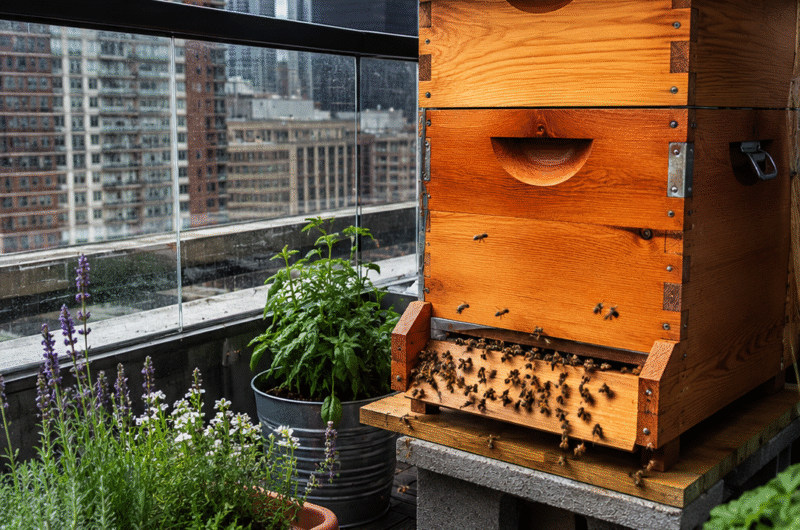

Most people assume beekeeping requires a sprawling countryside property, a barn, and preferably a grandmother who already knows what she’s doing. I thought the same thing — until the spring I installed two hives on the flat roof of a converted textile factory in east London, four floors above a Turkish restaurant and a bicycle repair shop.
That was eleven years ago. Those two hives produced more honey per colony than anything I’d kept in the countryside. The city, it turns out, is not the obstacle. In many ways, it’s the advantage.
The city is secretly a paradise for bees
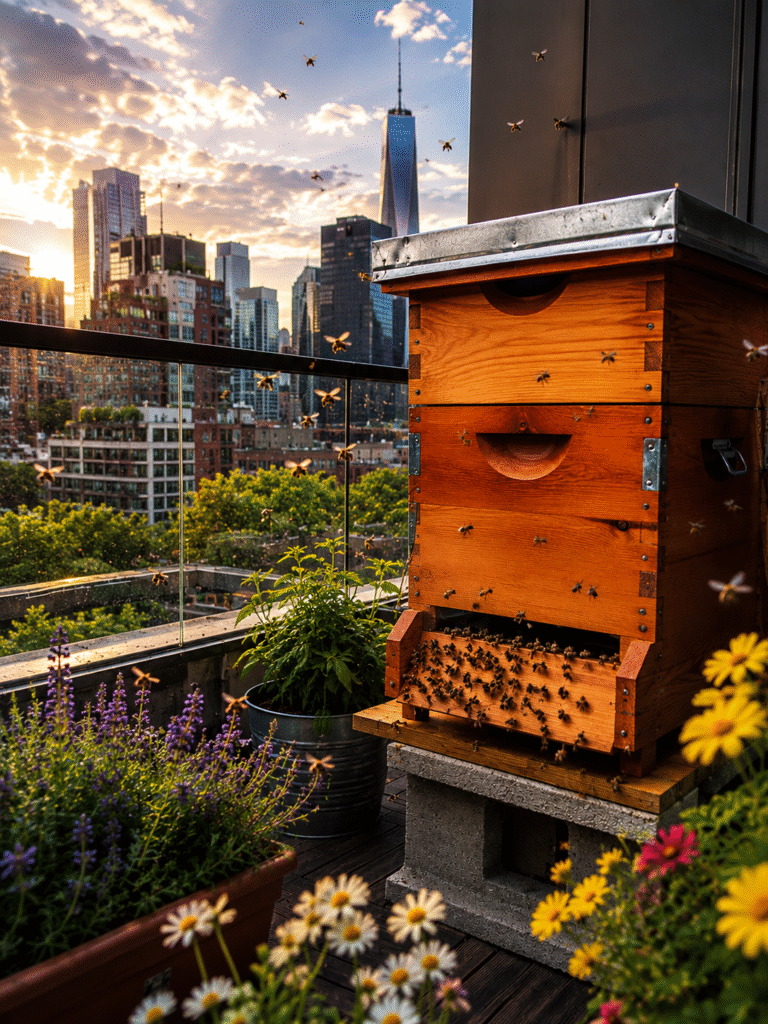
Here’s something most people don’t know: urban bees often outperform rural ones.
The reason is monoculture. Modern agricultural land is frequently dominated by a single crop — rapeseed, corn, sunflowers — which blooms intensely for three weeks and then offers nothing for the rest of the season. A city, by contrast, is a patchwork of flowering trees along boulevards, community gardens, window boxes, neglected lots erupting with wildflowers, parks maintained on offset schedules. The result is a near-continuous forage season from February through November.
A 2016 study published in the Journal of Apicultural Research found that honey produced in urban environments often contains greater floral diversity than rural equivalents — reflecting dozens of different plant species within a single jar. Your rooftop honey might contain linden from the park two streets over, lavender from a neighbor’s terrace, and clover from the football pitch at the end of the road.
The bees don’t know they’re in a city. They just know there’s food.
Before you do anything: check the rules
This is the part where enthusiasm has to slow down for a moment.
Urban beekeeping regulations vary enormously — between countries, between cities, sometimes between neighborhoods. In New York, keeping bees was illegal until 2010; it’s now permitted with registration. In Paris, hives are installed on the rooftops of the Opéra Garnier and Notre-Dame Cathedral, but private keepers must notify their local authority. London has no formal licensing requirement, but the London Beekeepers’ Association strongly recommends registration with BeeBase, the national bee health database.
Before you order a nucleus colony, spend an afternoon researching your local rules. Check with your city or municipal authority, your building management if you rent, and your neighbors — particularly those directly below or adjacent to your hive placement. A surprised neighbor who discovers a hive above their washing line is rarely a sympathetic one.
Speaking of which.
The neighbor question is actually a design question
The most common concern people raise about urban beekeeping isn’t disease, or stings, or noise. It’s this: “Won’t the bees bother everyone around me?”
The honest answer is: only if you place the hive badly.
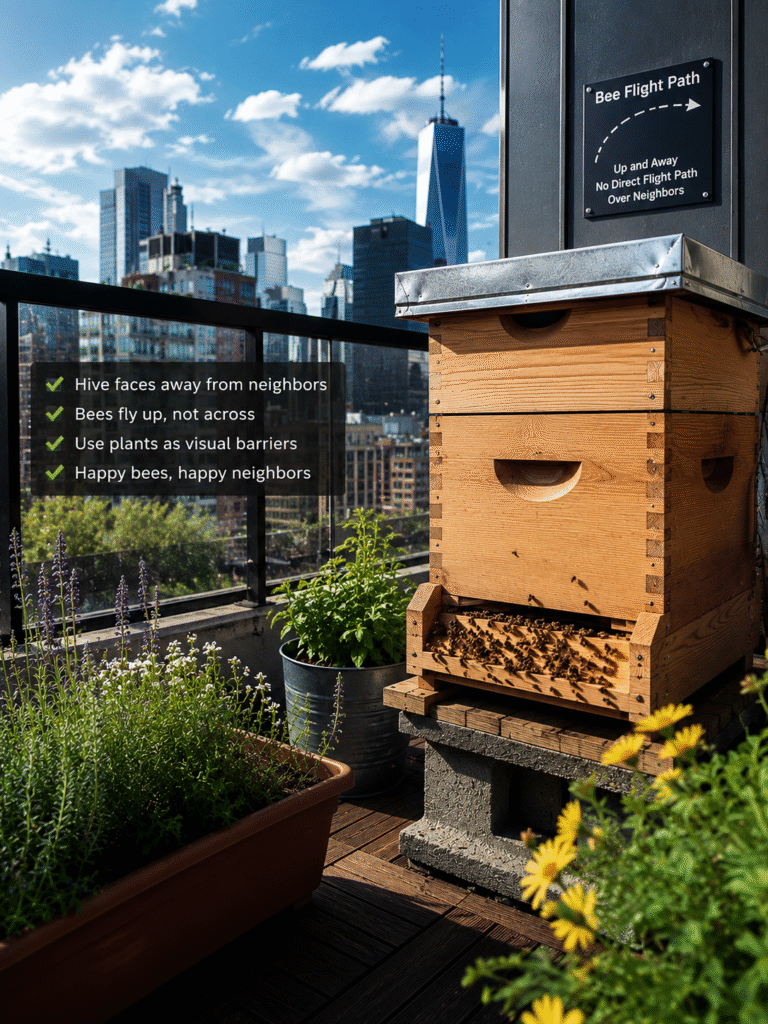
Bees leaving a hive take off on a direct flight path called the “bee line.” If that line passes through a neighbor’s garden at head height, you have a problem. The solution is simple geometry: raise the hive or redirect the entrance using a barrier. A hive entrance facing a solid wall, fence, or hedge two meters high forces the bees to climb steeply before leveling off, placing them well above foot traffic within a few meters. Rooftop hives, by their nature, solve this automatically.
Flight path management is one of those things nobody teaches in beginner courses, and it’s responsible for more neighborhood disputes than actual stings. Get it right from the start and you’ll spend the next decade being the person who brings small jars of honey to apologize for nothing in particular.
Here’s a visual showing how urban bees forage across a city — one of the most surprising advantages of rooftop beekeeping.
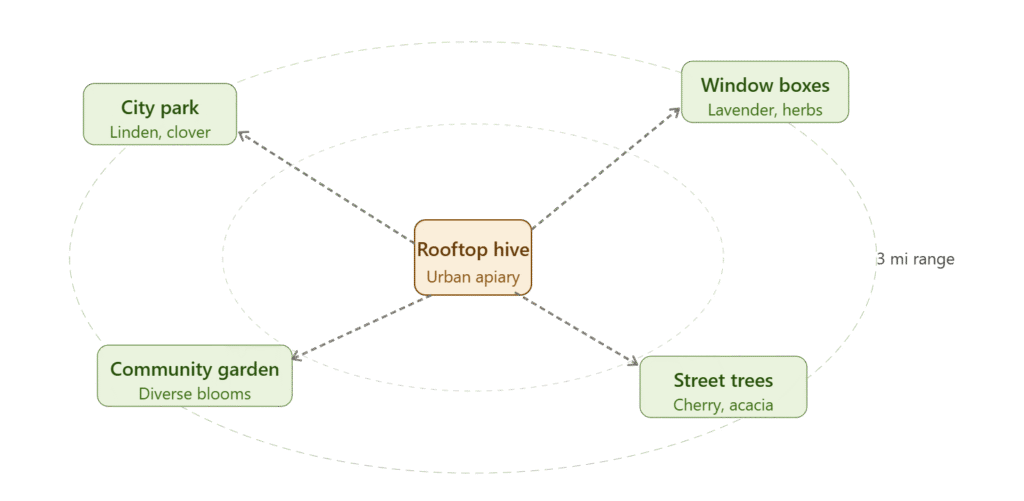
That foraging range — up to three miles in every direction — is exactly why urban honey tends to be so complex and layered in flavor. Now, back to the practicalities.
Where to actually put the hive
Let’s talk placement, because this is where most urban beginners go wrong — not through negligence, but through overthinking the wrong variables.
The instinct is to tuck the hive somewhere discreet, low, and out of sight. A corner behind the garden shed, up against the wall, facing the fence. That instinct is almost always wrong.
What you actually need is this: morning sun on the entrance, wind protection from the north and west, a stable flat surface that won’t shift under the weight of a full colony (which can reach 100 pounds by midsummer), and — most critically — a clear flight path that sends bees upward rather than across.
Rooftops are ideal precisely because they solve the flight path problem automatically. A terrace or balcony works too, provided the entrance faces outward over open space rather than toward a wall the bees will bounce off. Ground-level hives in urban settings are manageable, but they require a deliberate barrier — a fence, a hedge, a trellis — positioned two meters in front of the entrance to force bees into a steep vertical climb.
Water is another thing beginners forget entirely. Bees need a reliable water source within about 300 meters, or they’ll find one themselves — and “finding one themselves” usually means a neighbor’s bird bath, a leaking air conditioning unit, or someone’s paddling pool. Set out a shallow dish with pebbles or corks for the bees to land on. Refresh it every few days. It sounds trivial; it prevents complaints.
Hive selection for small spaces
The standard Langstroth hive is perfectly usable in urban settings, but it’s worth knowing that several more compact alternatives have become popular precisely because of city beekeeping.
The Warré hive, developed by French monk Abbé Émile Warré in the early 20th century, is smaller, lighter, and designed to mimic natural colony behavior more closely. It requires less frequent intervention — appealing if you have a demanding week job and can’t always make your Sunday inspection window. The tradeoff is that it’s less forgiving when things do go wrong, since you’re looking inside less often.
The top-bar hive, long common in Africa and now popular with natural beekeeping advocates, is horizontal rather than vertical, making it easier to work on a rooftop where overhead clearance might be limited. It produces no extractable surplus in the conventional sense — you harvest by cutting comb — which some find charming and others find impractical.
For most urban beginners, a single standard Langstroth body with one super is the right call. It’s the format every beekeeping association, course, and manual assumes, and when you have a problem at 11pm on a Tuesday and need help from someone on a forum, you want to be speaking the same language as everyone else.
The inspection rhythm in the city
Inspections in urban settings require one additional layer of planning that rural beekeepers rarely think about: your neighbors’ schedules.
Bees are calm and manageable during inspections. The occasional bee that drifts away from the hive, however, is less predictable — and if that bee happens to encounter a frightened child or a person with a severe allergy, the consequences are serious. This isn’t a reason to not keep bees in a city. It’s a reason to be thoughtful.
Inspect on weekday mornings when the street below is quietest. Choose warm, still days — bees are most defensive in cold, overcast, or windy conditions. Keep your smoker going steadily. Work slowly. And if something is going wrong — if the colony is unusually agitated, if you’ve spotted signs of a defensive reaction — close up, step back, and come back another day. Urban beekeeping requires a slightly thicker patience than its rural equivalent.
What city honey actually tastes like
Here’s the part that surprises people most: urban honey is often extraordinary.
Where a clover monoculture produces a honey that is pleasant, mild, and largely uniform, the complexity of an urban landscape produces something with genuine depth. London’s rooftop honey has been documented to contain nectar from over 20 different plant species. Paris’s famously produces an intensely floral honey from the horse chestnut and linden lining its boulevards. New York’s is notoriously darker and more robust — partly from the basswood trees planted throughout Central Park, partly from the improbable abundance of wildflowers that colonize every neglected corner of the city.
Your honey will taste like your city. That, in itself, is worth the effort.
One last thing: join the community
Urban beekeeping can feel isolating in a way rural beekeeping rarely does. Your closest fellow keeper might be three subway stops away rather than over the next field.
Seek out your local beekeeping association early — before your first season, if possible. The Urban Beekeepers collective networks in most major cities now, and many run mentorship programs that pair beginners with experienced keepers for their first two or three seasons. Beyond technique, these communities are where you’ll learn the unwritten local knowledge: which neighborhoods have the most trouble with Varroa, which parks the city maintains chemical-free, which month the linden bloom tends to peak in your specific microclimate.
That knowledge doesn’t exist in any book. It lives in the people who’ve been watching these particular rooftops for years.
Go find them.