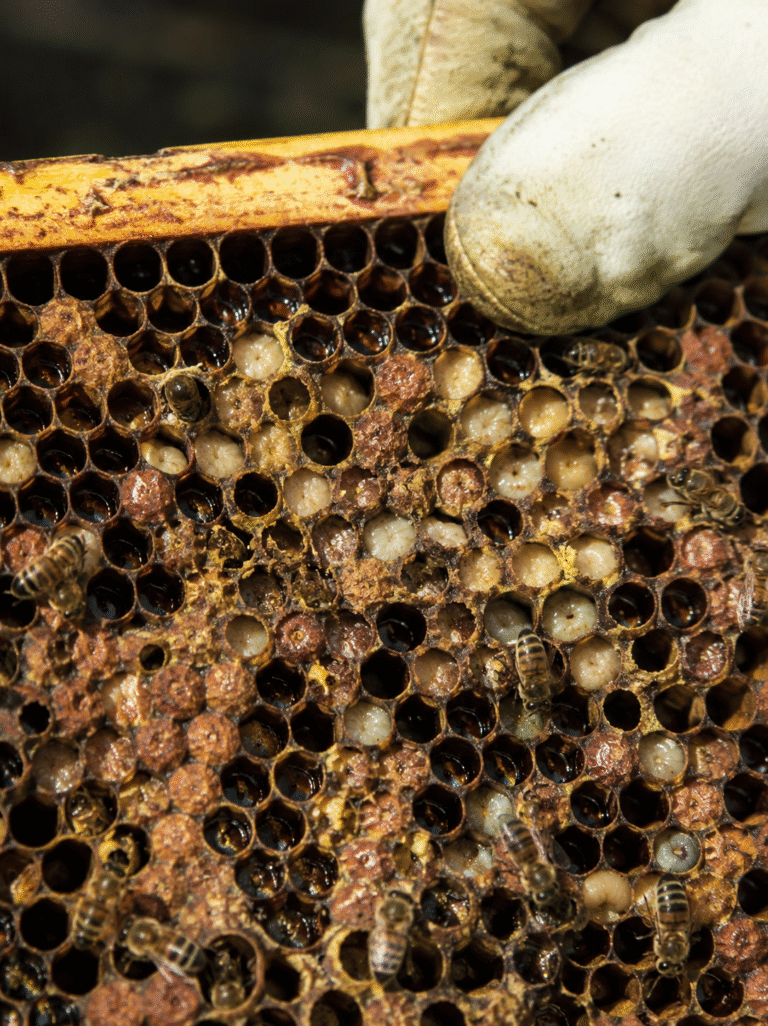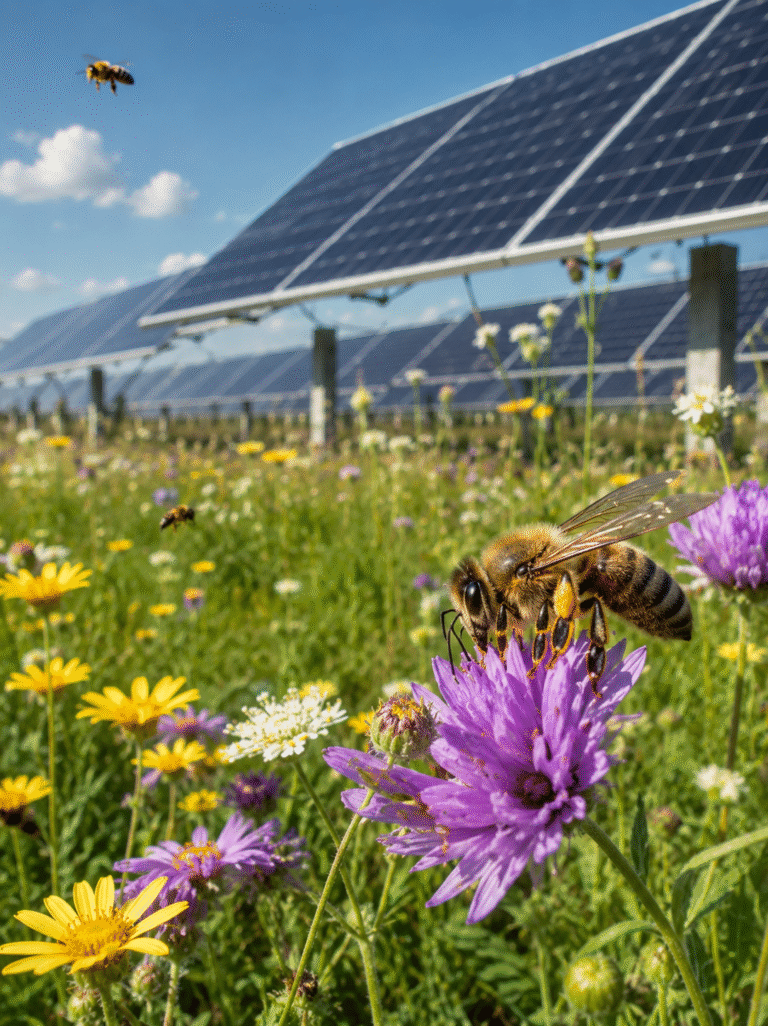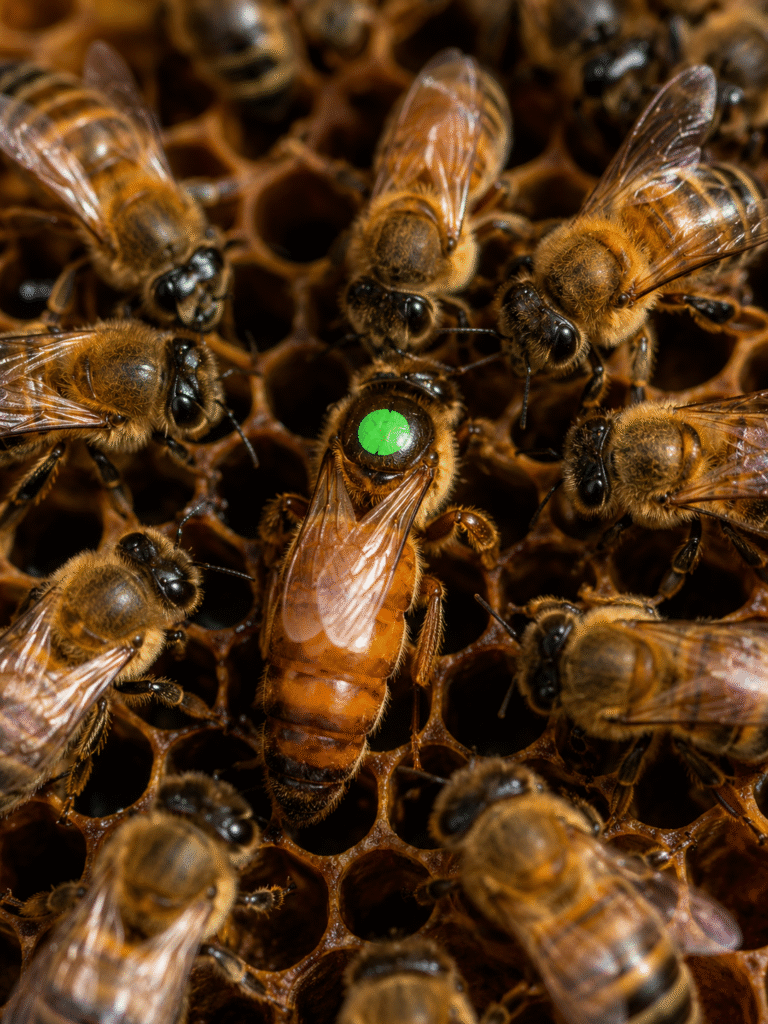

There’s a particular sound a hive makes when something is hunting at the entrance. It’s not the usual traffic hum. It’s tighter, more anxious, the kind of pitch that makes any beekeeper with enough hours logged stop whatever they’re doing and walk over to look. I heard that sound once when a robbing event was underway, and I’ve read enough accounts now from beekeepers in Georgia and South Carolina to know that the yellow-legged hornet produces something similar — except robbing bees eventually give up. A hornet colony doesn’t.
This is a predator problem, not a disease problem, and that distinction matters more than most coverage gives it credit for. You can vaccinate against a virus, in a manner of speaking, by breeding for resistance. You can treat a mite. You cannot treat a hornet that has learned your hive’s flight path is an easy meal.
Meet Vespa Velutina
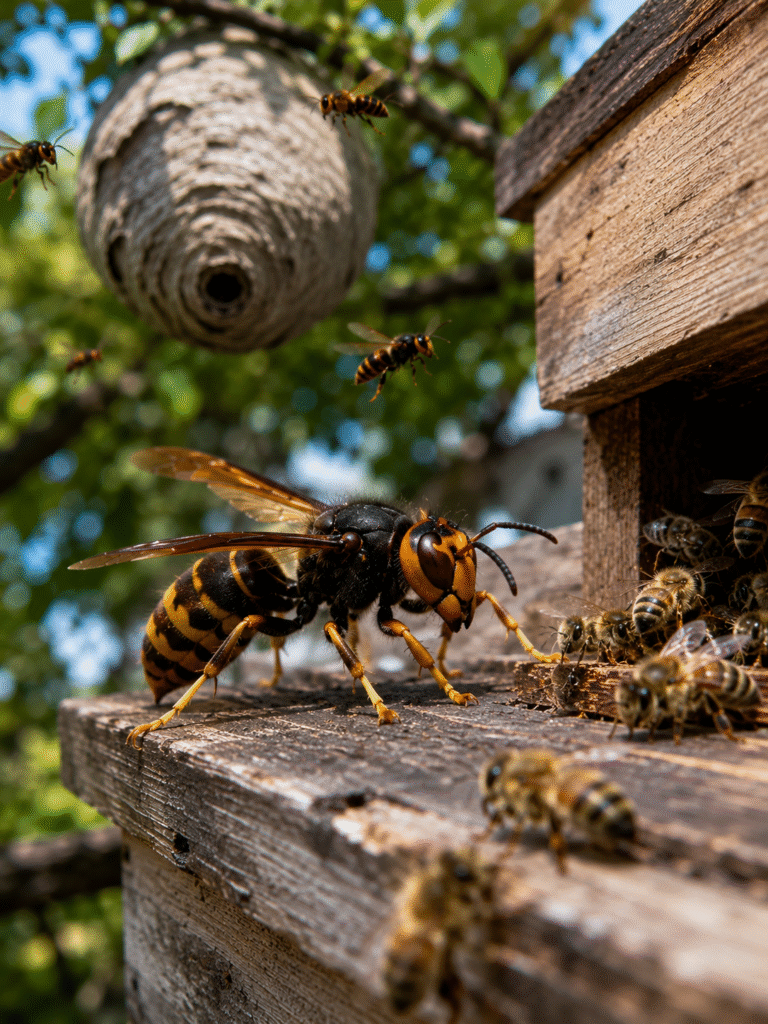
The yellow-legged hornet, scientifically Vespa velutina, is a social wasp species that builds paper-like nests above ground, often hanging in trees or tucked into structures like barns, garages, and sheds — nests that can house up to 6,000 workers. That number is worth sitting with. Six thousand workers is not a nuisance colony you knock down with a can of wasp spray from the hardware store. That’s an organized predatory operation with the manpower to sustain sieges on multiple apiaries across a season.
It’s not native to the United States, and if it becomes established, it threatens both domestic and feral honey bee populations — some of which are already under pressure — along with other native pollinators and the crop pollination they support. I want to underline “feral” there, because it’s easy for backyard and commercial beekeepers to think of this purely as a threat to managed colonies. It isn’t. Wild and feral bee populations, the ones already doing quiet, uncredited pollination work in hedgerows and orchards nobody’s actively managing, are just as exposed.
How This Hornet Actually Hunts
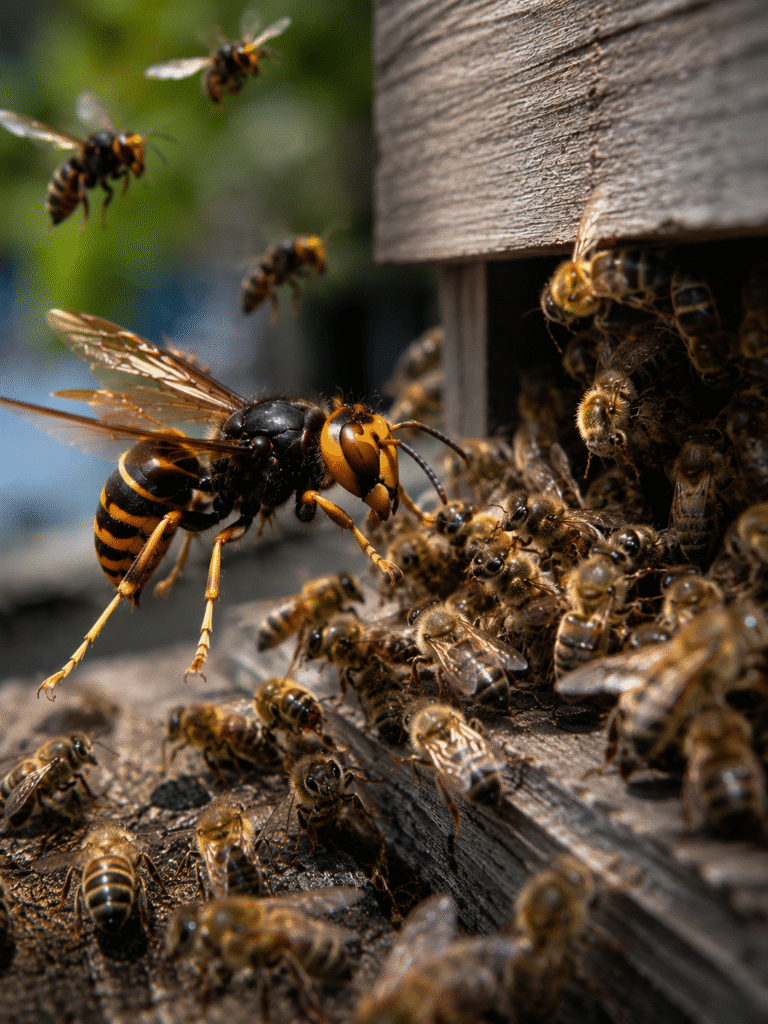
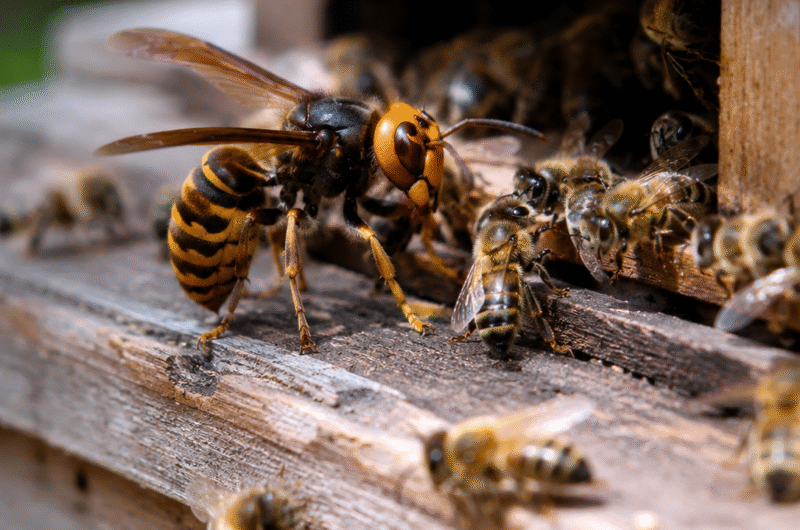
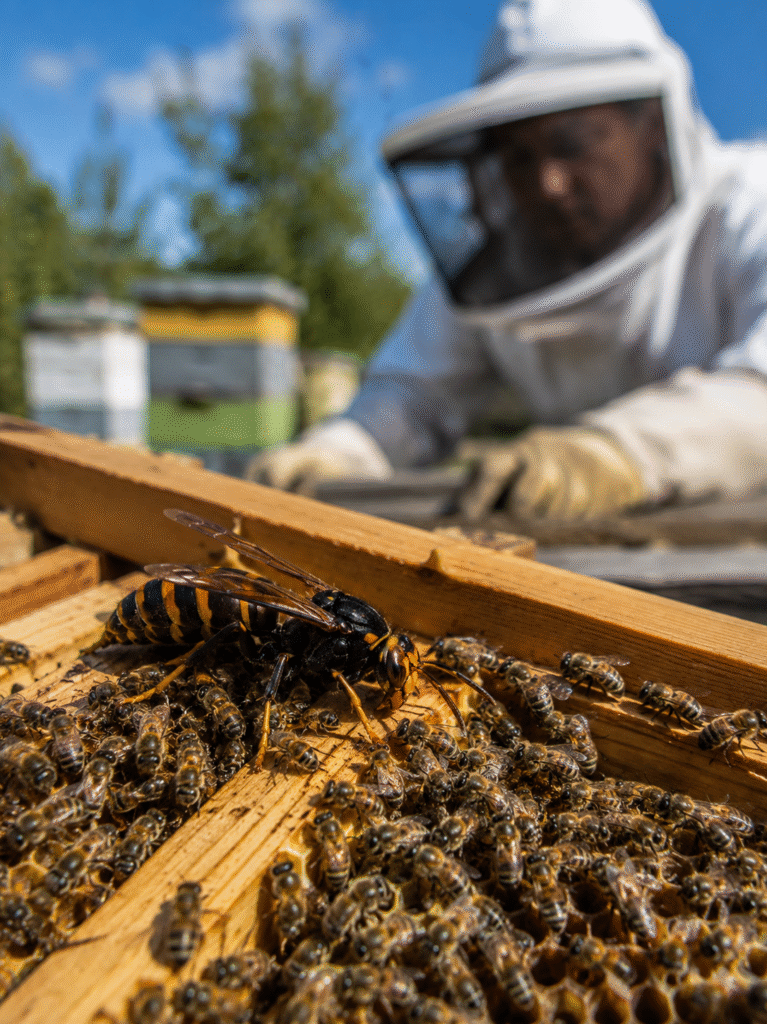
What sets Vespa velutina apart from hornets most American beekeepers are already used to dealing with is its hunting strategy. Hornets typically begin preying on honey bees where they’re most concentrated — right at the hive entrance — snatching bees out of mid-air or straight off the landing board. As more hornets discover a productive hive, the attack intensifies until it becomes nearly relentless. Beekeepers call this behavior “hawking,” and it’s an apt description. Picture a hornet hovering just off your landing board, picking off returning foragers one at a time, then multiply that by a dozen hornets working in shifts throughout the day.
Even a relatively small number of hornets can depopulate an entire apiary within days, and the foraging range of a single colony can extend up to 1,000 meters — which is the radius a beekeeper realistically needs to search if they’re trying to track a problem nest back to its source. That’s not a walk around your own property. That’s a search that likely crosses into a neighbor’s land, a wooded lot, or municipal property, which is exactly why individual beekeepers can rarely solve this on their own and why coordinated regional trapping programs matter so much.
Here’s the detail that I find most sobering, though, and it’s one I didn’t fully appreciate until I read the entomology literature on it directly. Eastern honey bees, Apis cerana, evolved a defense against this exact predator — a behavior called “social fever,” where a hornet that enters the hive gets mobbed and enveloped by a ball of bees that raise their body temperature to near-lethal levels, effectively cooking the intruder while sparing themselves. It’s one of the more remarkable examples of coevolution I’ve come across in years of covering this field. The problem is that western honey bees, Apis mellifera — the bees kept in nearly every managed colony in Georgia, South Carolina, and the rest of the country — only express a weak version of that same defense, never strong enough to actually kill a hornet. Our bees never had the evolutionary pressure to develop the full response, because this predator was never part of their history. They are, in the most literal sense, defenseless against a threat their eastern cousins learned to neutralize over thousands of years.
Identification: Don’t Confuse This With the “Murder Hornet”
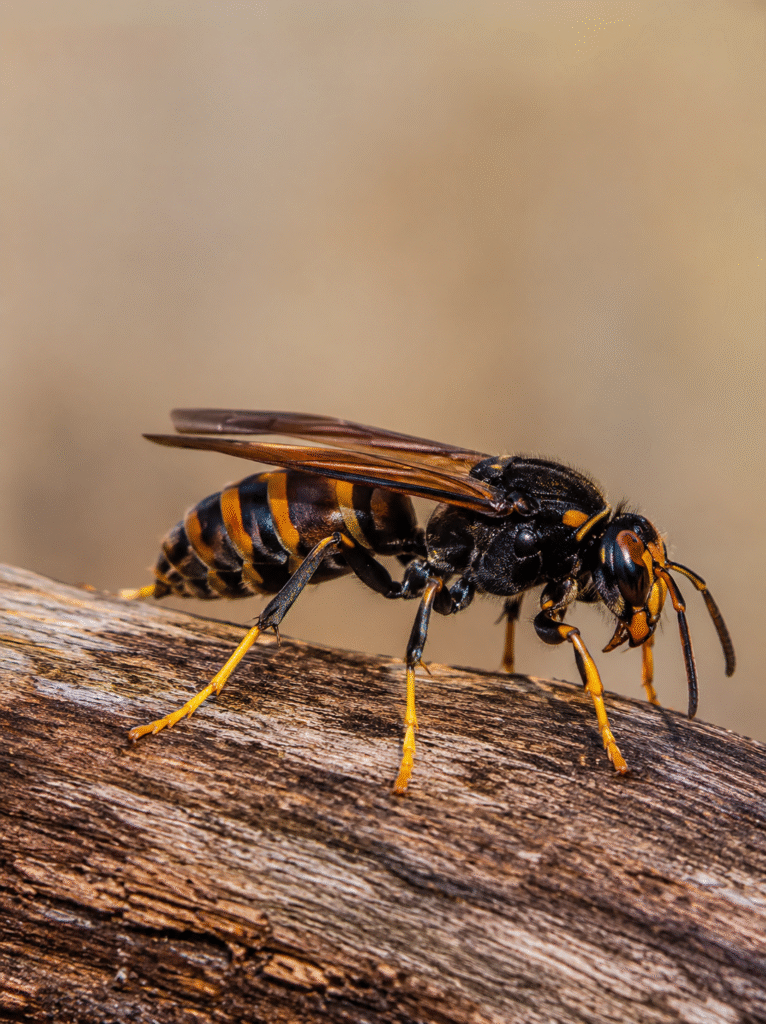
I get asked constantly whether this is the same insect that made national headlines a few years back as the “murder hornet.” It isn’t, and mixing them up matters, because response protocols and actual risk levels differ.
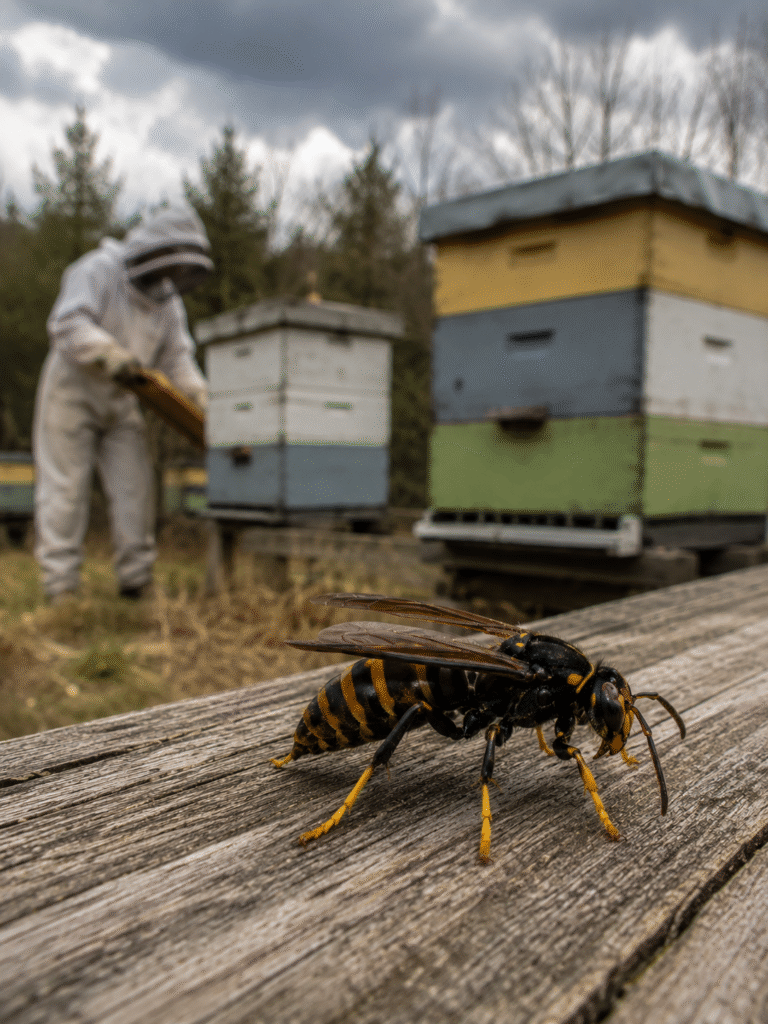
The yellow-legged hornet is a different species from the northern giant hornet (Vespa mandarinia), which was first detected in Washington State in 2019 and hasn’t been confirmed anywhere in the U.S. since 2021. Size is your fastest visual cue — the yellow-legged hornet runs 0.7 to 1.0 inches in body length, noticeably smaller than the giant hornet, with a mostly black head carrying yellow-to-orange markings, a solid dark thorax, alternating dark and yellow-orange abdominal bands, and legs that are dark near the body but distinctly yellow at the tips — hence the name.
It’s also frequently mistaken for the European hornet, Vespa crabro, which is already established and largely harmless to established colonies by comparison. The practical difference for anyone doing a quick field ID: European hornets have more sinuous, wavy yellow banding and a heavier, more robust build, while yellow-legged hornets show tighter, more uniform banding and — again — those telltale yellow leg tips.
Where It Stands in 2026
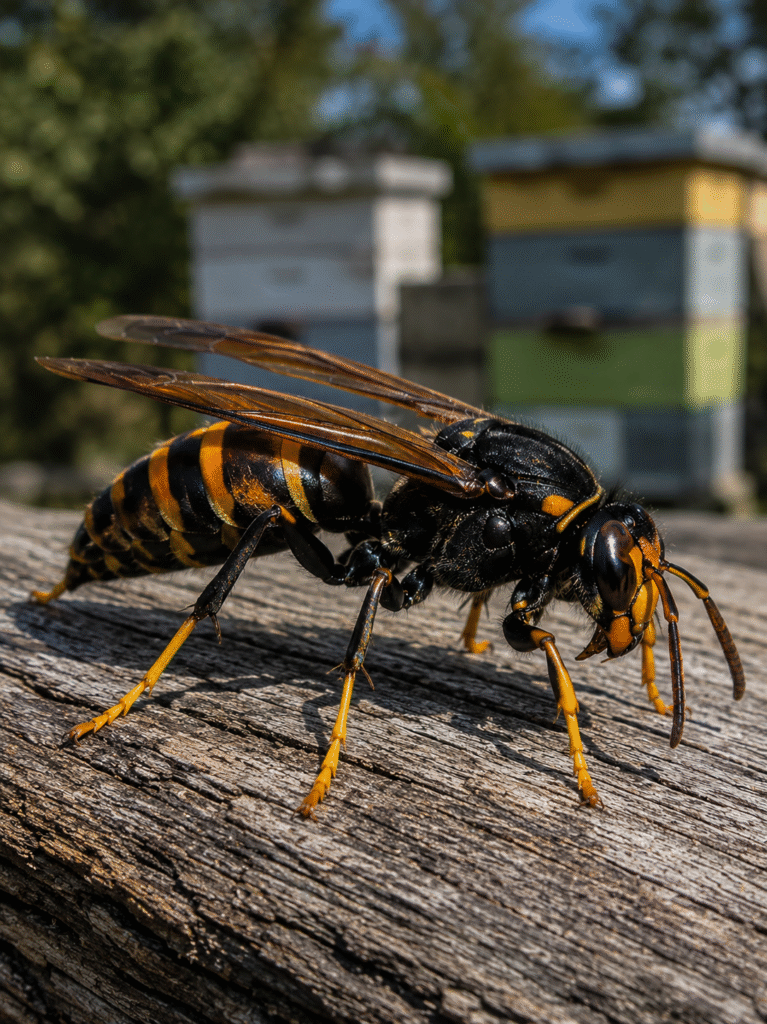
This isn’t a distant hypothetical for beekeepers in the Southeast. The yellow-legged hornet was first confirmed in the contiguous United States near the Port of Savannah, Georgia, in August 2023, and the trajectory since then has been consistently upward. Despite extensive trapping and nest destruction efforts across Georgia and South Carolina over multiple seasons, the species is now almost certainly established in the southeastern U.S. — a conclusion one entomologist I’ve followed closely reached after tracking the population’s spread pattern against what happened in Europe two decades earlier.
The scale of the current response effort tells its own story. In 2026 alone, more than 4,000 traps have been deployed across nine counties in South Carolina, over 100 embryo nests have been removed in the Low Country region, and more than 3,500 queens have been captured in traps. Those aren’t the numbers of a contained novelty. Those are the numbers of an active, resource-intensive containment war that agricultural agencies are fighting on multiple fronts simultaneously.
One entomologist who has tracked the European invasion for years offered a forecast I think every Southeastern beekeeper should read twice: given how rapidly yellow-legged hornet populations have grown in several European countries, the area currently inhabited in coastal Georgia and South Carolina is expected to roughly double within a single year, with expansion trending northeast due to prevailing spring winds that carry dispersing queens. Climate modeling backs up the concern about range — researchers project the hornet could survive across much of the eastern U.S. wherever the climate stays relatively moist and average annual temperatures exceed about 50°F, a band that stretches as far north as Detroit and Pittsburgh, plus parts of the Pacific Northwest.
A Beekeeper’s Reality Check on the Fear Factor
I’d be doing you a disservice if I let this article read as pure alarm without adding some context, because the human-safety angle has actually been studied — and the results are more nuanced than the headlines suggest. A 2026 study out of Spain examined whether the hornet’s spread was associated with increased deaths from stinging insects, and found no clear evidence of increased mortality tied to Vespa velutina’s expansion, despite considerable public anxiety and alarming media coverage. The researcher leading that study made a point I think is worth repeating to anyone getting nervous about this insect stinging them personally: public discourse frequently frames the yellow-legged hornet as an emerging lethal threat in a way that outpaces the actual documented epidemiological risk.
So let’s be precise about where the real danger lies. This is not primarily a human safety crisis. It is an apiculture and pollination crisis. The same researchers were clear that established scientific evidence still points to serious negative impacts on honey bees, beekeeping operations, wild insect populations, and the pollination services those insects provide — that part of the concern is not overstated at all. The danger to you personally, walking near a nest you don’t disturb, is lower than headlines imply. The danger to your hives, if this hornet finds them, is exactly as severe as it sounds.
What Beekeepers in Affected Regions Should Actually Do
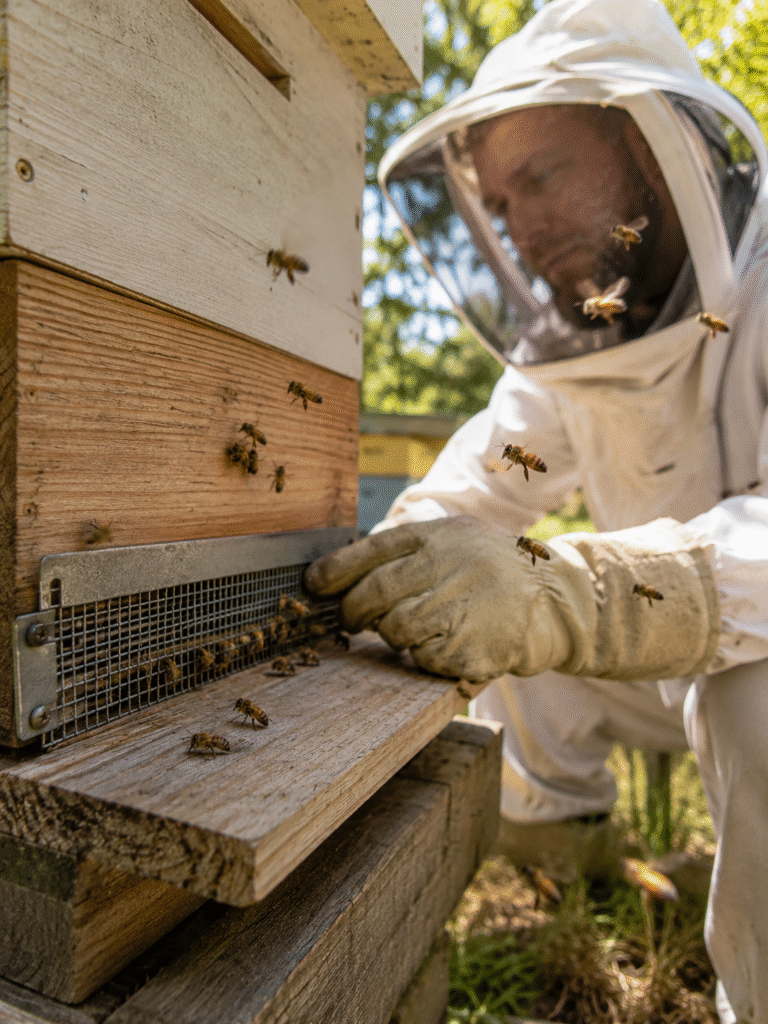
- Modify hive entrances before you have a problem, not after. Reduced entrances with screening sized to block hornets while still allowing bee traffic are a proven mitigation, not a theoretical one, and they cost far less than replacing a depopulated colony.
- Learn hawking behavior, not just nest identification. Most beekeepers will encounter individual hunting hornets at the landing board long before they ever locate a nest. Recognizing the behavior pattern buys you response time.
- Report, don’t relocate or destroy on your own. Nests can be large, defensive, and genuinely dangerous to approach without proper equipment — this is a job for state agriculture officials, not a DIY afternoon project.
- Watch the northeastern expansion pattern if you’re outside the current core states. Given the projected spread trajectory, beekeepers well outside Georgia and South Carolina — including the Mid-Atlantic and parts of the Pacific Northwest — have a real reason to start learning identification now rather than after the fact.
Why This Story Matters Beyond the Hive
What keeps this on my mind isn’t just the threat to any one apiary — it’s the pattern. We’ve now watched three separate invasive threats establish beachheads in North American beekeeping within a relatively short window: Small Hive Beetle decades ago, the northern giant hornet briefly in the Pacific Northwest, and now this. Each one arrived through global trade and travel routes that move faster than our biosecurity screening can realistically keep pace with. The yellow-legged hornet isn’t an isolated bad-luck event. It’s what the modern shipping economy looks like when it intersects with an ecosystem that never evolved defenses for what’s arriving on its shores.
Frequently Asked Questions
Is the yellow-legged hornet the same as the “murder hornet”? No. The “murder hornet” nickname refers to the northern giant hornet (Vespa mandarinia), a larger species detected briefly in Washington State. The yellow-legged hornet (Vespa velutina) is smaller, established in different states, and not confirmed anywhere near the Pacific Northwest.
How dangerous is the yellow-legged hornet to humans? Recent research found no clear evidence that its spread has increased sting-related deaths, though any hornet nest should still be treated with caution and reported rather than disturbed.
How many bees can a yellow-legged hornet colony kill? A relatively small number of hunting hornets can depopulate an entire apiary within days by repeatedly picking off foragers at the hive entrance.
What states currently have confirmed yellow-legged hornet populations? As of 2026, confirmed and expanding populations exist in Georgia and South Carolina, with active surveillance underway in Alabama and North Carolina.
Suggested internal links: Alabama Killer Bees, Robbing Bees Protection During Summer Dearth, 7 Signs Bees Are About to Swarm, Beekeeping Near Me