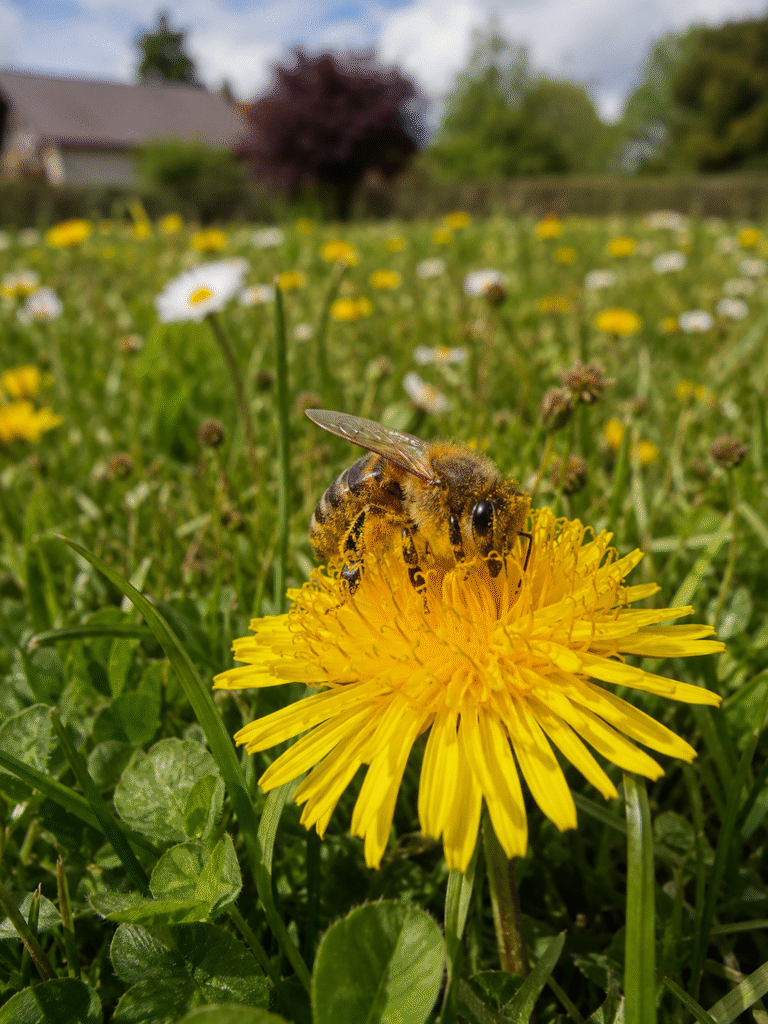
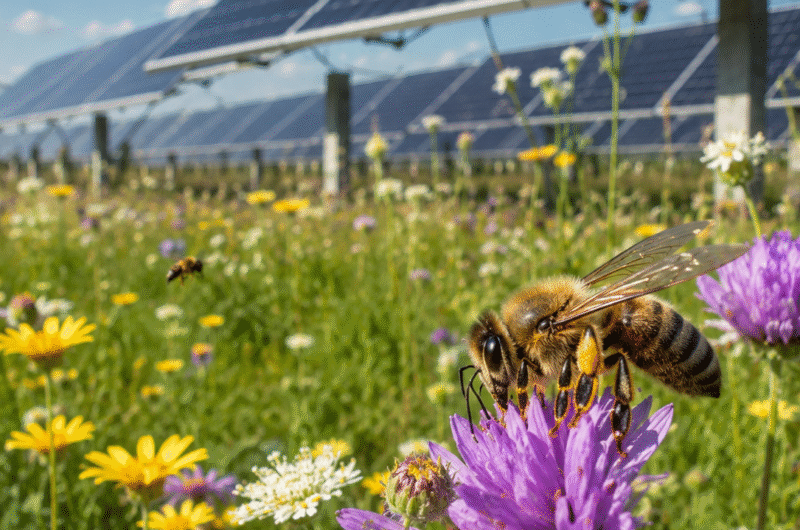

I drove past a solar installation in June that I hadn’t seen in about two years, expecting the usual — rows of panels over mowed gravel, the kind of site that looks efficient and says nothing about anything living. Instead there was a haze of white and yellow at knee height, clover and some kind of native aster I couldn’t place from the road, and bees working it hard enough that I could hear them from the shoulder with the window down. That’s not what I expected a power plant to sound like.
It turns out that scene has a name — agrivoltaics — and a growing body of research behind it. What used to be dead ground under a solar array is being deliberately turned into pollinator habitat, and the early data on what that’s doing for bee populations is better than I expected when I first went looking for it — especially set against everything else in the conversation right now about why pollinators are struggling in the first place.
What “Agrivoltaics” Actually Means
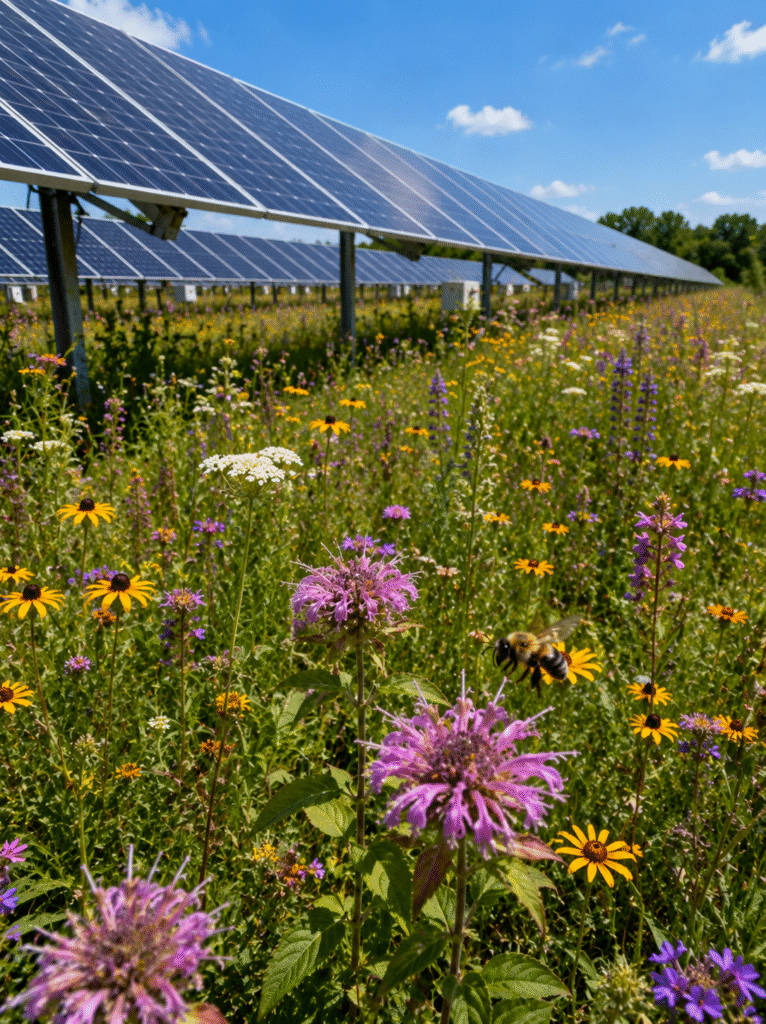
Agrivoltaics is the practice of combining solar energy production with agricultural or ecological use of the same land — most commonly by planting native, pollinator-friendly wildflowers and grasses beneath and around solar panels instead of the turf grass or gravel that’s traditionally used.
The term covers more than pollinator habitat specifically — solar grazing with sheep is a related practice, and there are currently around 130,000 acres of U.S. solar arrays being grazed that way — but the pollinator-focused version is the piece that matters most for anyone thinking about bees. Instead of mowing a solar site into bare-minimum turf, developers seed it with regionally native wildflowers, sometimes working with state wildlife agencies to target specific threatened species alongside the general pollinator benefit.
The Numbers Behind the Buzz
This is where I went in skeptical — “good for pollinators” gets claimed about a lot of land-use decisions that turn out to be marginal at best — and came out more convinced than I expected to.
IRENA’s 2026 findings on pollinator density
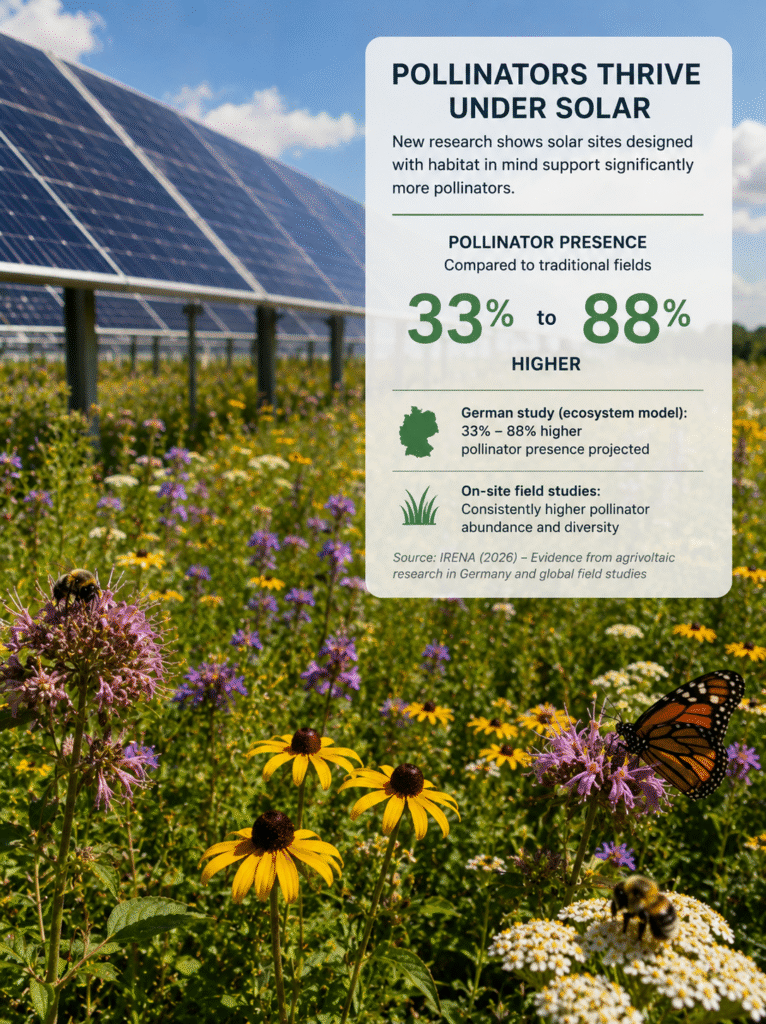
The International Renewable Energy Agency pulled together the accumulated evidence on this in March 2026, and the headline figure is hard to wave off: pollinator presence at solar sites designed with habitat in mind ran 33% to 88% higher than at comparable fields with no panels at all, citing agrivoltaic research out of Germany. That German figure comes from an ecosystem model rather than a literal field count, so it’s a projection rather than a tally — worth being honest about that distinction — but it lines up with what’s being measured directly on the ground elsewhere.
The Minnesota and Vermont field results
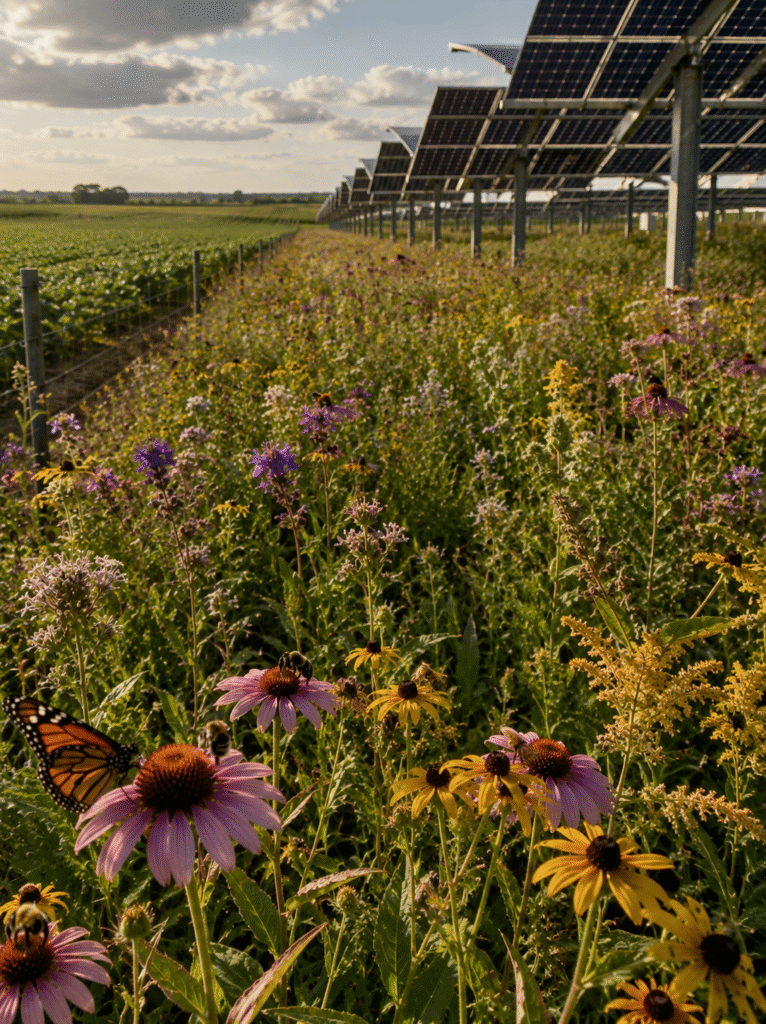
Two Minnesota solar farms replaced the gravel under their panels with native prairie and wildflowers, and five years later, native bee numbers there had multiplied roughly twentyfold, with bees crossing the fence line to pollinate the soybean fields next door. In Vermont, a Weybridge-based nonprofit called Bee the Change has been converting solar sites into pollinator habitat and reports steady increases in both the number and diversity of pollinators on their monitored sites, according to reporting from WBUR in April 2026.
A March 2026 peer-reviewed study in Energy, Ecology and Environment took this a step further and modeled the downstream effect: converting the non-native grassland typically found under solar arrays into real pollinator habitat has the potential to meaningfully boost crop yields on surrounding farmland — not just support pollinator counts for their own sake, but generate a measurable agricultural return next door.
How It Works — What’s Planted, and Why
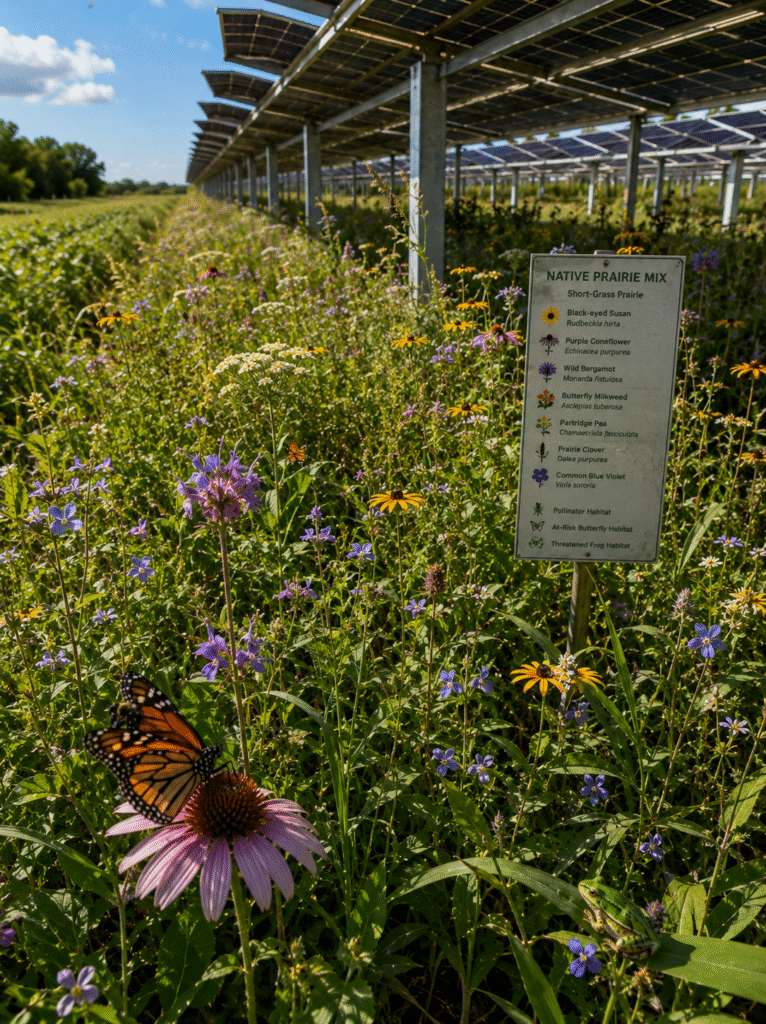
The mechanics are less exotic than the results suggest. Developers work with regional ecologists to select native wildflower and grass mixes suited to the specific site — in one Illinois project I read about, that meant a short-grass prairie mix including violet species and multiple nectar-producing wildflowers, chosen in part because it also created habitat for an at-risk butterfly and a threatened frog species alongside the pollinators. The panels themselves provide a side benefit that’s easy to overlook: partial shade and shelter that can moderate ground temperature and reduce moisture loss compared to open, unshaded field, which matters more in hotter regions than you’d initially assume.
This is the same underlying logic behind building habitat for native bees at a much smaller scale — give pollinators forage and shelter that isn’t competing with pesticide-treated monoculture, and populations respond. Agrivoltaics is essentially that principle applied across hundreds or thousands of acres of land that was previously offering nothing at all.
Beekeepers on Solar Land — A Real Partnership
This is the part of the story that connects most directly back to actual hives, not just wild pollinators. Some solar developers have gone a step further than passive habitat and are actively partnering with commercial and small-scale beekeepers to place working colonies on-site.
The Lightsource bp “Solar Honey” model
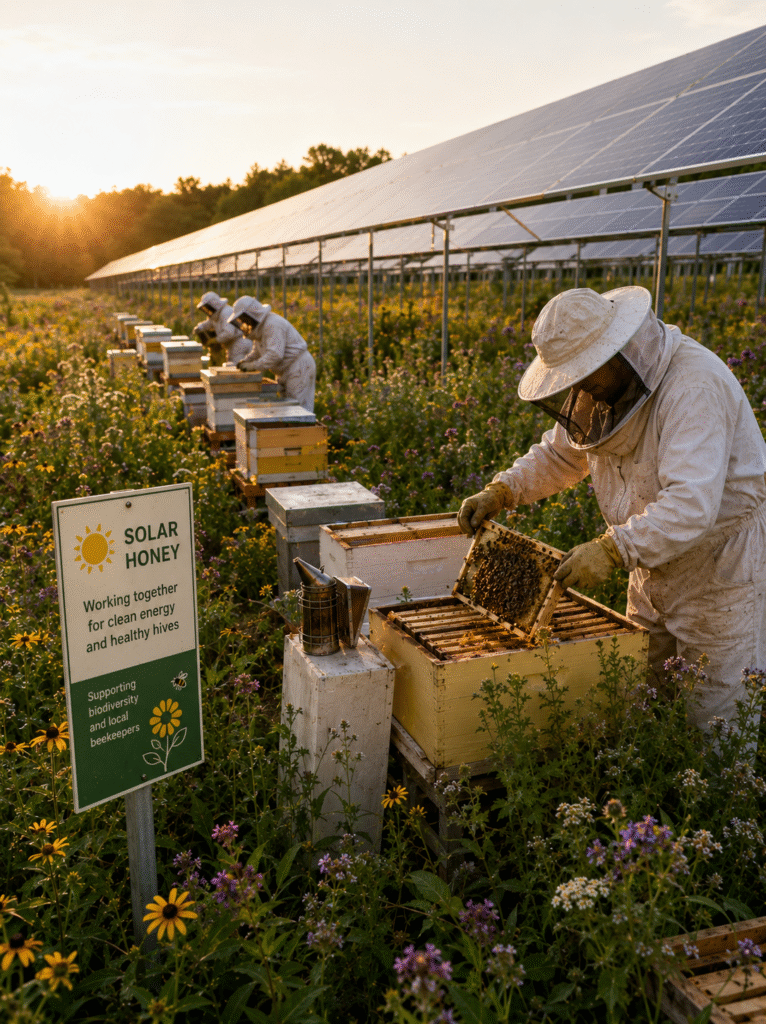
Lightsource bp runs a program it calls Solar Honey, working directly with local beekeepers to establish apiaries at its solar facilities. The company plants wildflowers under and around the panels specifically to support the hives, framing it as part of a broader biodiversity commitment — and it’s not a purely symbolic gesture. A similar model is running at a solar project in Aguascalientes, Mexico, where BayWa r.e. has set up workshops training local families in hive installation, maintenance, and honey harvesting, turning the solar site into a source of both energy and household income.
I’ll be honest that when I first read about this, I assumed it was closer to greenwashing than substance. Having gone through the actual habitat-restoration data, I think that’s the wrong read. A solar company doesn’t need functioning apiaries to hit a biodiversity marketing target — planting some wildflower seed and taking photos would do that. Actually facilitating beekeeping partnerships and reporting real hive-health outcomes is a heavier commitment than the minimum required.
The Limits and Open Questions
I don’t want to oversell this. Agrivoltaic habitat isn’t automatic — a 2026 DOE-funded study noted that many existing solar sites still plant and manage generic non-native turf grass rather than genuine pollinator-specific habitat, even when developers market them as biodiversity-friendly. The difference between a real pollinator meadow and a green-branded lawn comes down to species selection and ongoing management, and right now that varies a lot by developer and by state.
There’s also a fair question about scale versus intention: solar development still converts land, and pollinator-friendly design is a mitigation, not a guarantee that the net effect on a given landscape is positive. It matters that the plantings stay pesticide-free nesting habitat long-term, not just at planting — herbicide use for “vegetation management” around panels can undercut the whole premise if it isn’t handled with the pollinators specifically in mind. And this fits into a broader pattern I keep circling back to in land-use debates around bee habitat — good intentions on paper don’t always survive contact with actual site management budgets.
The U.S. Department of Energy has been trying to close that gap with real data. Argonne National Laboratory and the National Renewable Energy Laboratory identified roughly 1,350 square miles of U.S. agricultural land near current or planned solar deployments that could benefit from pollinator habitat if developers actually implemented it — which tells you the opportunity here is still mostly untapped, not mostly realized.
What This Means for Backyard and Commercial Beekeepers
If you keep bees anywhere near a solar development — and there’s a decent chance you might, given how fast utility-scale solar has expanded — it’s worth finding out directly what that site’s vegetation management plan actually is, rather than assuming panels mean either “wasteland” or “meadow” by default. Some developers will genuinely welcome a conversation about apiary placement, especially the ones already running programs like Solar Honey. Others are still mowing turf and would need a specific ask to consider anything different.
For anyone finding space to keep bees in a tighter urban or suburban footprint, a nearby community or utility-scale solar array with real habitat plantings can function as forage territory well beyond what your own property offers — the same way a well-managed dedicated pollinator sanctuary extends far past its own boundary. Given how much pressure comes from commercial colony losses and the general habitat squeeze pollinators are under, a genuinely well-managed agrivoltaic site nearby isn’t a minor footnote — it can meaningfully change what forage is available across an entire season.
FAQ
Do solar farms actually help bees and other pollinators?
When solar sites are deliberately planted with native wildflowers instead of turf grass or gravel, yes — a March 2026 IRENA compilation found pollinator presence at habitat-designed solar sites running 33% to 88% higher than at comparable fields without panels, and Minnesota sites have recorded roughly a twentyfold increase in native bees over five years.
What is agrivoltaics?
Agrivoltaics is the combined use of land for both solar energy production and agricultural or ecological purposes — most relevantly here, planting pollinator-friendly wildflowers under and around solar panels instead of conventional turf grass.
Can beekeepers place hives on solar farms?
Yes, in a growing number of cases. Programs like Lightsource bp’s “Solar Honey” actively partner with local beekeepers to establish working apiaries at solar facilities, and similar models exist internationally, including a family-training program at a solar site in Aguascalientes, Mexico.
Do solar panels harm nearby crops or pollination?
Not inherently — research suggests the opposite in some cases, with pollinator habitat under panels boosting pollination and yields on adjacent farmland. The risk isn’t the panels themselves but poor vegetation management, such as planting non-native turf or using pesticides that undercut the habitat value.
How much do pollinator-friendly solar sites boost bee populations?
Field results vary by site, but documented examples include a roughly twentyfold increase in native bees at two Minnesota solar farms over five years and a 33–88% higher pollinator presence in IRENA’s 2026 review of habitat-designed sites versus panel-free comparison fields.
Are solar farms replacing farmland that pollinators need?
Solar development does convert land use, and pollinator-friendly design should be understood as a mitigation rather than a guarantee of net-positive impact — the actual outcome depends heavily on whether a given site plants genuine native habitat or generic turf grass, which currently varies widely by developer.
What plants are used under solar panels to attract bees?
Regionally native wildflower and short-grass prairie mixes are typical, often including nectar-producing species selected with input from state wildlife agencies — in some projects, chosen specifically to also support at-risk butterflies or amphibians alongside pollinators.