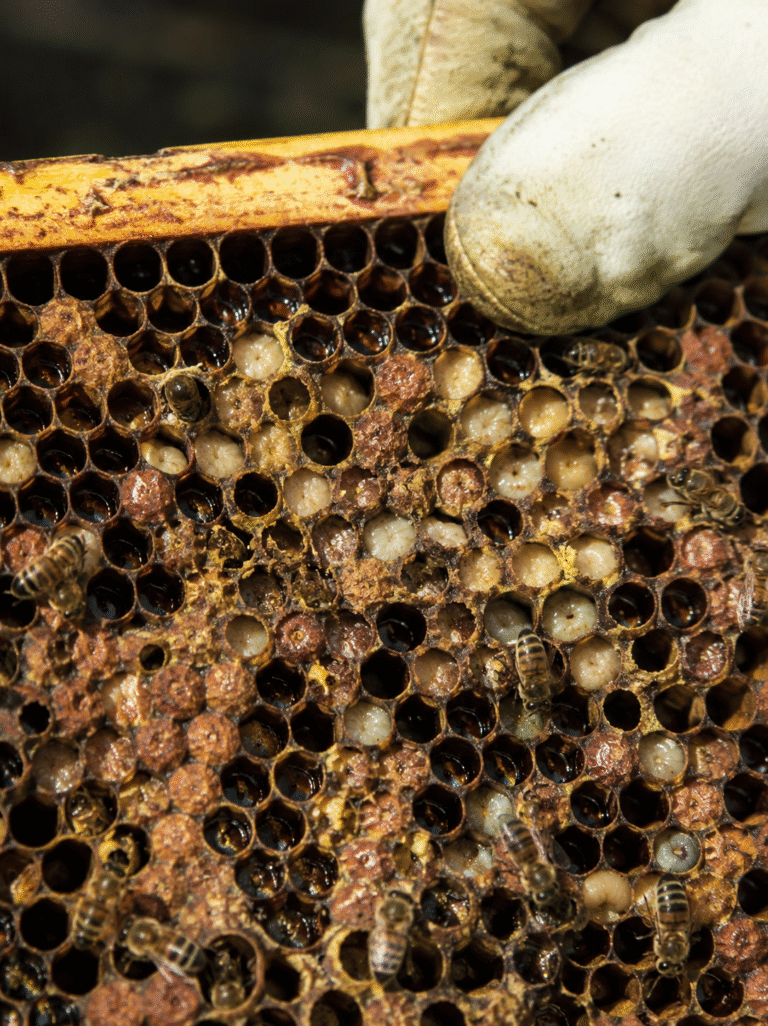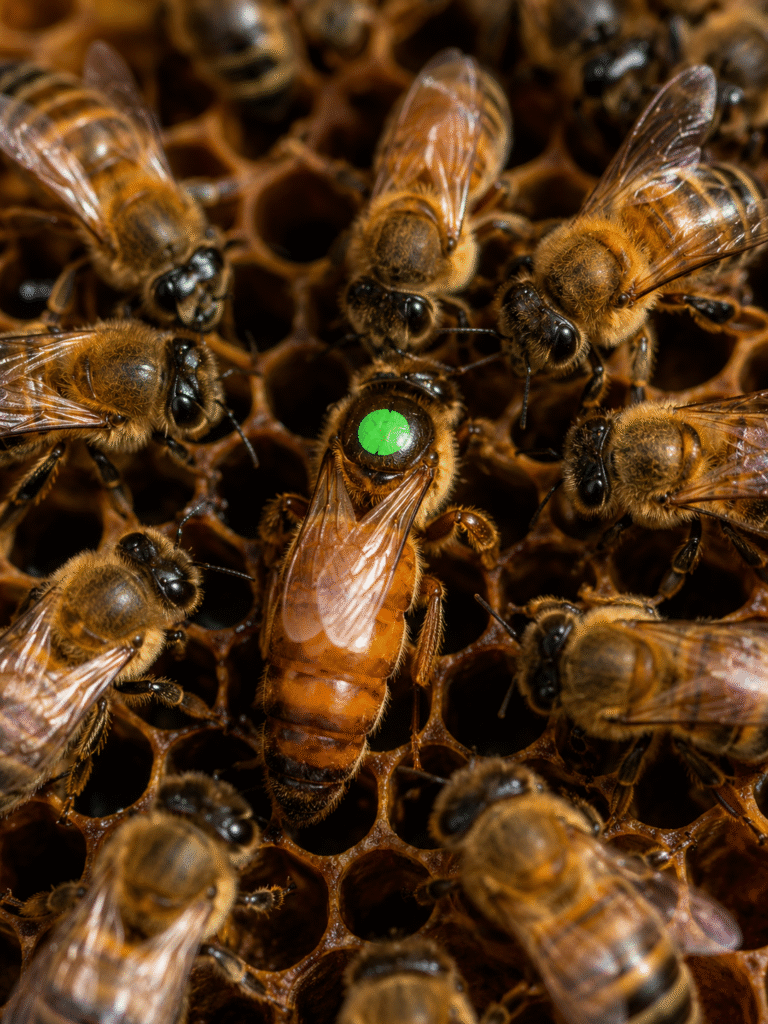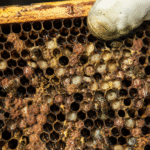
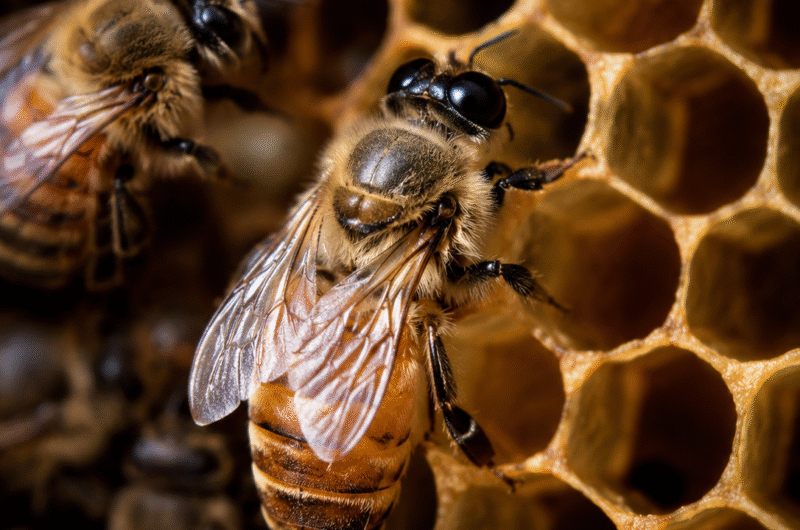

I’ve pulled thousands of drones out of brood frames over the years, usually while hunting for a queen I’d rather not have found sitting on a frame full of them. Most beekeepers treat drones the way you’d treat a slow-moving houseguest — tolerated, occasionally resented, rarely studied closely. I’ll admit I was one of those beekeepers for a long time. It took a paper out of Germany, published at the tail end of 2025, to make me stop and actually watch what a drone does with his mouth.
Here’s the part that stopped me cold: a full-grown male honeybee cannot feed himself. Not “struggles to.” Cannot. He has no functional way to process pollen, which is the only real protein source inside a hive. If nobody feeds him, he starves standing in a box full of food.
That’s not a minor biological quirk. That’s a colony that has built an entire caste of its own members to be permanently, structurally dependent on begging. And a team at Heinrich Heine University Düsseldorf, working with collaborators in Bochum and Paris, just found the genetic switch that makes that begging possible in the first place.
Why This Isn’t Just a “Cute Bee Fact”
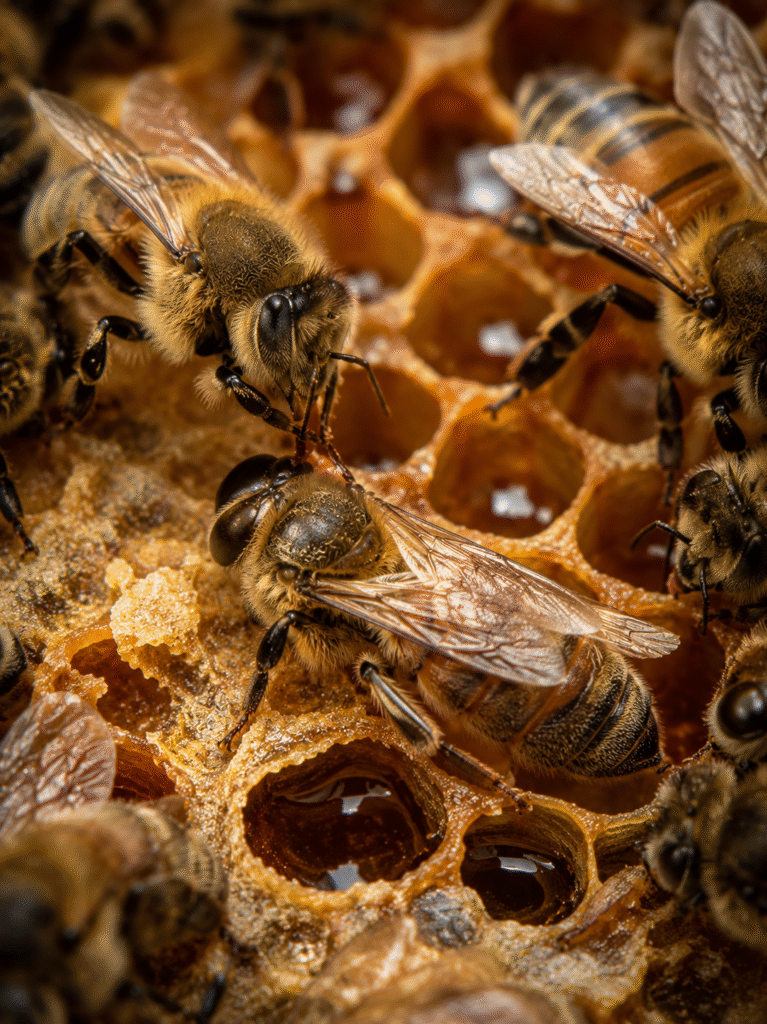
I want to push back gently on how this study has been covered elsewhere, because most of it read like trivia — “drones can’t feed themselves, isn’t that funny.” It’s not funny. It’s a design choice by natural selection, and it tells you something uncomfortable about how honeybee colonies actually allocate resources.
Think about what it means, practically, for a colony to carry drones that are born unable to feed themselves. Every single one of them is a walking liability unless the begging behavior works flawlessly. There’s no backup plan, no drone equivalent of a worker switching tasks when she’s hungry. If the signaling breaks down, he doesn’t downgrade to eating less — he starves in a box that might be overflowing with capped honey two frames away.
I’ve seen this play out, unknowingly, in weak colonies late in the season. Drones looking listless, moving slowly along the comb, getting bumped past by workers who have bigger problems to deal with. I used to chalk it up to drones just being drones — low-priority, expendable, on their way out anyway as the colony trims down for winter. Reading the Düsseldorf research, I think what I was actually watching, at least some of the time, was a begging system under strain. When resources tighten, the choreography between drone and worker gets sloppier, and drones lose out first. That’s not speculation dressed up as science — that’s twenty-plus years of frame inspections lining up with what the genetics now explain.
The Gene Doing the Work
The researchers, led by Professor Martin Beye, tracked the behavior down to a transcription factor called fruitless, or fru for short. A transcription factor is essentially a master switch — a protein that turns other genes on or off during development, wiring the brain a particular way before the animal ever has a chance to learn anything.
What makes this experiment elegant is how they proved it wasn’t guesswork. They used CRISPR-Cas9 to knock out the fru gene in a set of drones, then dropped those drones into real colonies and watched. The mutant drones could still fly. They could still groom themselves. Their senses worked fine. But they were bad at begging — they approached workers less often, and when they did approach, the exchange didn’t go as far. Less contact, less persistence, less food.
That specificity matters more than it might seem. If the mutant drones had been clumsy or confused across the board, you could argue the gene just controls general competence, not begging specifically. Instead, everything else worked. Only the begging sequence — antennae contact, positioning, persistence — fell apart. That’s about as clean a demonstration as you’ll see that a complex social behavior, not just a physical trait, can be written directly into an animal’s genetic code.
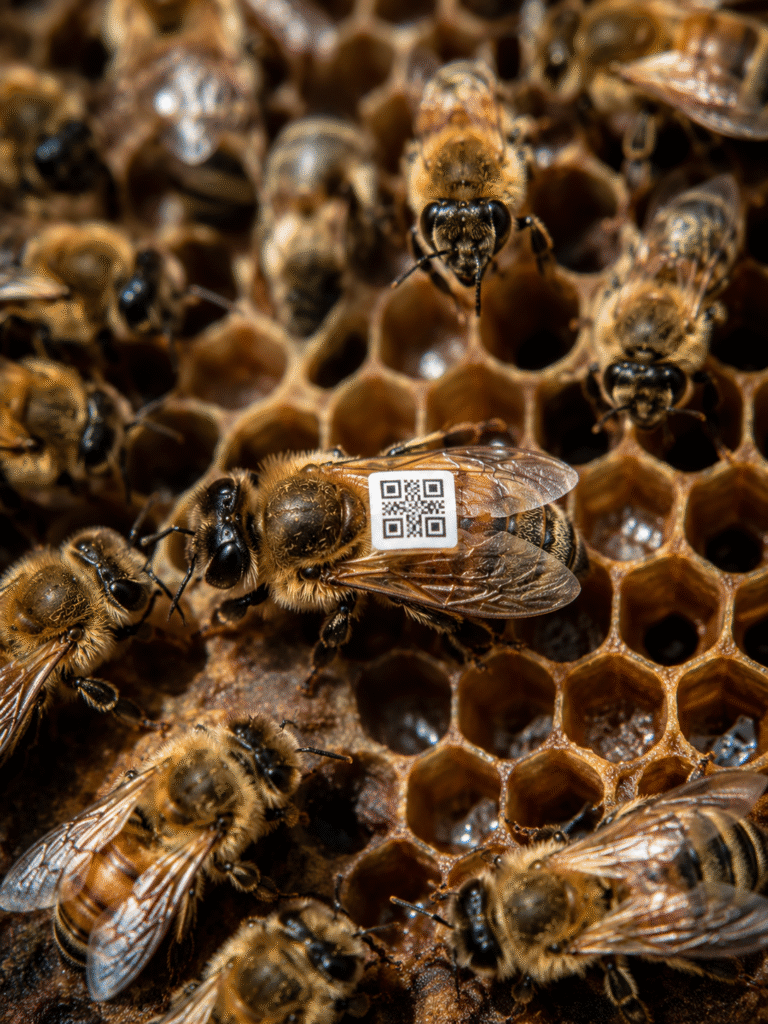
To track this without guessing, the team fitted drones with tiny QR codes and filmed their movements with camera systems, essentially building a behavioral surveillance network for a bee colony. I’ve watched a lot of bee behavior with nothing more than a headlamp and patience. Watching a QR-tagged drone tells you something my eyeballs never could: exactly how many attempts it takes, on average, for a normal drone to get fed, and how that number changes when the gene is disabled.
Where in the Brain This Actually Happens
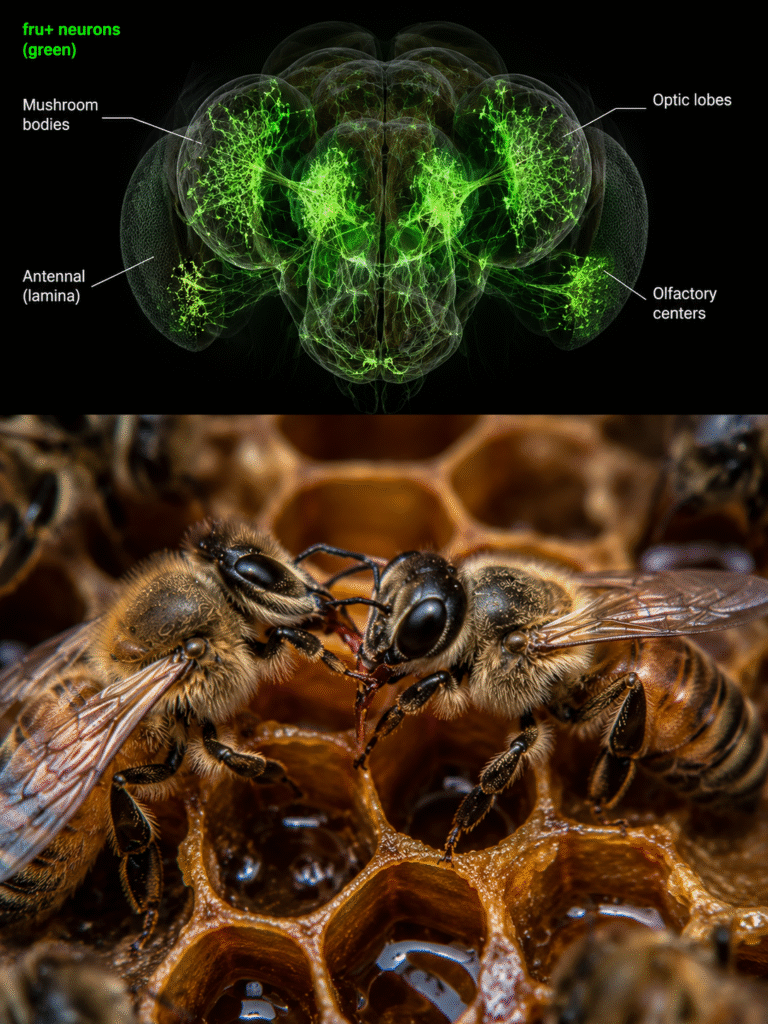
The team also traced where fru was active inside the drone’s brain, using a fluorescent marker that lit up wherever the gene switched on. The marked neurons weren’t scattered randomly. A good number sat in the mushroom bodies — the part of a bee’s brain responsible for combining different sensory inputs and learning from them. Others showed up in regions tied to smell and vision.
That pattern tells a specific story: begging isn’t a single reflex, like a knee-jerk. It’s a coordination task that pulls together touch, taste, sight, and probably scent, all wired through one genetic pathway. The drone isn’t just tapping a worker randomly and hoping. He’s running something closer to a decision process — read the worker’s posture, adjust the approach, persist or back off.
If you keep bees long enough, you start noticing that nothing in the hive is actually simple once you look closely. Comb-building looks mechanical until you watch bees adjust cell size on the fly for drone versus worker brood. Foraging looks instinctive until you learn about the waggle dance’s precision. Begging fits right into that pattern — it looks like the least interesting behavior in the hive, right up until someone maps the neurons doing it.
What This Changes for How We Think About Drones
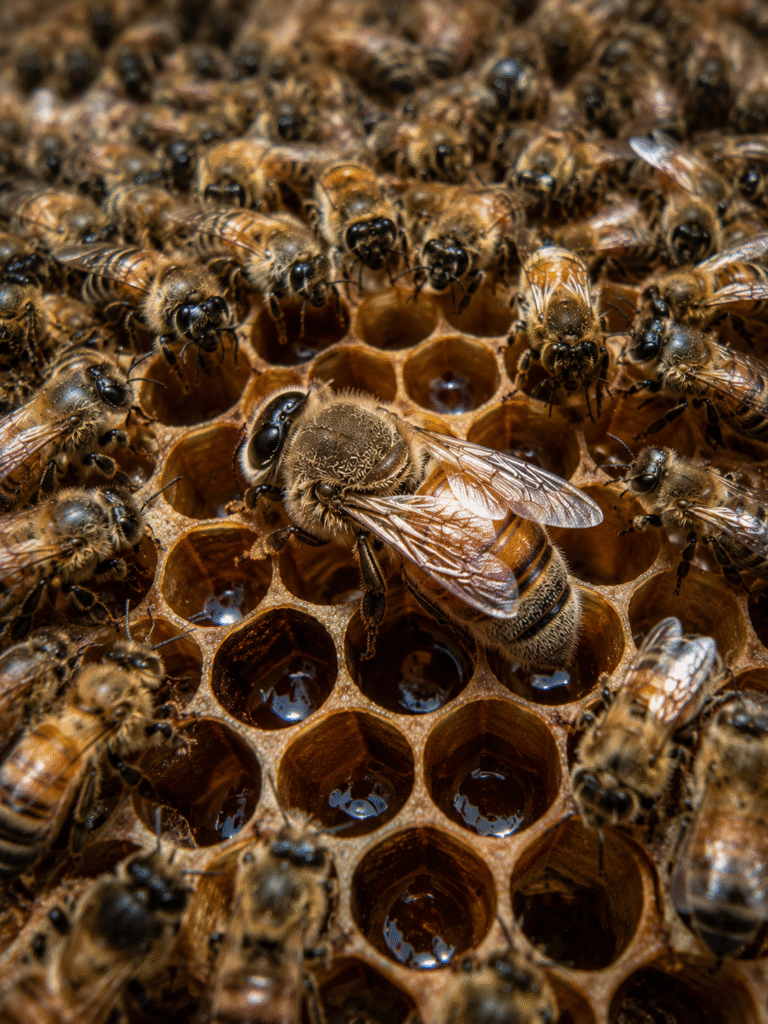
I’ll say something that might sound like heresy to beekeepers who’ve been taught to view drones purely as a management cost: this study gives me a reason to pay more attention to drone health, not less.
Here’s my reasoning. If begging is a genetically wired, multi-sensory task that depends on the drone being in good shape — properly nourished as a larva, developing normally — then anything that disrupts larval development might quietly produce drones who are worse at this task without ever showing an obvious symptom. A drone raised in a stressed colony, in cooler-than-ideal brood temperatures, or in comb that’s been reused past its prime, might emerge physically intact but behaviorally less effective at getting fed. He won’t look sick. He’ll just slowly lose out to healthier drones in every food exchange, and eventually die quietly, and you’ll never know why because nothing about him looked wrong from the outside.
That’s a genuinely new lens for me, and I’ve been doing this a long time. It reframes “poor drone quality” from a vague phrase beekeepers throw around during queen-rearing conversations into something with an actual mechanism behind it — brain wiring during development, not just body size or flight strength.
For beekeepers running drone congregation programs or queen-rearing operations where drone quality genuinely affects mating success, this is worth sitting with. We already obsess over drone flight timing, sperm viability, congregation area quality. Add “was this drone raised somewhere that let his begging circuitry develop properly” to the list of questions nobody’s been asking, because until now, nobody knew to ask it.
The Bigger Picture: Genes and Cooperation
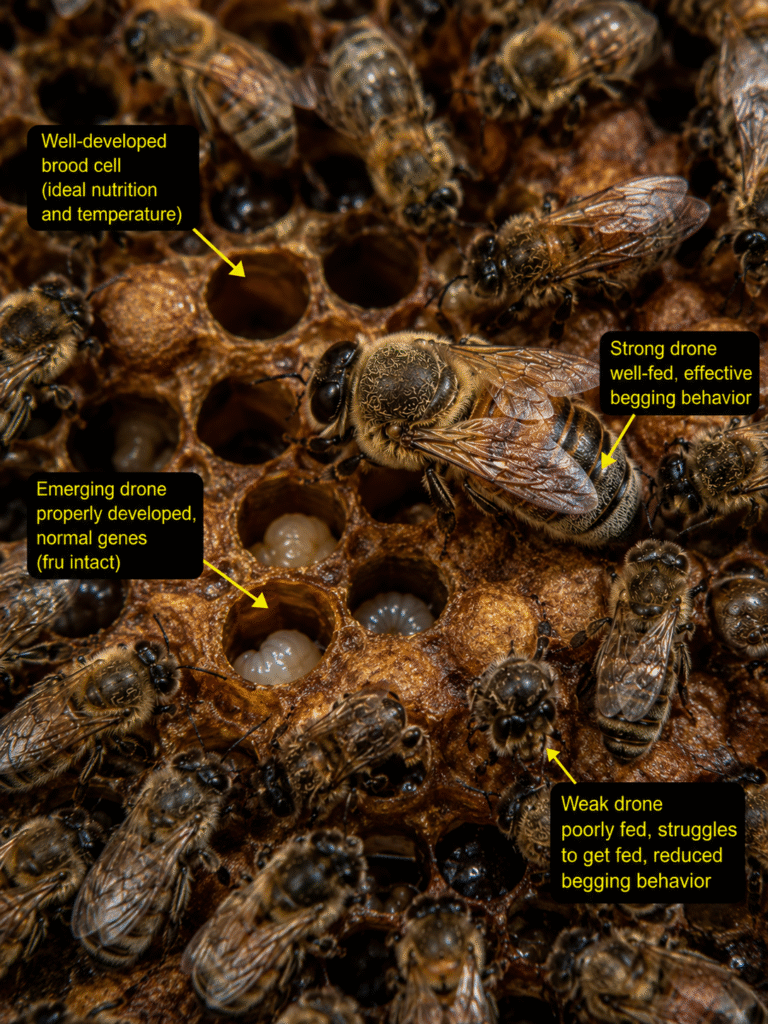
Step back from bees for a second. What Beye’s team really demonstrated is that a complex, cooperative social behavior — one that requires two different individuals to coordinate in real time — can be traced to a single genetic factor. That’s a bigger deal in biology generally than it sounds when you frame it around bees.
Most discussions of social behavior in animals lean on learning, environment, and experience as the drivers. This study is a clean counterexample: a behavior requiring split-second coordination between two animals, hardwired before either of them has done anything at all. It’s the kind of finding that ripples outward into how researchers think about cooperation in ants, in wasps, in any species where individuals depend on each other in structured, predictable ways.
For beekeepers, I think the honest takeaway is smaller but still valuable: the hive is a tighter, more interdependent system than most of us give it credit for, even in the parts of it we’ve written off as background noise. Drones asking for food isn’t filler behavior between more “important” hive activities. It’s a genetically engineered negotiation, running constantly, all summer, mostly invisible to anyone standing over the box with a smoker.
Next time you crack a hive and see a drone nosing up to a worker, watch for a second longer than usual. You’re looking at a script written into his DNA before he ever hatched — and now, for the first time, we actually know which gene is holding the pen.
About the Study: Köhnen, S., Ulbricht, P., Sturm, A., Carcaud, J., Sandoz, J-C., Eltz, T., Beye, M. “The fru gene specifies male cooperative behaviors in honeybee colonies.” Nature Communications (2025). Research conducted at Heinrich Heine University Düsseldorf in collaboration with Ruhr University Bochum and Université Paris-Saclay.