

I’ve spent more hours than I’d like to admit standing over an open hive, watching workers move across comb like they’re following some invisible script. After a while, you start to think you’ve seen it all. The waggle dance. The undertaker bees hauling out the dead. The guards at the entrance, testing every incoming bee like bouncers at a club that only lets in members. And then a story crosses my desk that reminds me, once again, how little we actually understand about what’s happening inside that wooden box in your backyard.
This one started, of all places, with a two-year-old.
The Question Nobody Thought to Ask
A bee researcher named Kai Wang, who works at the Chinese Academy of Agricultural Sciences in Beijing, brought his young son into the lab one day to look at an observation hive — the kind with a glass panel so you can watch the bees work without cracking open the colony. Any beekeeper will tell you those hives are mesmerizing even for adults. For a toddler, it must have been like staring into a tiny, humming city.
The boy pointed at something. A queen cell, hanging down from the comb like a peanut shell, completely unlike the neat hexagons surrounding it. “Daddy, is this also a bee’s house? Why isn’t it a hexagon?” he asked.
It’s the kind of question a parent fields and forgets by dinner. Except this dad happened to study bees for a living, and that question apparently lodged itself somewhere it couldn’t be shaken loose. Wang has said the moment hit him like a lightning bolt, and instead of giving his son a quick answer and moving on, he went back to the hive with fresh eyes.
I love this part of the story, honestly. Every beekeeper has had a moment like that — not necessarily with a child, but with some small detail that’s been sitting in plain sight for years before it suddenly demands an explanation. You stop seeing the hive as familiar and start seeing it as strange again. That’s usually when the real discoveries happen.
What the Cameras Caught
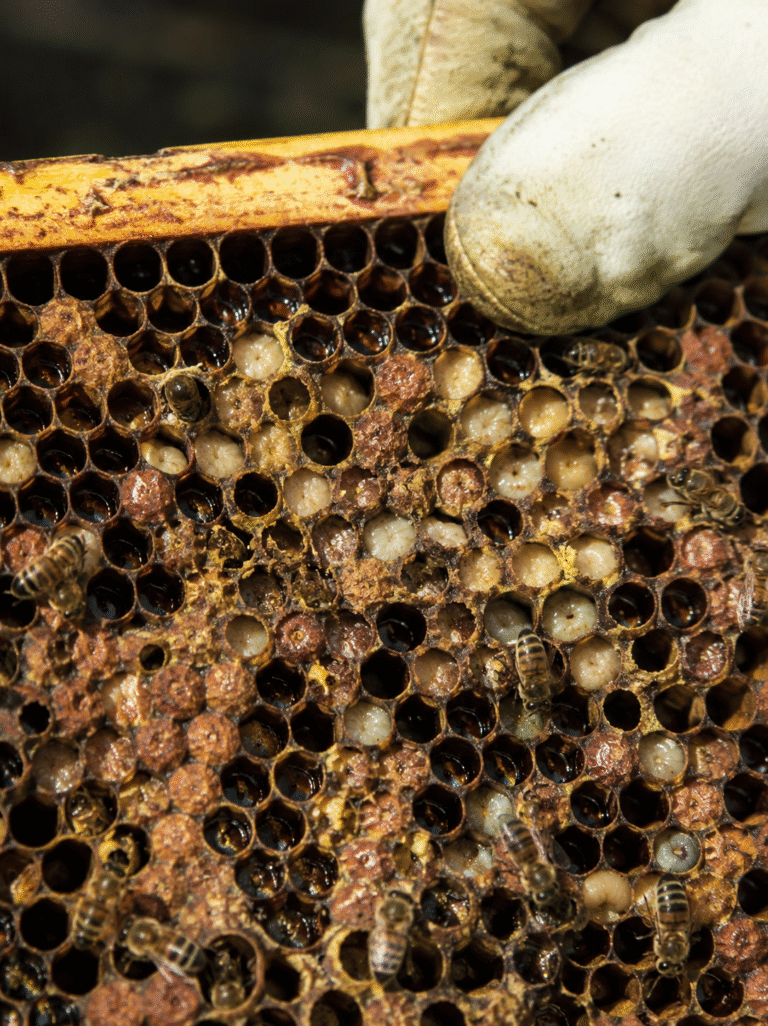
Wang and his team started watching the hive more closely, and what they noticed didn’t show up to the naked eye. Worker bees were using their mandibles to chew and manipulate the wax around the queen cells — shaping that strange, peanut-like structure instead of the standard hexagon every other cell in the hive follows.
The obvious question was: how were they softening wax that’s normally too stiff to mold by hand? Bees don’t carry tiny blowtorches. So the team pointed infrared thermal cameras at the colony, expecting maybe a small, uniform temperature bump across the group of workers involved.
What they found instead was stranger and, frankly, kind of beautiful. The workers were heating their own thoraxes while building the queen cells — turning their bodies into tiny, living furnaces.
Sit with that for a second. We already knew honeybees generate heat collectively — that’s how a cluster survives winter, vibrating their flight muscles to keep the core of the hive above 90°F even when it’s freezing outside. But this was different. This wasn’t whole-colony thermoregulation. This was a specific, dedicated group of bees using their own body heat as a tool, like a sculptor warming clay in their palms before shaping it.
A New Job Title in the Hive
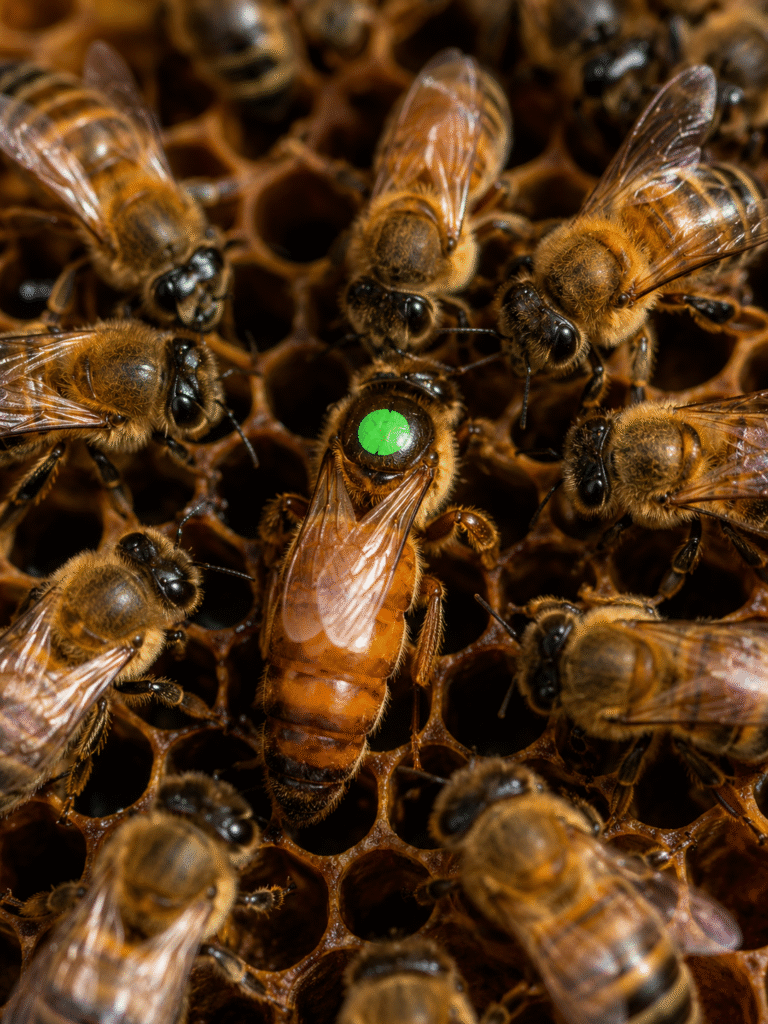
Here’s where it gets even more interesting for anyone who’s spent time reading about bee biology. The research team identified this as an entirely new class of worker bee, distinguished by different patterns of gene expression in the abdomen. Wang nicknamed them “royal engineers” — workers whose primary function appears to be the construction of queen cells, the structures where future queens develop.
For decades, the working assumption in entomology was straightforward: a fertilized egg can become either a worker or a queen, and the deciding factor is diet. Larvae that are fed royal jelly — the glandular substance secreted by worker bees — turn into queens, while everyone else becomes a worker. That explanation has been in beekeeping textbooks since before I was born. It’s not wrong, exactly. But it turns out it was incomplete.
If “royal engineers” really are a distinct functional caste — not just workers doing odd jobs here and there, but bees with their own genetic signature built around this one task — that reshapes part of the basic architecture of how we think about colony roles. We’ve known about foragers, nurses, guards, and undertakers for a long time. Now there’s apparently a construction crew with a specialty nobody had mapped before, building the literal cradle of the next queen using heat generated by their own muscles.
The research, for what it’s worth, was significant enough to land in Nature, which isn’t where casual hive observations usually end up.
Why This Isn’t Just a Cute Science Story
I’ll admit my first reaction reading this was pure delight — the kind of “huh, that’s wild” reaction you get from a good nature documentary. But the longer I sat with it, the more it struck me how much this matters for anyone who actually keeps bees, not just studies them.
If queen cell construction involves a dedicated caste using thermal energy in a targeted way, that opens questions worth asking in your own apiary. Is colony stress — heat stress, nutritional stress, disease — affecting these “royal engineers” specifically during swarm season or supersedure, when colonies are actively raising new queens? Could that help explain why some hives produce strong, viable queens during requeening and others quietly fail at it, even when conditions look fine on paper?
We don’t have answers to those yet. Wang’s team has opened a door, not closed a case. But that’s how good science usually works — one observation cracks something open, and a decade of follow-up research walks through it.
What I Keep Coming Back To
What I love most about this story isn’t really the thermal imaging or the gene expression data, as genuinely fascinating as both are. It’s the reminder that the people closest to bees — the ones who watch them every single day, sometimes for years — can still walk right past something extraordinary until someone asks the “obvious” question out loud.
I think about that every time I’m out checking hives and something looks slightly off from what I expected. A weird shape in the comb. A pattern of activity at the entrance that doesn’t match the manual. Most of the time it’s nothing — bees being bees, doing something idiosyncratic that doesn’t mean much. But every once in a while, it’s not nothing. It’s a queen cell shaped like a peanut, and a two-year-old pointing at it, asking why.
Next time you’re at your own hive and something catches your eye that doesn’t quite fit the pattern, don’t be too quick to explain it away. Sometimes the strangest detail in the box is the one worth following.