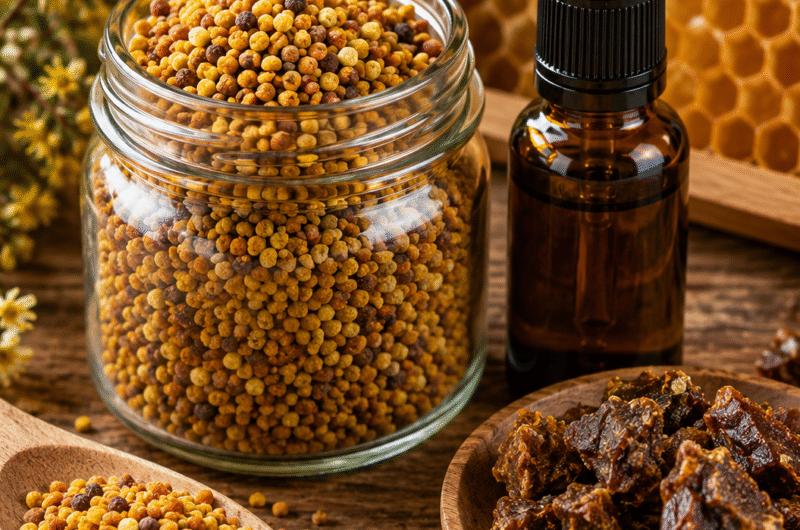

A woman at a farmers market once pointed at a small bag of dark, sticky chunks on my table and asked, “what’s the brown stuff?” I told her it was propolis, raw, straight off my hive scrapers. She picked one up, sniffed it, made a face like she’d just smelled a campfire mixed with pine sap — which, chemically, is not far off — and asked if it would cure her son’s eczema. I had to tell her honestly: maybe a little, for some people, sometimes. That’s a much less exciting answer than what she’d read on a wellness blog the night before, and it’s the answer I’m sticking with here too.
These two hive products get marketed aggressively as miracle supplements, and the truth sits in a much more interesting, much less dramatic middle ground.
What pollen actually is, mechanically speaking
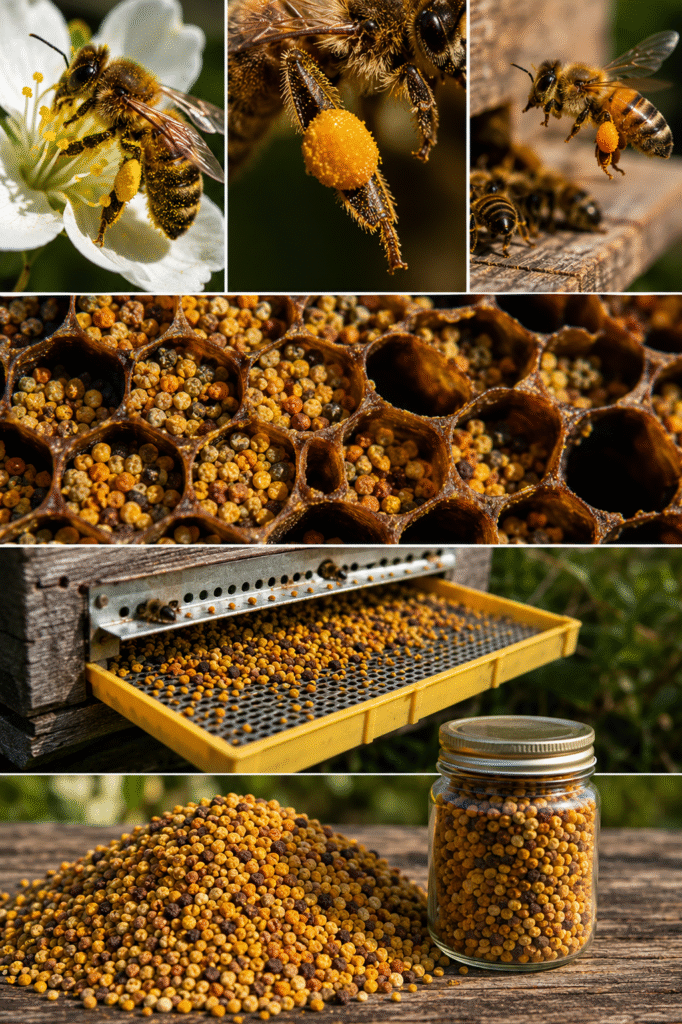
When a forager bee lands on a flower, pollen grains stick to the fine hairs covering her body. She combs them off with her legs, moistens them slightly with nectar and a bit of her own saliva, and packs them into two dense pellets on her hind legs — the corbiculae, sometimes just called pollen baskets. Back at the hive, she deposits those pellets into a cell, where house bees pack them down further and add enzymes that begin a light fermentation process, turning raw pollen into what beekeepers call “bee bread,” the colony’s primary protein source.
Bee pollen sold commercially is almost always harvested before that fermentation happens, using a pollen trap fitted at the hive entrance — a mesh screen fine enough to knock the pellets off a forager’s legs as she squeezes through, dropping them into a collection tray underneath. I’ve run traps on a few of my hives during strong spring flows, and the volume that collects in just a few days is genuinely surprising — easily a cup or more from a single strong colony.
Here’s the part that doesn’t make it into most pollen marketing: the nutritional content of that pellet varies enormously depending on which plant it came from. Pollen from one source might run 25% protein with a rich amino acid profile; from another, barely half that, with almost no fat content. A bag of mixed commercial bee pollen is whatever combination of plants happened to be blooming in that apiary’s foraging radius that week. There’s no consistency from batch to batch unless a supplier is doing real testing, and most aren’t, because most consumers never ask.
Why I stopped running pollen traps year-round
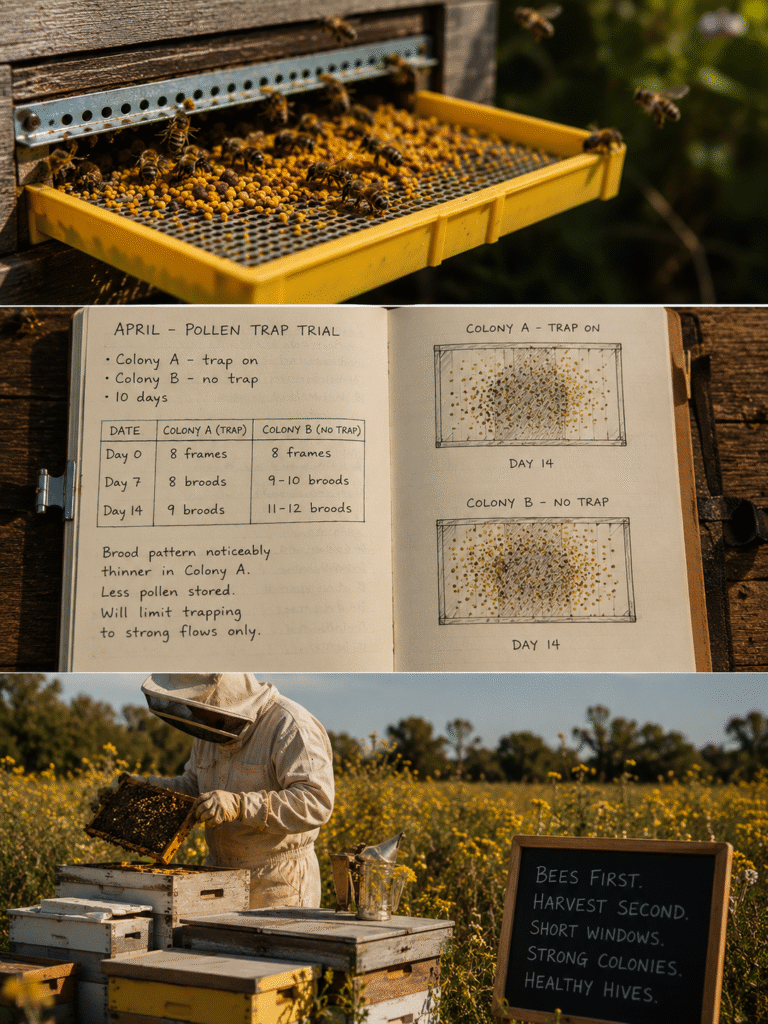
I’ll be straight about this part because it matters more than most pollen marketing admits. Pollen traps work by intercepting protein the colony was about to eat. Run a trap aggressively, especially in early spring when the colony is rebuilding its brood nest after winter, and you’re pulling food away from a hive that needs every gram of it to raise new bees. I trapped pollen from one of my strongest colonies for about ten days one April, mostly out of curiosity, and noticed the brood pattern on that hive looked noticeably thinner than its neighbors by the time I checked again two weeks later. That’s not a controlled experiment, and I won’t pretend it proves anything on its own, but it matched what several more experienced commercial beekeepers had already warned me about, and it was enough for me to limit trapping to short windows during genuinely strong nectar and pollen flows, never during buildup or dearth periods.
If you’re a hobbyist thinking about selling pollen as a side income, that’s the trade-off nobody mentions on the supplement aisle: every gram you harvest is a gram your bees don’t get.
What propolis actually is, and why bees make it
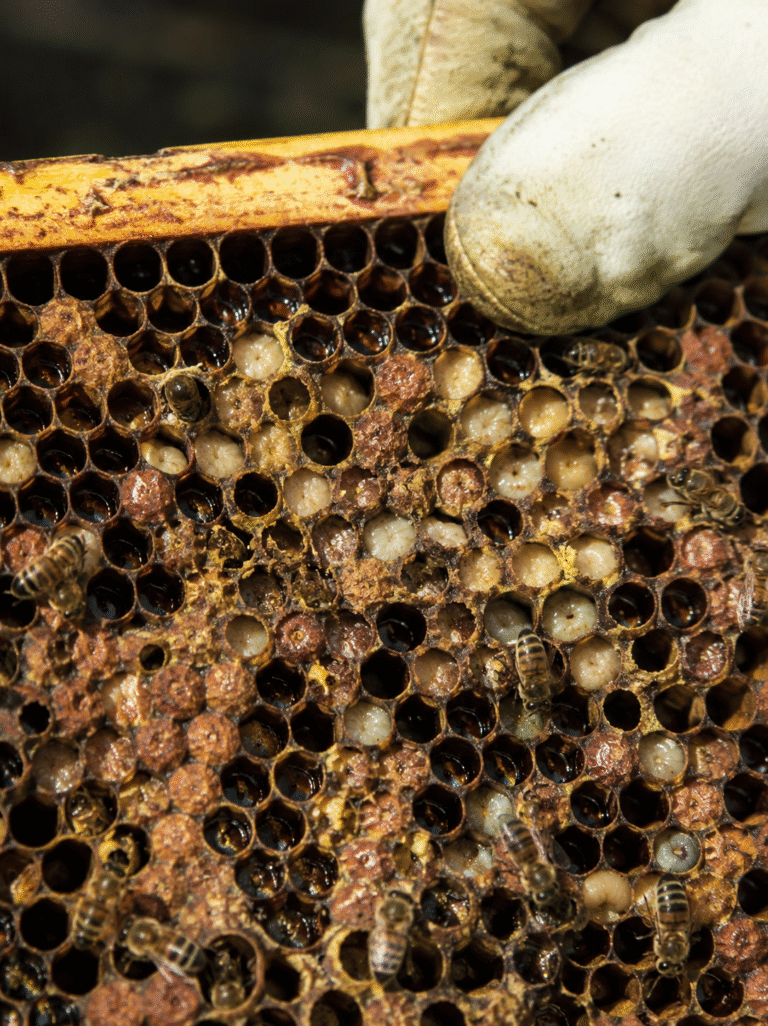
Propolis is resin that bees gather from tree buds and bark wounds — poplar, birch, conifers, depending on what’s locally available — and mix with a small amount of wax and their own enzymatic secretions. Bees use it as a structural sealant and, more interestingly, as an antimicrobial varnish. They line the interior of the hive with a thin coat of it, plug small gaps and cracks, and sometimes mummify intruders too large to remove, like mice, by encasing the carcass entirely in propolis to prevent decay and bacterial growth inside the hive. I’ve opened a hive and found a fully propolized mouse exactly once in years of keeping bees, and it’s a genuinely strange thing to see — essentially preserved, odorless, sealed.
That antimicrobial function inside the hive is the most scientifically grounded part of propolis’s reputation. Tree resins themselves have measurable antimicrobial compounds, which is part of why trees produce them in the first place — to seal wounds and resist pathogens. Bees are essentially borrowing a plant defense mechanism and repurposing it for hive hygiene. That’s a real, observable, mechanistically sensible function. Whether it translates cleanly into a human health supplement is a separate and much less settled question.
Sorting the real claims from the inflated ones
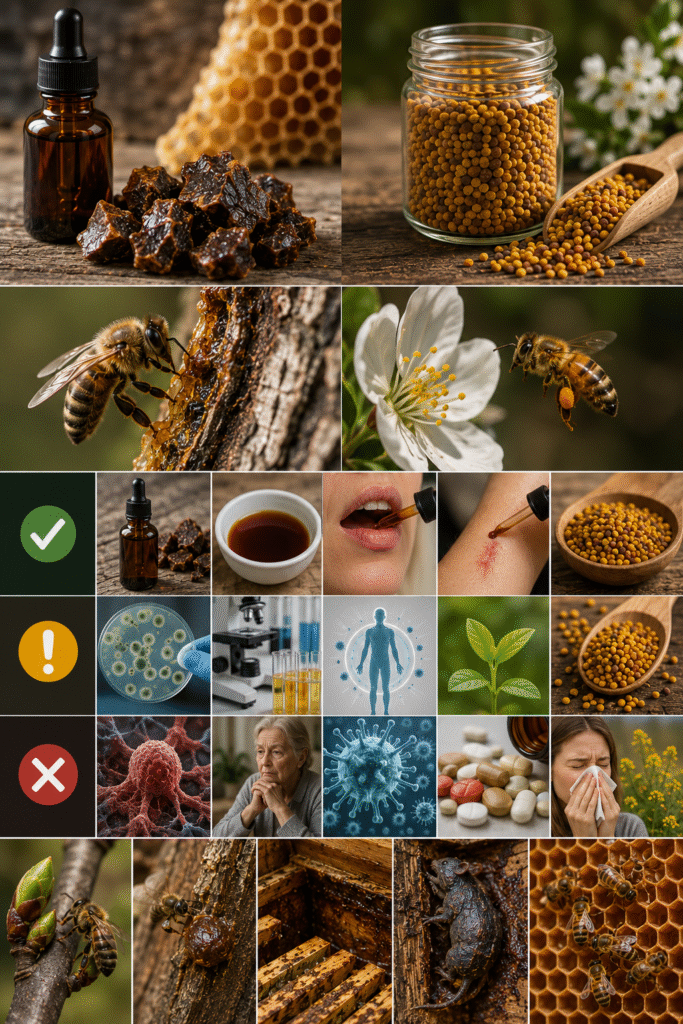
I want to draw a clear line here between what’s reasonably supported and what’s overreach, because both pollen and propolis attract some genuinely wild claims online.
Propolis has shown some antimicrobial and anti-inflammatory activity in laboratory and small clinical studies, particularly in topical applications — mouth rinses for minor oral health issues, and skin preparations for minor wound care, are the areas with the most reasonable supporting evidence. That tracks with its actual biological function inside the hive. I’d treat a propolis tincture for a canker sore or a minor cut as a plausible folk remedy worth trying, not a wild leap.
Where I get skeptical is the broader category of claims around both products treating or preventing serious illness — cancer, chronic disease, immune disorders. The research in these areas tends to be preliminary, small-scale, or conducted in lab conditions that don’t translate directly to a person eating a spoonful of pollen at breakfast. If a seller is implying their pollen or propolis treats a serious medical condition, that’s a marketing claim outrunning the actual evidence, full stop. I’d rather say that plainly than dress it up.
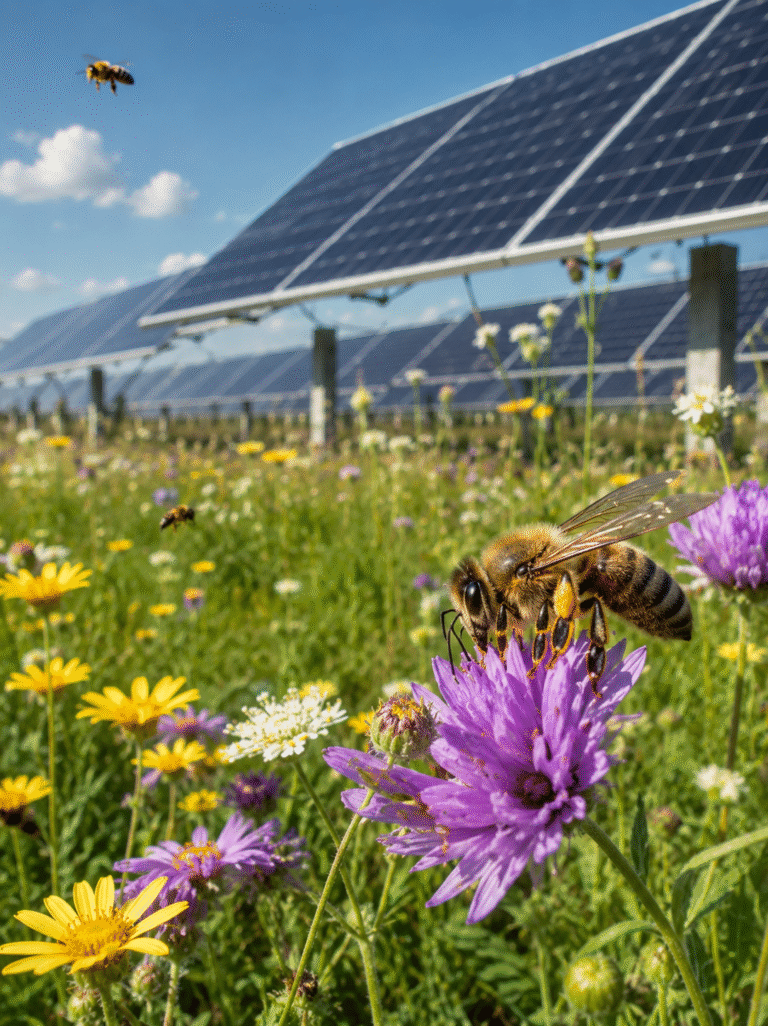
As for pollen specifically fixing seasonal allergies through gradual exposure — the idea that eating local pollen desensitizes you to local allergens — the logic sounds appealing, but it doesn’t hold up well to scrutiny. Most seasonal allergies are triggered by wind-pollinated plants like grasses, ragweed, and certain trees, precisely because their pollen is light enough to become airborne. Bees, by contrast, primarily collect pollen from flowering plants that rely on insect pollination, which produce heavier, stickier pollen that doesn’t travel on wind and isn’t typically the allergy culprit in the first place. The plants matching your hay fever and the plants your local bees are actually visiting are often not the same plants at all.
The allergy risk that actually matters
This is the part I take seriously enough to put a real warning on. People with pollen allergies, asthma, or any history of anaphylactic reactions should be cautious with raw bee pollen specifically, because it can trigger genuine allergic reactions, including severe ones, in sensitive individuals. I’ve heard directly from another beekeeper whose customer had a serious reaction after trying pollen for the first time at a market sample table — itching, swelling, the kind of response that sends you to urgent care, not just mild discomfort. If you’ve never had bee pollen before, start with an amount smaller than a single pellet, not a spoonful, and know what an allergic reaction looks like before you try more.
What to actually look for if you’re buying
Skip anything labeled simply “raw” with no other information — that word is doing no regulatory work and means whatever the seller wants it to mean. Look instead for a supplier who can tell you roughly which region and which bloom season the pollen or propolis came from, since that at least tells you something real about likely composition. Refrigerate pollen after opening; it’s biologically active and degrades faster than people expect at room temperature. And treat any claim involving the words “cure,” “miracle,” or a specific serious disease as a sign to look elsewhere, regardless of how good the rest of the packaging looks.
None of this makes pollen and propolis useless. It makes them what they actually are: genuinely interesting hive byproducts with some real, modest, mechanistically sensible benefits, sold inside a marketing ecosystem that consistently promises more than the evidence supports. I still sell propolis tincture at my own market table. I just don’t tell people it’ll cure anything, because it won’t, and I’d rather they trust the next thing I tell them too.