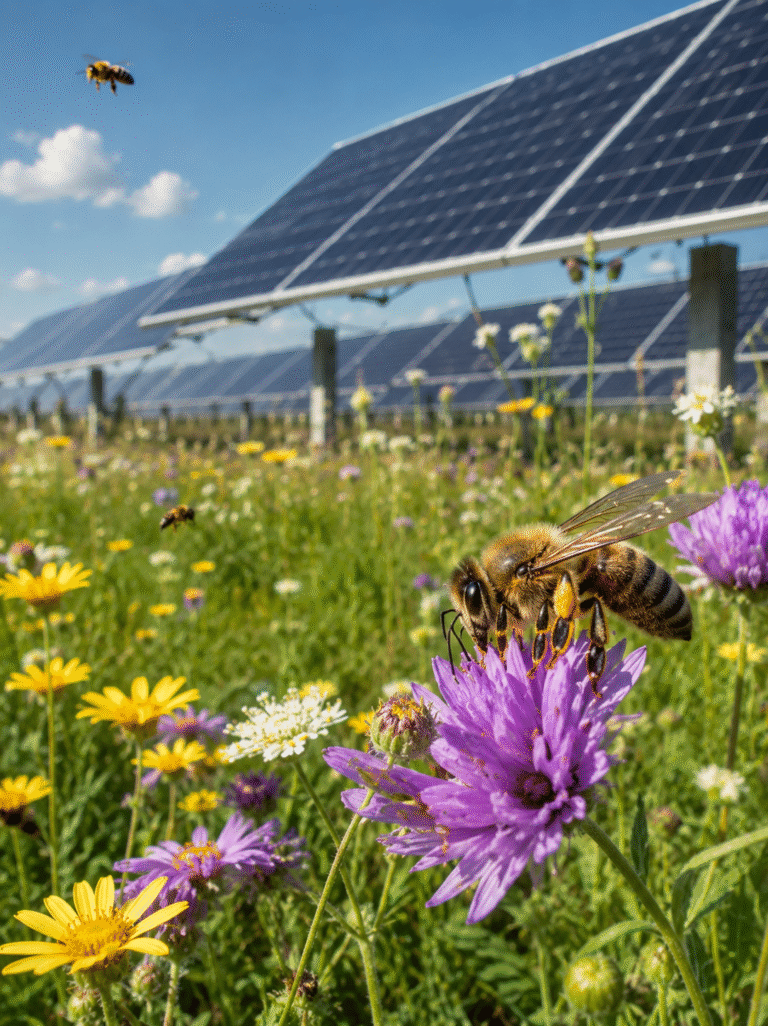

Every June I stand in the same patch of garden and watch my bees make a decision I can’t fully explain by looking at what I’m looking at. Two rows over, there’s a bed of bright red dahlias my neighbor is unreasonably proud of, and right beside them, a scruffy patch of black-eyed Susans I’ve never bothered to deadhead. The dahlias, to my eyes, are the showstopper. My bees treat them like they don’t exist. The black-eyed Susans get worked over methodically, forager after forager, all afternoon.
For years I explained this away with the usual beekeeper shorthand — bees “prefer” yellow, bees “don’t like” red, end of conversation. It took reading actual vision research to understand that I had the framing backwards the whole time. My bees aren’t choosing the black-eyed Susans over the dahlias out of preference the way I might choose one restaurant over another. In a very real sense, they may barely be able to see the dahlias at all.
Five Eyes, and Only Two of Them Do Most of the Work
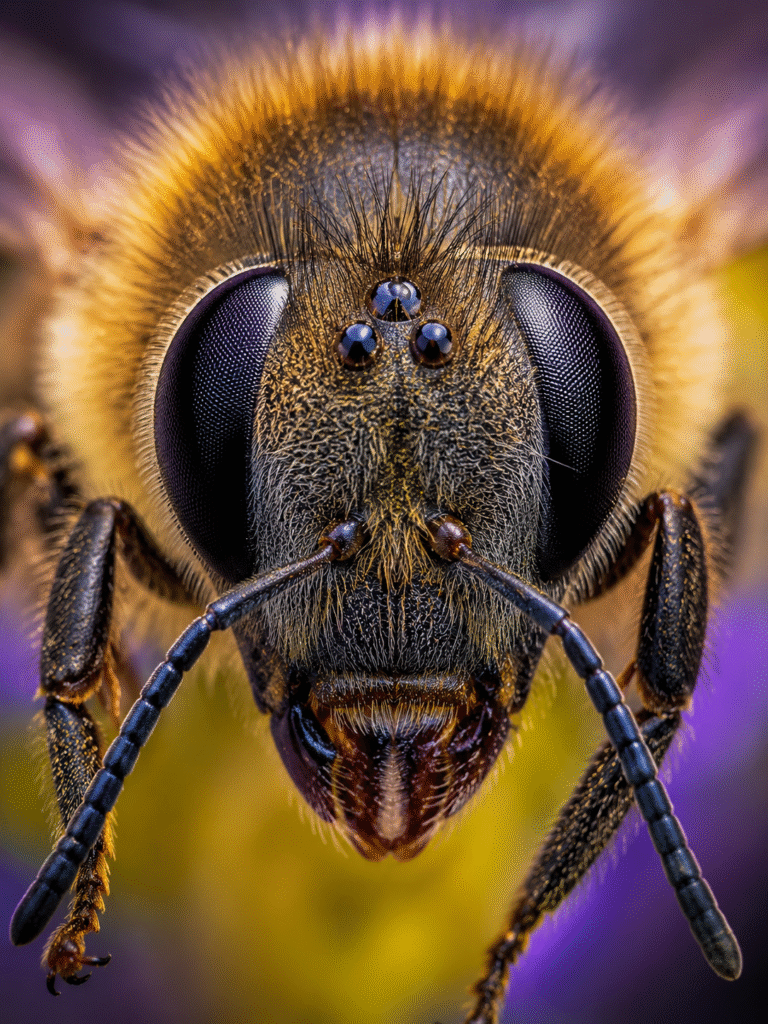
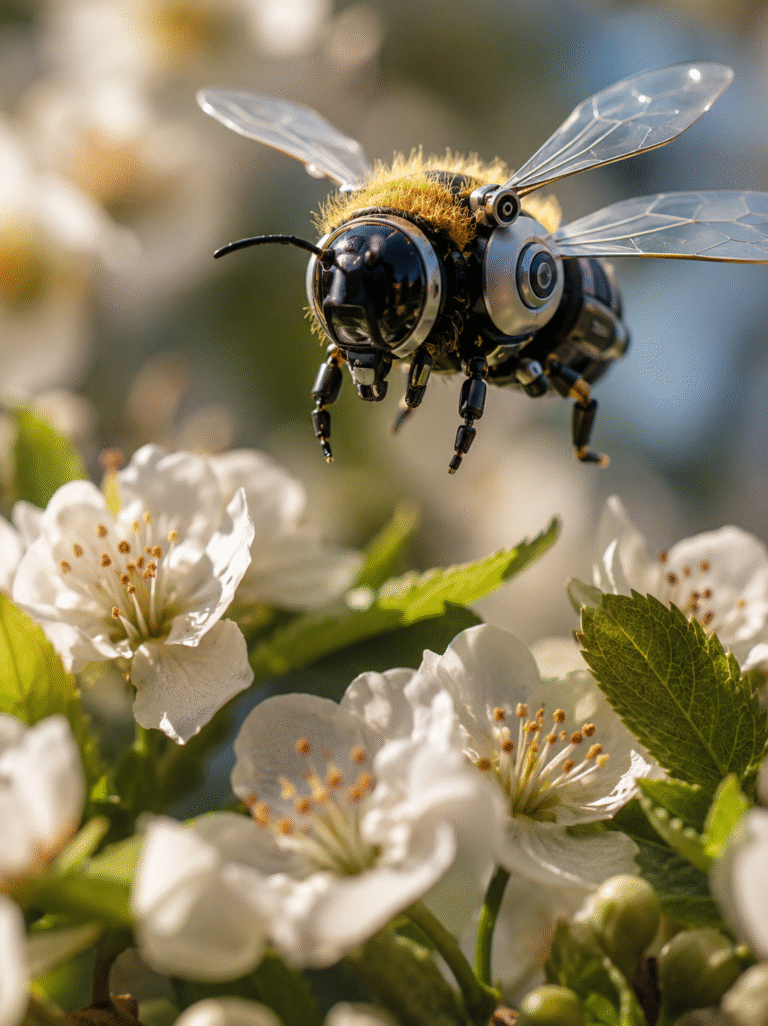
Start with the hardware, because it explains everything downstream. A honey bee has five eyes total — two large compound eyes on either side of the head, doing the bulk of the visual processing, plus three small simple eyes called ocelli, arranged in a triangle on top of the head, mostly used for detecting light intensity and orientation rather than forming images.
The compound eyes are the interesting part for this discussion. Each one is built from thousands of individual optical units called ommatidia, each pointed in a slightly different direction, each contributing something like one tile to a mosaic image. It’s a completely different strategy from the single-lens eye you and I are using to read this sentence, and it comes with real tradeoffs — bee vision has much lower spatial resolution than ours, meaning fine detail is not their strong suit. What they trade that resolution for is exceptional motion detection and a color range that extends somewhere we can’t follow at all: ultraviolet.
The Color Gap Runs Both Directions
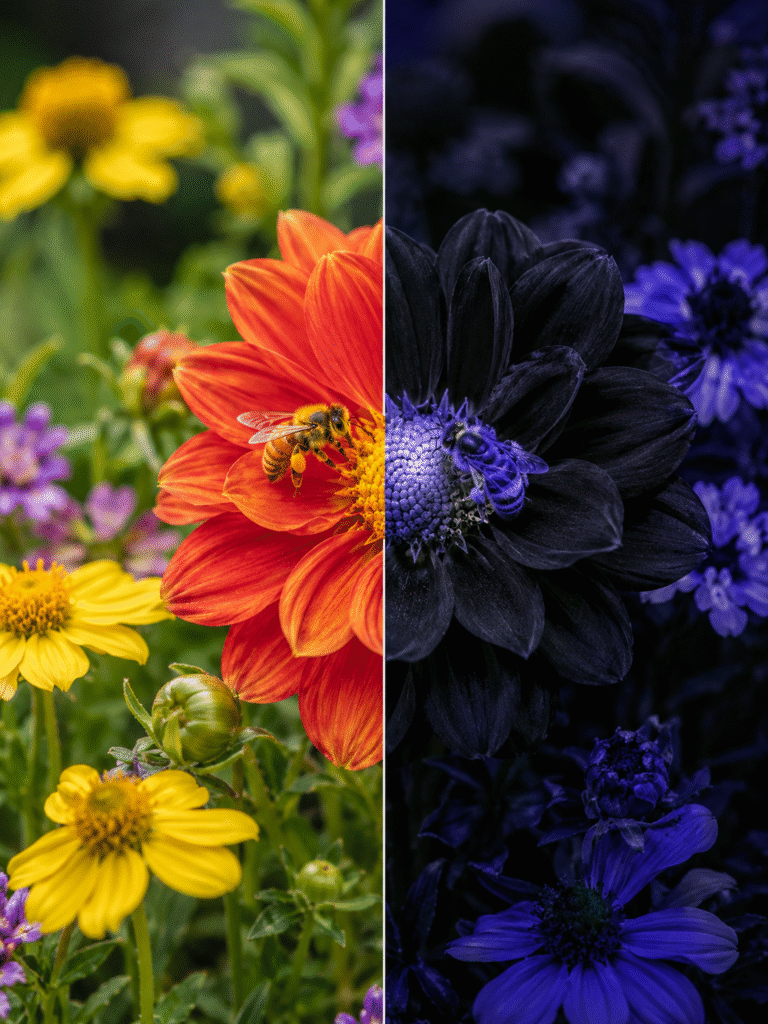
Human color vision and bee color vision aren’t just shifted versions of each other. They actually diverge at both ends of the spectrum, and I think this is the detail that gets lost when people summarize this topic as “bees can see UV, isn’t that neat.” Yes, bees can perceive ultraviolet wavelengths that are completely invisible to us — our eyes’ lenses physically block UV light before it ever reaches the retina, so this isn’t a matter of untrained perception, it’s a hard biological ceiling. But at the other end, bees are essentially blind to red. A red flower that looks brilliant and saturated to a human eye often registers to a bee as dark, flat, and low-contrast — sometimes close to black.
That’s not a minor footnote. It reshapes an entire category of plant breeding decisions that were made for human eyes, not pollinator eyes. Red flowering varieties bred for garden appeal frequently perform worse for pollinator visitation than the exact same species in its wild-type yellow, blue, or purple form — and it’s not because bees have bad taste. They may genuinely be foraging half-blind on those blooms, relying on shape and scent rather than color contrast to find them at all.
I’ve started testing this informally in my own beds over the past two seasons — not a controlled trial by any stretch, just an attentive beekeeper with a notebook — and the pattern holds up embarrassingly well against my dahlia bed. The reddest cultivars get the least forager traffic of anything I grow, consistently, across varying weather and bloom timing. It’s not proof of anything on its own, but it lines up exactly with what the vision research predicts.
The Pattern Hiding in Plain Sight
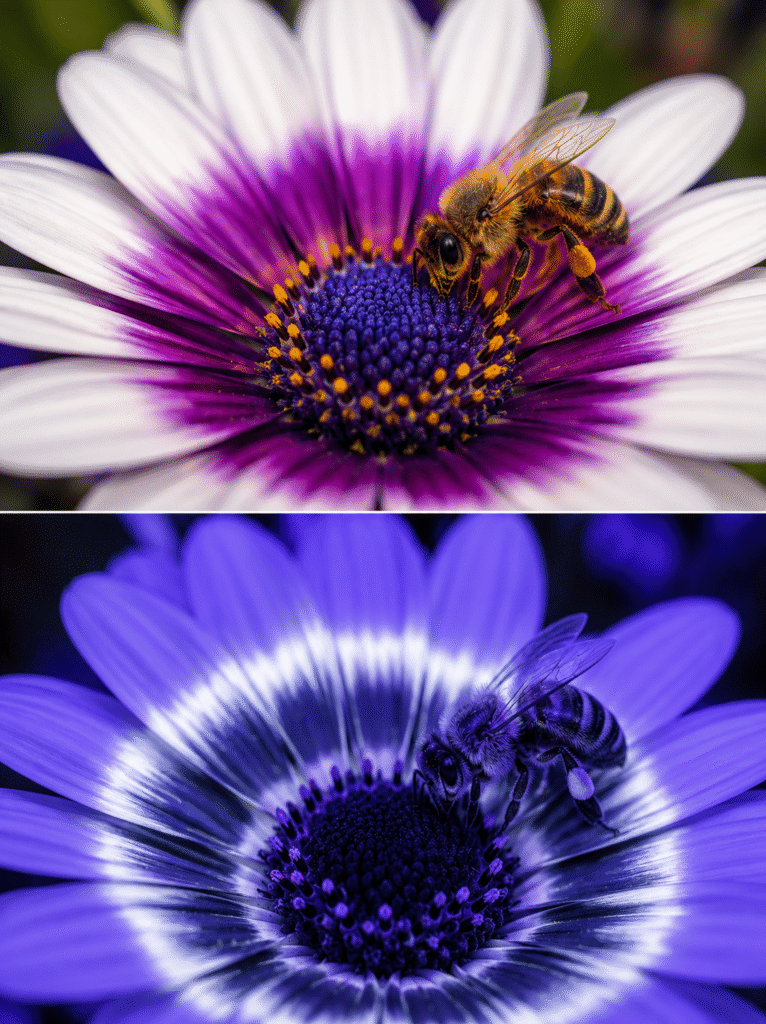
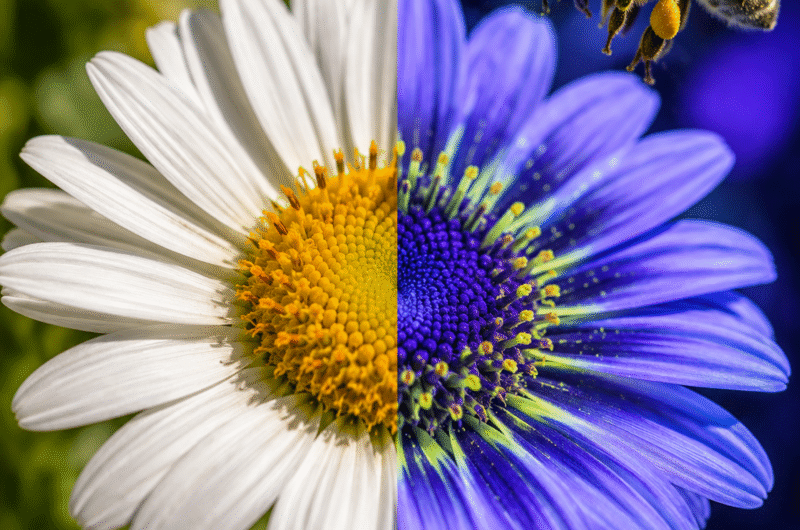
Here’s where it gets genuinely strange, and where a recent academic review — published in 2025 in the journal Plant Biology by researchers including Klaus Lunau at Heinrich Heine University in Düsseldorf — pulled together decades of scattered findings into one clear picture. Many flowers have UV reflectance and absorption patterns built directly into their petals: rings, radiating lines, and sectors that are completely invisible to us but create strong visual contrast for a bee. Researchers sometimes call the most common version of this the UV “bullseye” — a pattern where the outer petal reflects UV light while the center, right around the nectar and pollen, absorbs it, creating a dark target sitting inside a bright field.
Think about what that means practically. A flower isn’t just advertising “here I am” with its overall color the way we perceive it. It’s often running a second, invisible layer of signage that says “land here, specifically,” pointed directly at the reward. We’ve been looking at flowers for centuries assuming we were seeing the whole advertisement. We’ve only ever been seeing half of it — the half aimed at us, essentially by accident, rather than the half actually aimed at the pollinators these plants evolved alongside.
The review paper is careful to point out something I think matters for how we talk about this: UV isn’t processed by bees as some separate, bolted-on signal. It’s simply one component of their overall color vision, woven into how they perceive hue the same way blue or green wavelengths are for us. We tend to talk about “bee UV vision” like it’s a special power, a night-vision-goggles kind of upgrade layered on top of normal sight. It isn’t an add-on. It’s just part of ordinary bee color perception, the same way seeing green is just part of ordinary human color perception. The extraordinary part is entirely on our side of the comparison — we’re the ones missing a channel, not them.
What This Looked Like Before Anyone Believed It
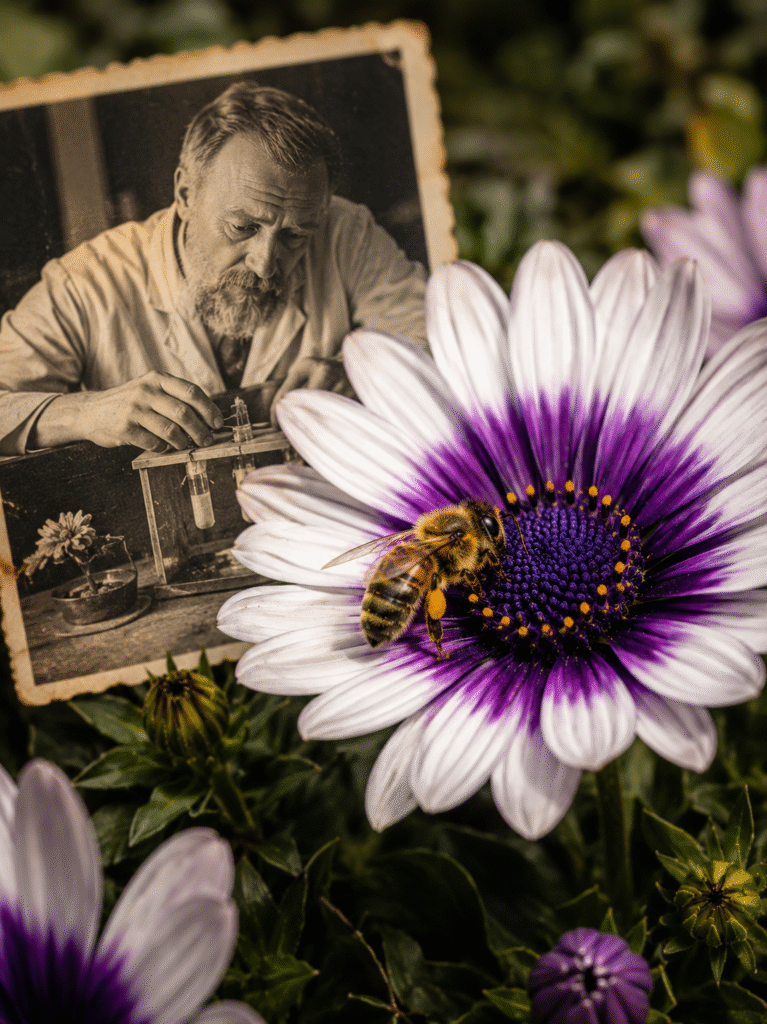
It’s worth remembering how contested this whole idea used to be. The foundational work tracing back to Karl von Frisch — the same researcher, incidentally, who later decoded the waggle dance — ran experiments in the 1910s training bees to associate specific colors with food rewards. At the time, the standard scientific position was that insects were essentially color-blind, operating purely on brightness and contrast. Von Frisch’s results were initially dismissed. It took repeated, careful replication before the field accepted that bees weren’t just detecting light and dark — they were seeing color, remembering it, and using it to make foraging decisions, decades before anyone had the tools to photograph what a UV flower pattern actually looked like.
I bring this up because it’s a useful reminder that “obvious once you know it” science usually wasn’t obvious at all on the way in. Von Frisch spent years being doubted on a claim that today gets summarized in a single sentence in a gardening blog.
What This Actually Means for Your Garden and Your Hives
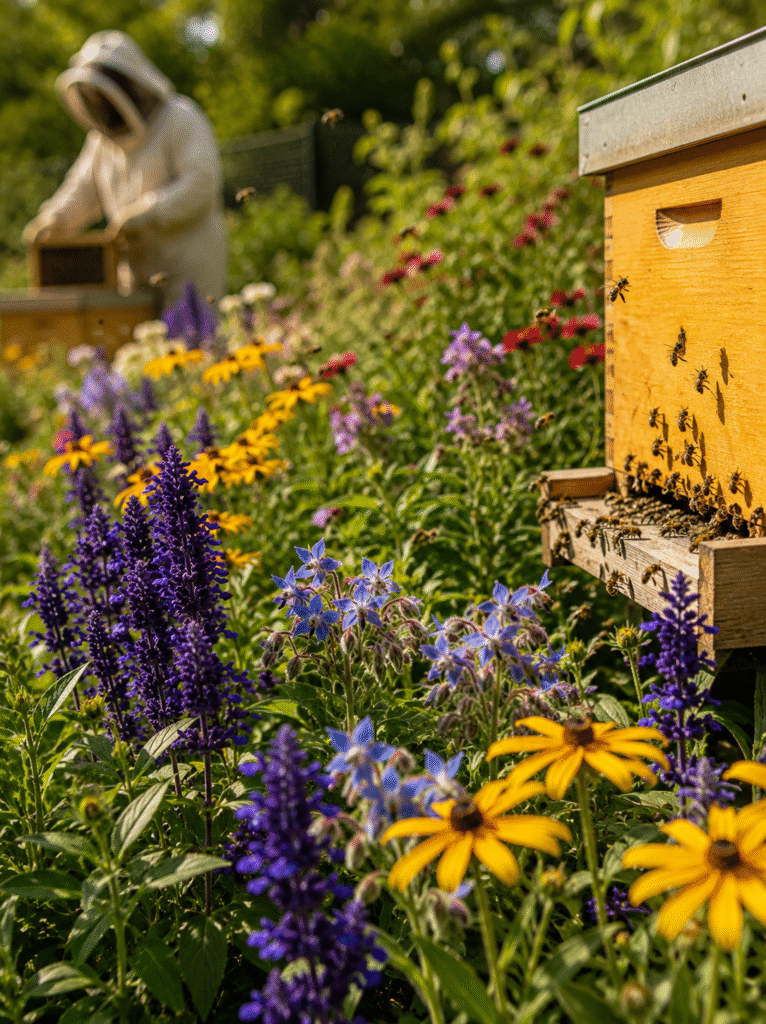
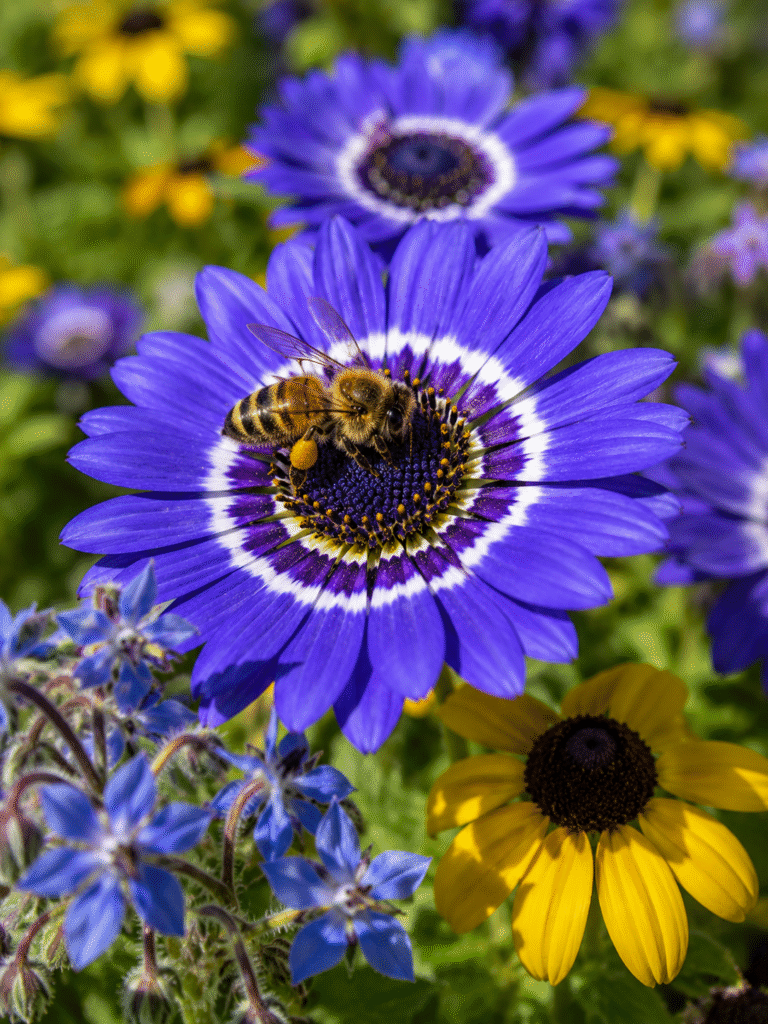
If you keep bees, or you’re planting for them, this isn’t just a neat piece of trivia — it has a direct, practical application. When you’re choosing pollinator-forward plants, color choice matters in a way that goes beyond simple aesthetic preference. Blues, purples, and yellows tend to register with strong contrast in bee vision and are generally reliable performers for pollinator traffic. Reds are the category to be skeptical of — not useless, since shape and scent still do real work, but they’re carrying a handicap that a blue salvia or a patch of borage simply doesn’t have.
For hive placement, I’d stop short of overstating this — bees will forage on a red flower if it’s the only food source around for a mile, and scent and nectar reward ultimately still drive the bulk of foraging decisions. But when you’re designing a border specifically to pull foragers in in a garden with lots of competing options, betting on high-UV-contrast color families over red cultivars is a small, evidence-backed edge, not just a guess.
Frequently Asked Questions
Can bees see the color red? Not really — red typically appears dark, flat, or black to bees, since their photoreceptors aren’t tuned to that end of the spectrum the way ours are.
How many eyes does a honey bee have? Five total: two large compound eyes that handle most of the visual work, plus three small simple eyes called ocelli on top of the head, mainly used for light-level detection.
Do all flowers have UV patterns? No. Only some species have evolved visible-to-bee UV nectar guide patterns — it varies significantly depending on the plant’s pollination strategy and evolutionary history.
Can humans see UV flower patterns at all with the naked eye? No — the human lens physically blocks UV wavelengths before they reach the retina. Seeing these patterns requires a modified UV-sensitive camera.
Does this affect what I should plant for pollinators? Yes, to a meaningful degree. Blue, purple, and yellow flowers generally register with stronger contrast in bee vision than red ones, making them a more reliable foraging draw when color options are being weighed.
The Takeaway
What strikes me most, standing in my own garden watching this play out season after season, is how much of what I assumed was bee “preference” was really just a hardware gap between their eyes and mine. My dahlias aren’t unloved because my bees have bad taste. They may simply be foraging on a flower that looks, to them, like it’s missing most of its advertisement. There’s a version of my garden I will genuinely never be able to see — one lit up in ultraviolet bullseyes and contrast patterns built for an audience that isn’t me. Every beekeeper eventually has to make peace with the fact that their bees are experiencing the same physical world through a genuinely different set of rules. This is one of the clearest, most measurable examples of exactly how different those rules really are.