
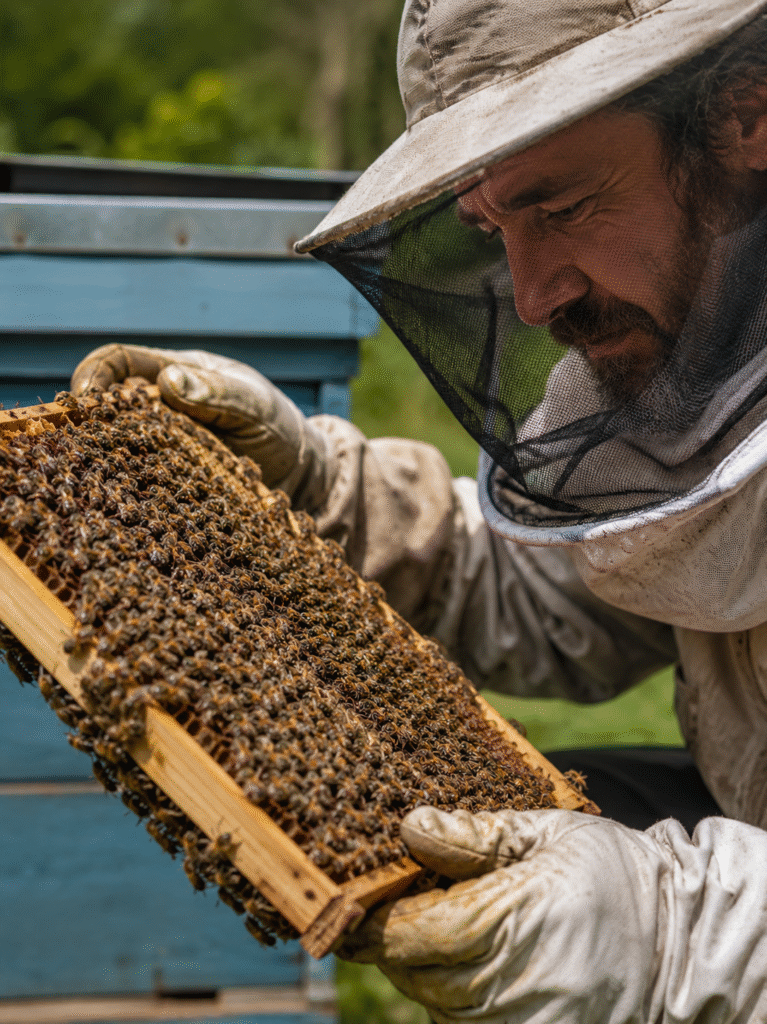
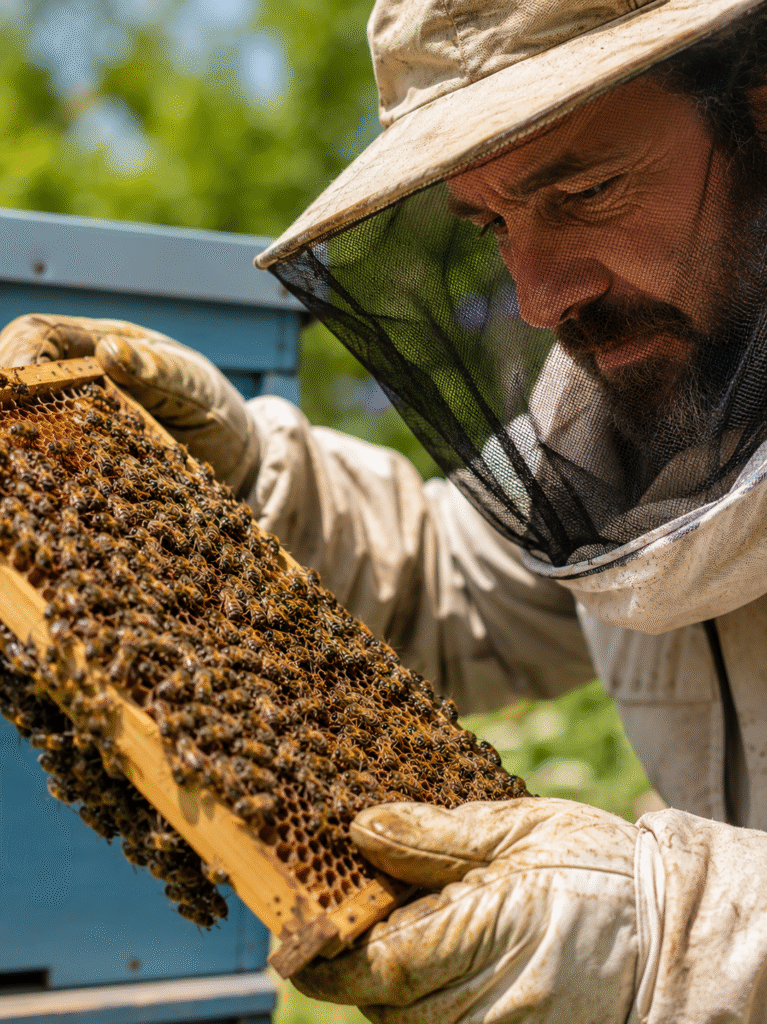
I’ve been stung by strangers and ignored by my own bees. That sentence sounds like a joke, but it’s the closest thing I have to a controlled experiment from twenty-some years of hive work. Visitors who tag along on inspections — friends, neighbors, the occasional nervous journalist — get bumped, buzzed, and sometimes stung within the first ten minutes. I get bumped too, plenty of times. But the pattern of how my colonies respond to me versus a stranger has always felt different, and for years I chalked it up to smell, or steadier hands, or just experience reading a colony’s mood before it boils over.
Turns out I might have been half right and half wrong. The smell and steady hands part, probably true. But there’s a second layer to this that has nothing to do with pheromones or technique, and everything to do with something almost nobody expects from an insect: bees can learn to tell human faces apart.
The Experiment Nobody Believed at First
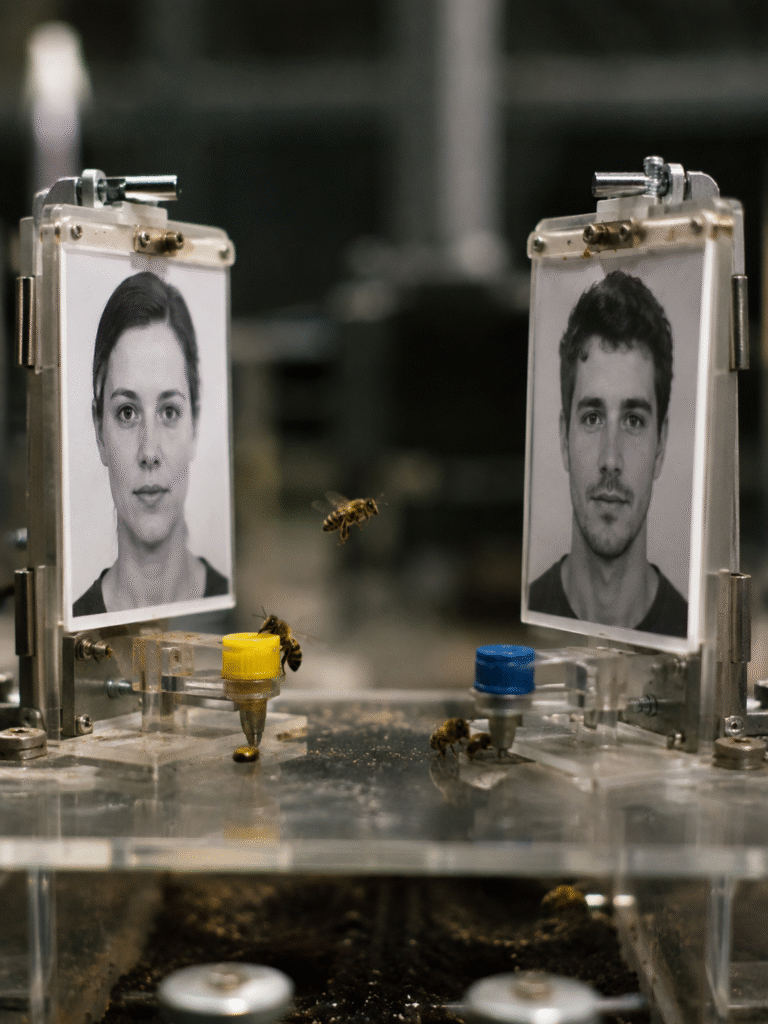
The core finding here isn’t brand new — it dates back to a 2005 study out of a research collaboration involving Adrian Dyer, then working between Cambridge and a German university lab, along with colleagues Christa Neumeyer and Lars Chittka. What’s new is how often this study keeps resurfacing in science coverage, most recently again this year, because it keeps holding up under scrutiny and keeps surprising people who hear about it for the first time.
Here’s what the researchers actually did, stripped of the jargon. They pinned up photographs of human faces — cropped tight to just the face and neck so bees couldn’t cheat by using clothing or hair as a shortcut — and trained individual bees to associate one specific face with a drop of sugar water. A different face got paired with a bitter quinine solution instead. Bees are relentless when sugar is on the line, and over repeated trials, individual foragers learned to fly toward the “sweet” face and avoid the “bitter” one.
The part that convinced skeptics wasn’t the training phase — animals get trained to do all sorts of things for food. It was the test phase, where researchers removed the reward entirely and just presented both faces side by side. If the bees were only following leftover scent trails or some other shortcut, they’d have no reason to prefer one photo over the other once the sugar was gone. They kept picking the trained face anyway, at rates researchers have since replicated closer to 80-90% accuracy. That’s not luck. That’s memory.
How a Brain Smaller Than a Sesame Seed Does This
This is where I have to be honest about something that used to needle me every time I read about insect cognition studies: the comparison to human face recognition always felt like a stretch. We have a dedicated piece of brain real estate — the fusiform gyrus — that lights up specifically when we look at faces. It’s a specialized circuit, arguably purpose-built by evolution for exactly this task, because recognizing individual humans mattered enormously for our ancestors’ survival.
A honey bee has none of that. Its entire brain contains something in the neighborhood of 960,000 neurons packed into a volume smaller than a grain of rice. Compare that to roughly 86 billion neurons in a human brain, and you’re looking at a difference of something like four orders of magnitude. There’s no evolutionary reason a bee would ever need to recognize a human face — we didn’t exist as a selection pressure for millions of years of bee evolution.
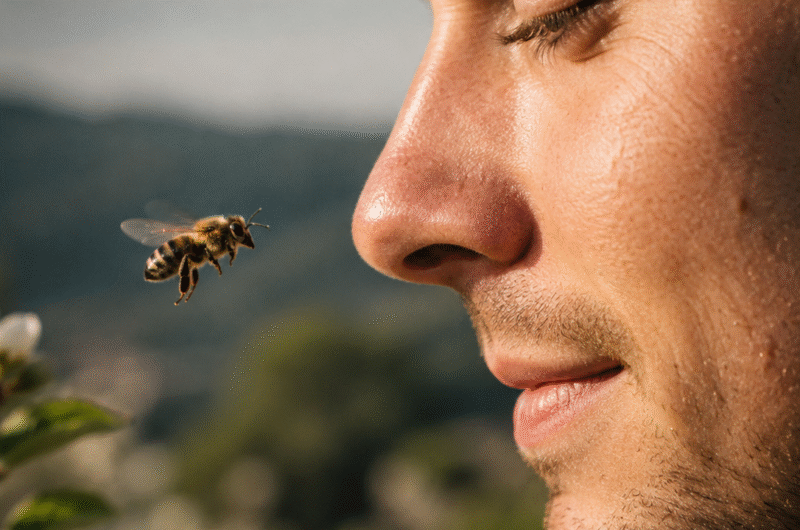
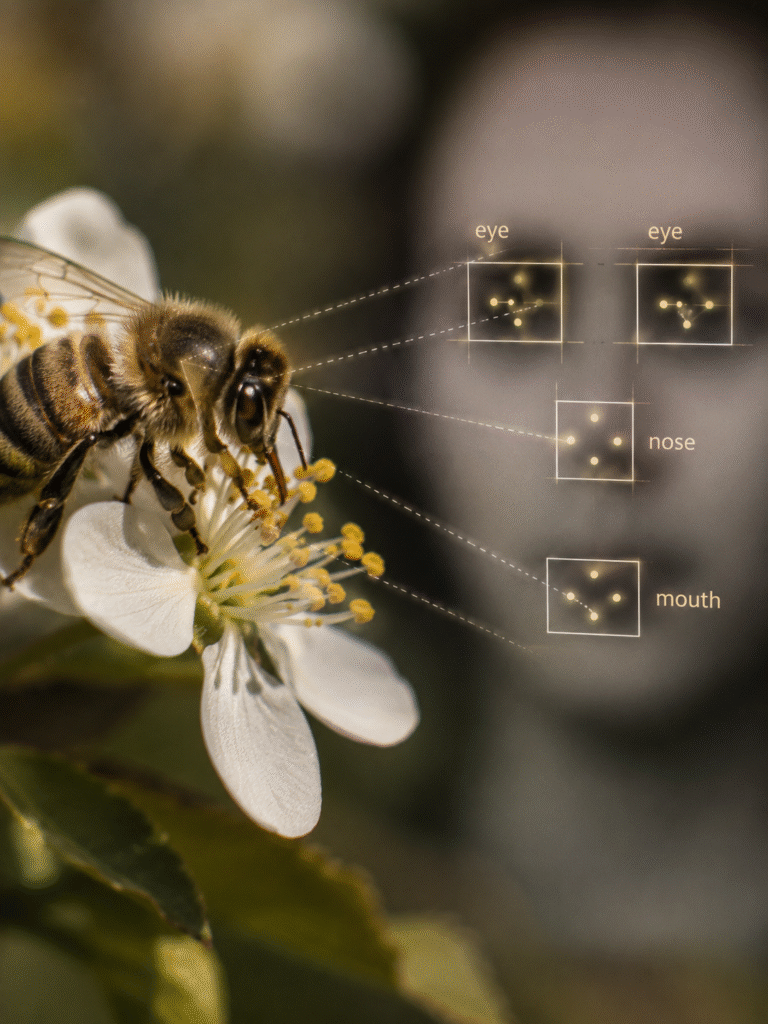
So how does it manage the task at all? The leading explanation is something researchers call configural processing — essentially, learning the arrangement of features relative to each other rather than memorizing a face as a holistic image the way we do. Eyes here, nose there, mouth below that, spaced in a particular way. It’s a cruder strategy than what our brains run, but it turns out to be good enough to distinguish one face from another with real reliability. In a strange way, it’s the same principle bees already use on flowers: shape, symmetry, and the spatial relationship between petals and center. A human face, to a bee, may just be an unusually shaped flower with the reward hidden somewhere in a familiar arrangement of dark and light patches.
I find that reframing oddly humbling. We like to think our faces are uniquely, irreducibly us. To a bee, my face might register as something closer to a distinctive bloom pattern it’s learned to associate with either sugar or trouble.
Does This Mean My Bees Actually Recognize Me?
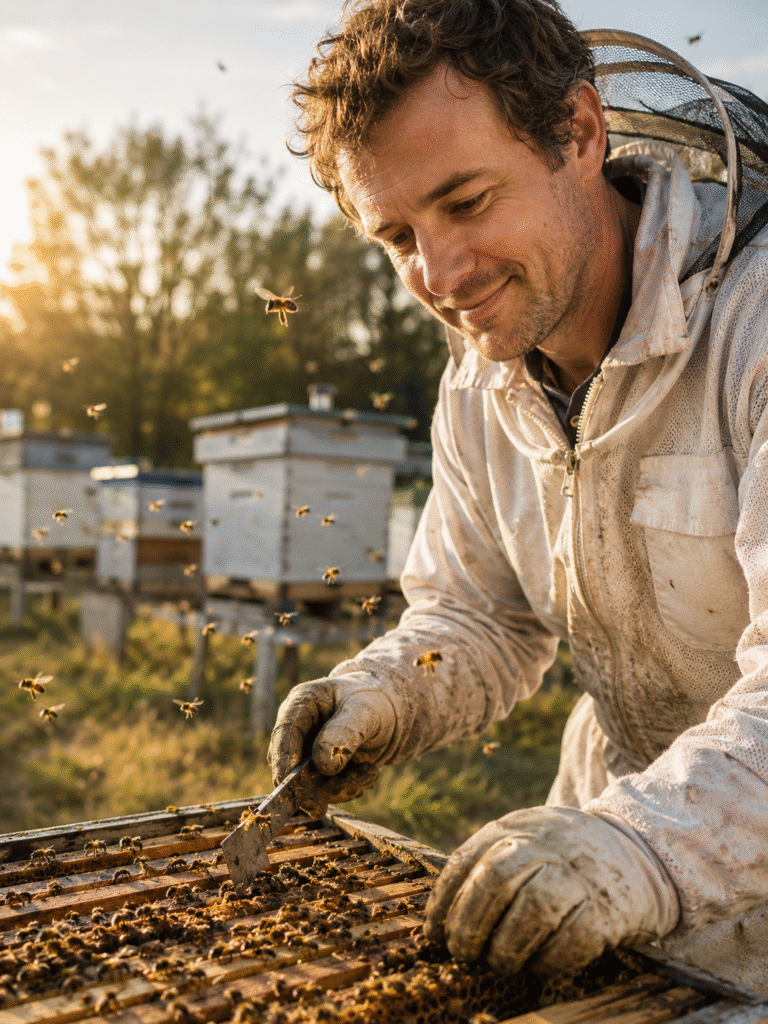
This is the question every beekeeper eventually asks once they hear about this research, and I want to be careful here, because it’s easy to overclaim. The lab study used sugar-reward training under controlled conditions with cropped, standardized photographs. My bees have never been trained that way, and nobody has run a rigorous field study isolating “recognizes the beekeeper’s face” from all the other cues present during a real hive inspection — scent, vibration, the rhythm of movement, the particular way I hold a hive tool.
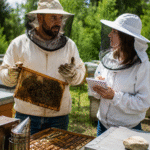
What I can tell you is what I’ve watched happen across dozens of hives over many seasons. Colonies that see me regularly, at consistent times, wearing roughly the same gear, tend to settle faster during inspections than they do for an unfamiliar handler doing the exact same movements. I’ve had beekeeping students shadow me — same suit, same smoker technique I coached them on beforehand — and still get a noticeably more defensive response than I do working the same box ten minutes later. Something is different, and it’s not the smoke, because I controlled for that.
Is it my face specifically? Honestly, I doubt it’s doing the work alone. My working theory, and I stress this is field observation rather than published data, is that face recognition is one thread in a larger rope of familiarity cues — scent from my hands and gear, my gait, the timing and duration of my visits, even the particular way I breathe near the entrance (calm breathing versus the shallow, nervous breathing of someone who’s never opened a hive before bees seem to pick up on, possibly through vibration or exhaled CO2 patterns). Face recognition might be a real contributor sitting quietly inside that bundle rather than the star of the show. But knowing it’s even a plausible contributor changes how I think about training new beekeepers — consistency in visits, not just technique, may matter more than we’ve been telling people.
What Other Animals Are Doing This Too
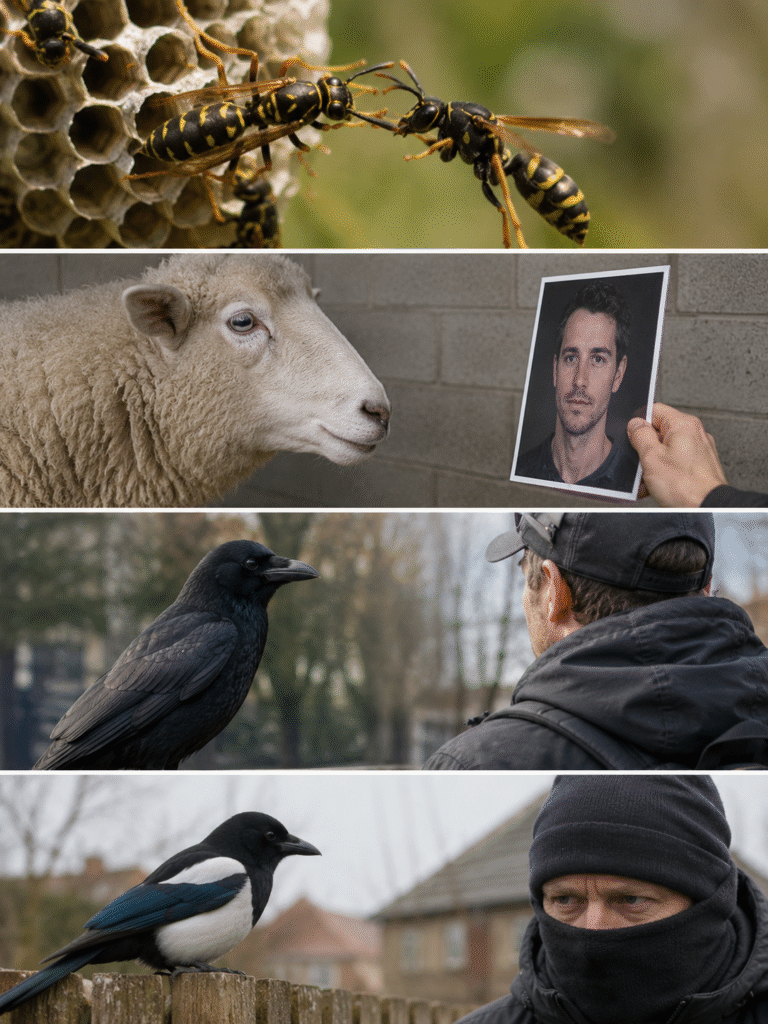
Bees aren’t alone in this, and the comparison is worth making because it reframes what “small brain” actually means as a limitation. Certain paper wasp species — Polistes, specifically — recognize individual faces of other wasps within their own colonies, which they use to track social hierarchy and avoid repeated conflicts with wasps they’ve already lost fights to. Sheep have been shown to recognize individual human faces from photographs and remember them for years. Crows and magpies are well documented holding grudges against specific individual humans who’ve wronged them, sometimes passing that recognition on to other birds in the flock who never witnessed the original offense.
The common thread across all of these examples is that specialized “face brain hardware” isn’t actually required to do sophisticated individual recognition. It’s a software problem more than a hardware problem, and evolution seems to have found several independent routes to solving it whenever the payoff — avoiding a fight, remembering a threat, finding a reward — justifies the investment.
Why This Actually Matters Beyond the Trivia Value
It would be easy to file this under “fun fact” and move on, but I think it has real implications for how we think about animal intelligence generally, and for beekeeping specifically.
For the broader question of animal cognition, this research keeps chipping away at an assumption that’s held on far longer than it deserves: that complex cognitive tasks require complex, specialized brain architecture. A bee brain running on less than a millionth of the neurons a human brain has can still pull off a task we assumed required a dedicated processing region. That should make us more curious, not less, about what other “simple” organisms might be quietly capable of.
For beekeeping, I think the practical takeaway is this: familiarity is not a soft, unmeasurable thing you either have or don’t with a colony. It’s built through repetition — the same face, the same scent, the same rhythm, visit after visit. New beekeepers sometimes treat every inspection as an isolated event, gearing up differently, moving erratically because they’re nervous, rotating who handles the colony. If there’s even a partial contribution from facial familiarity sitting inside that bundle of recognition cues, then part of “reading” a hive is also being read by it — and that argues for keeping the same person on a colony consistently, especially with a new or particularly defensive hive, rather than rotating handlers early on.
Frequently Asked Questions
Can bees really recognize individual human faces? Yes — peer-reviewed research from 2005, replicated in follow-up work since, shows bees trained with sugar rewards can distinguish and remember specific human faces for at least several days after training.
Does this mean my bees recognize me as their beekeeper? Likely as one factor among several. Many experienced beekeepers, myself included, observe calmer colony behavior around a familiar, regularly present handler, but this hasn’t been formally isolated from scent, movement, and timing cues in field conditions.
How can an insect with such a tiny brain do this? Bees appear to use configural processing — reading the spatial arrangement of features rather than holistic image memory. It’s a simpler strategy than the human brain’s dedicated face-processing circuitry, but effective enough for reliable individual discrimination.
Is this the same as facial recognition software? Conceptually related — both rely on pattern matching — but bees are using trained visual memory built through reward association, not algorithmic feature-mapping.
Do other insects recognize faces too? Yes. Certain paper wasp species (genus Polistes) recognize individual faces of colony-mates for social hierarchy tracking, a separate but related line of research.
The Takeaway
I opened this piece with a joke about strangers getting stung more than I do. I’m not going to pretend the research hands me a clean explanation for that pattern — the honest answer is that it’s probably a combination of things, and face recognition may be a smaller piece of that puzzle than I’d like to claim for the sake of a tidy story. But it’s a real piece, backed by real, repeated experimental results, and that alone is worth sitting with. An insect with a brain smaller than a poppy seed can look at a photograph and remember which one meant something good and which one meant something bitter. However familiar you already are with these creatures, that’s worth a second look every time.