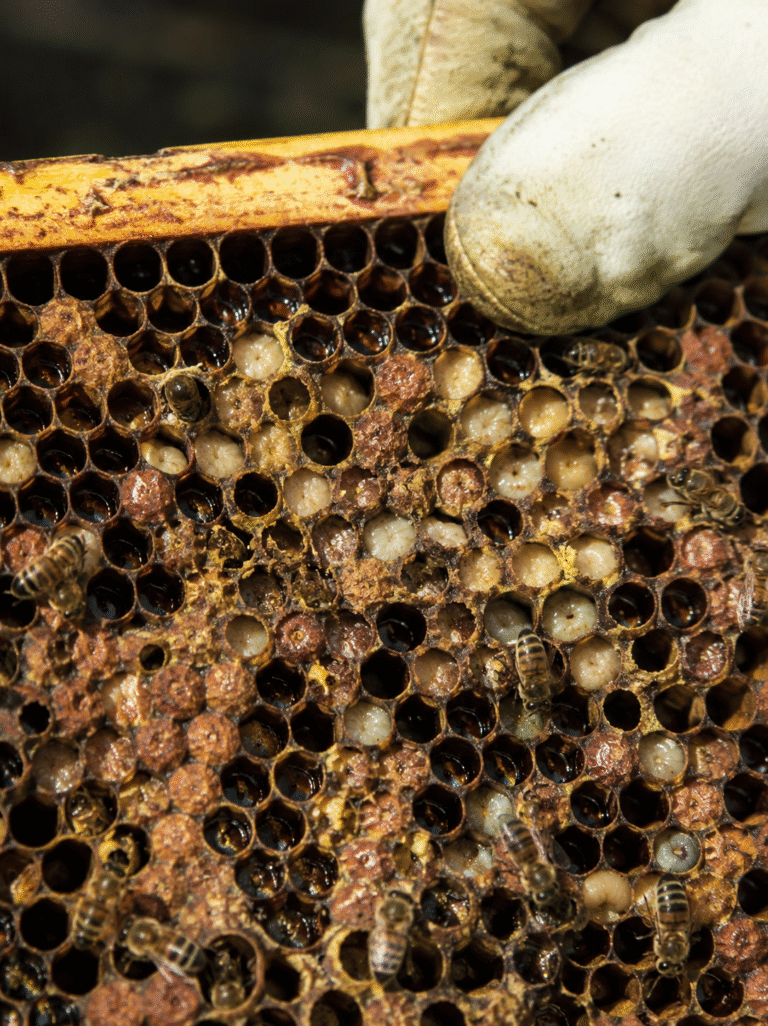
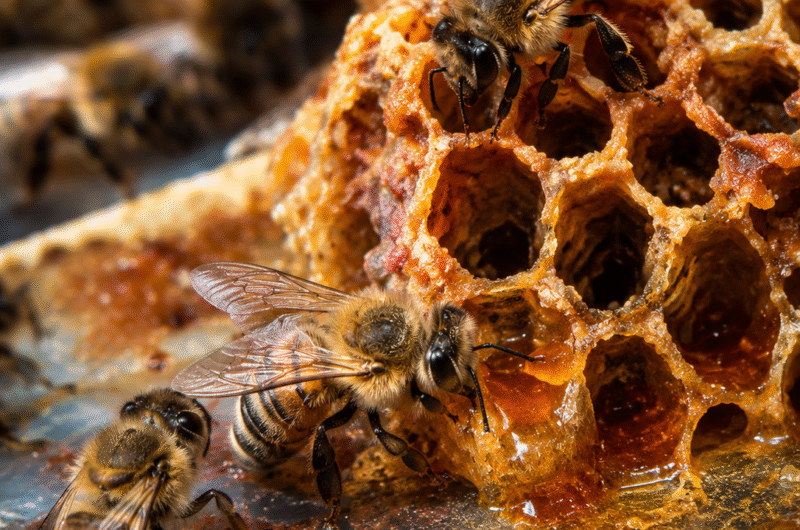

If you’d told me a decade ago that bees might, under the right conditions, choose to eat food carrying a virus over food that’s clean, I’d have laughed you out of the bee yard. Every instinct I’ve built inspecting hives says the opposite should be true — bees are meticulous, almost obsessive, about cleanliness. Workers haul out dead brood within hours. Propolis gets smeared into every crack like a colony-wide disinfectant program. The whole operation runs on hygiene.
So when I read the new study out of LSU and the USDA’s bee research lab in Baton Rouge, I did what I always do with a claim that contradicts twenty years of field experience — I went looking for the holes in it. I didn’t find any. What I found instead was a much stranger, more interesting explanation than “bees are careless.”
An Experiment That Wasn’t Supposed to Be Interesting
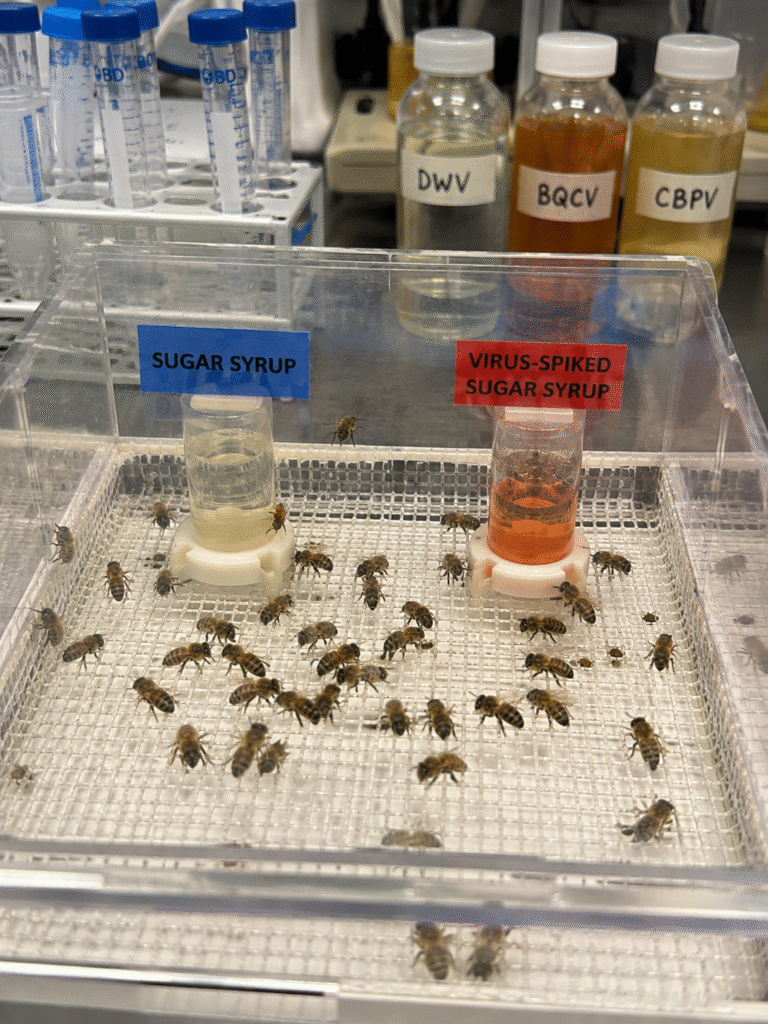
Here’s the part I appreciate as someone who’s spent plenty of time around agricultural research: this study started as a simple teaching exercise. According to Joseph McCarthy, an extension associate at the LSU AgCenter, the original goal was just to give a student some hands-on experience running a basic choice test — offer bees two food sources, one plain and one spiked with virus, and see which they picked. Nobody expected a headline out of it.
That’s worth sitting with for a second, because it’s a good reminder that some of the most useful findings in bee science don’t come from massive, well-funded initiatives chasing a hypothesis. They come from somebody actually watching what the bees do, carefully, without assuming they already know the answer. I’ve had a few of my own “huh, that’s not what I expected” moments over the years watching colonies behave in ways that didn’t match the textbook, and most of them turned out to be worth investigating rather than dismissing.
The setup itself was straightforward. Researchers placed nurse bees — young workers whose job includes feeding larvae and, relevant here, tending to other bees — into cages, each with two feeders. One held plain sugar syrup. The other held syrup spiked with purified extracts of viruses known to plague honeybee colonies: Deformed Wing Virus, Black Queen Cell Virus, and Chronic Bee Paralysis Virus. Then they watched which feeder the bees actually used, and tracked survival alongside it.
The Result Nobody Predicted
In summer trials, the bees behaved the way you’d expect: they generally preferred the clean sugar solution. Sensible. Predictable. The kind of result that confirms what you already believed and lets you move on.
Then they ran the same test in the fall — and the preference flipped. Bees showed a clear, statistically significant preference for the virus-contaminated food. Not a shrug, not a coin-flip split. A real preference, in the opposite direction of what basic hygiene instincts would suggest.
I want to be precise about what this does and doesn’t mean, because I’ve already seen this get oversimplified in a few places I follow. This isn’t bees being reckless or ignoring an obvious danger. Something about the fall season itself was changing the bees’ relationship to that virus-laced food, and changing it enough to reverse their behavior entirely.
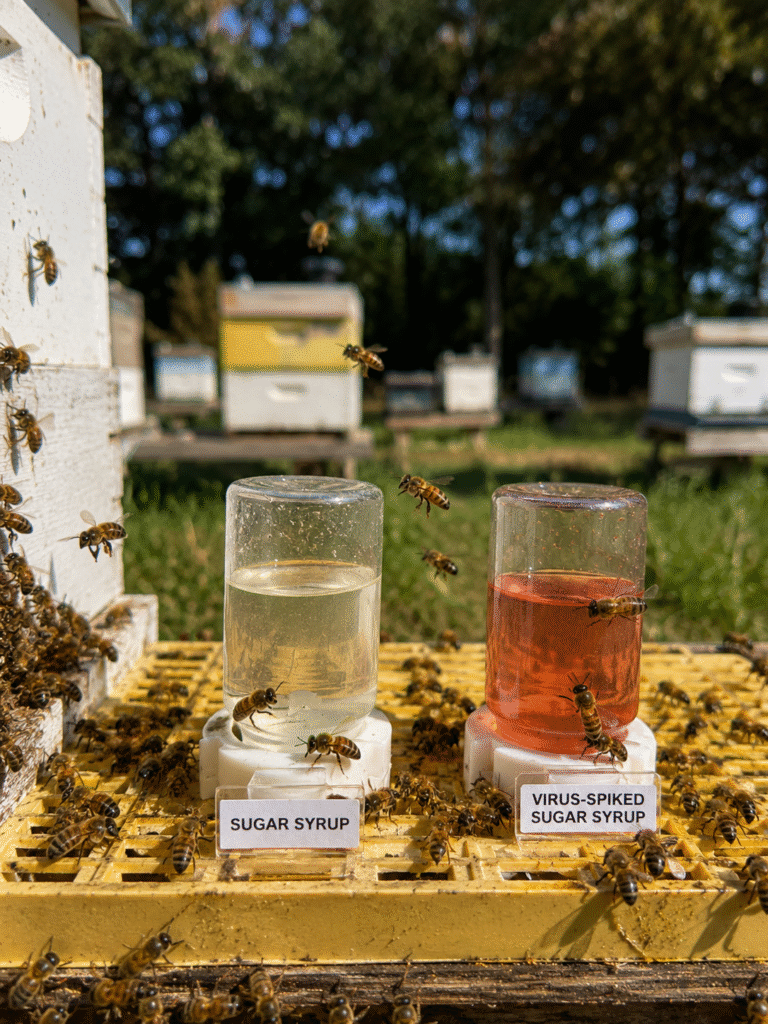
The team then took the experiment out of the cage and into the field, running choice tests at an actual apiary near Baton Rouge managed by USDA-ARS researchers, with roughly thirty working colonies. That matters to me more than the cage results, honestly. Cage experiments are useful for control, but bees in cages aren’t living real colony life — no foraging pressure, no seasonal brood cycle stress, no competition for resources. Getting a matching signal out in a working apiary, across two different seasonal trials roughly six months apart, tells you this isn’t some artifact of an artificial lab setup. It’s a real seasonal shift in how nurse bees relate to contaminated food.
My Best Guess at Why — and Why It Matters
Nobody has nailed down the exact mechanism yet, and I’d be doing you a disservice if I pretended otherwise. But having kept bees through enough autumns to have opinions about what’s different biologically at that time of year, I have a theory worth putting on the table.
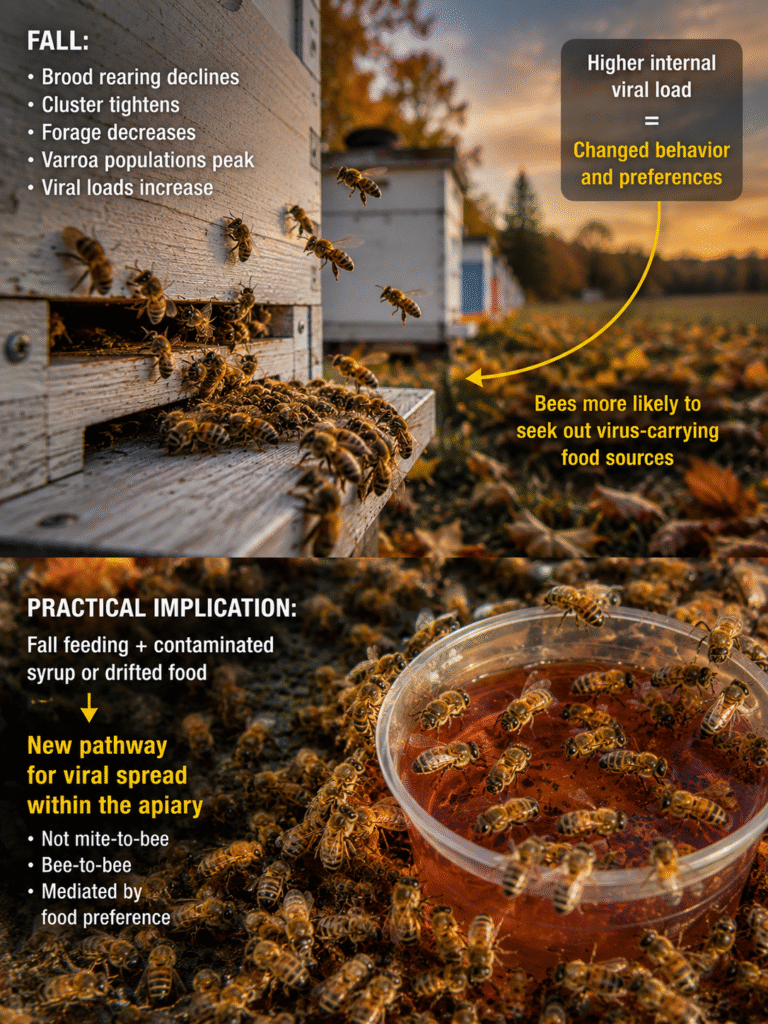
Fall is when colonies are winding down brood production, tightening the cluster, and preparing for a long stretch with far less access to fresh forage. It’s also, not coincidentally, when viral loads inside colonies tend to climb — Varroa mite populations peak going into fall in a lot of regions, and mites are one of the primary vehicles spreading these exact viruses between bees. If a colony’s overall viral burden is already higher in autumn, it’s plausible that individual bees are already carrying these viruses at meaningfully higher rates than they were in summer, and something about that internal viral load shifts how they respond to viral particles they encounter externally.
There’s a rougher parallel here to something beekeepers actually notice on the ground: bees behaving differently around drifting or robbing activity in fall versus summer. We already know colony behavior isn’t fixed year-round — foraging range changes, aggression levels change, tolerance for outside bees at the entrance changes. Adding “response to pathogen-contaminated food” to that list of seasonally shifting behaviors isn’t a stretch. It’s consistent with how much else about a colony’s psychology, if I can use that word loosely, changes across the year.
Why would that matter practically? Because if nurse bees are more likely to seek out — not just tolerate, but actually prefer — virus-carrying food sources in fall, that has direct implications for anyone managing fall feeding programs. A lot of commercial and hobbyist operations ramp up syrup feeding in autumn to build winter stores. If contaminated forage or drifted food from a weaker, more heavily infected neighboring colony is in the mix at that exact moment when bees are behaviorally primed to prefer it, you’ve got a plausible new pathway for viral spread inside an apiary that has nothing to do with mites directly transmitting the virus mite-to-bee. It’s bee-to-bee, mediated by a preference nobody knew existed until this spring.
Flowers as an Overlooked Middleman
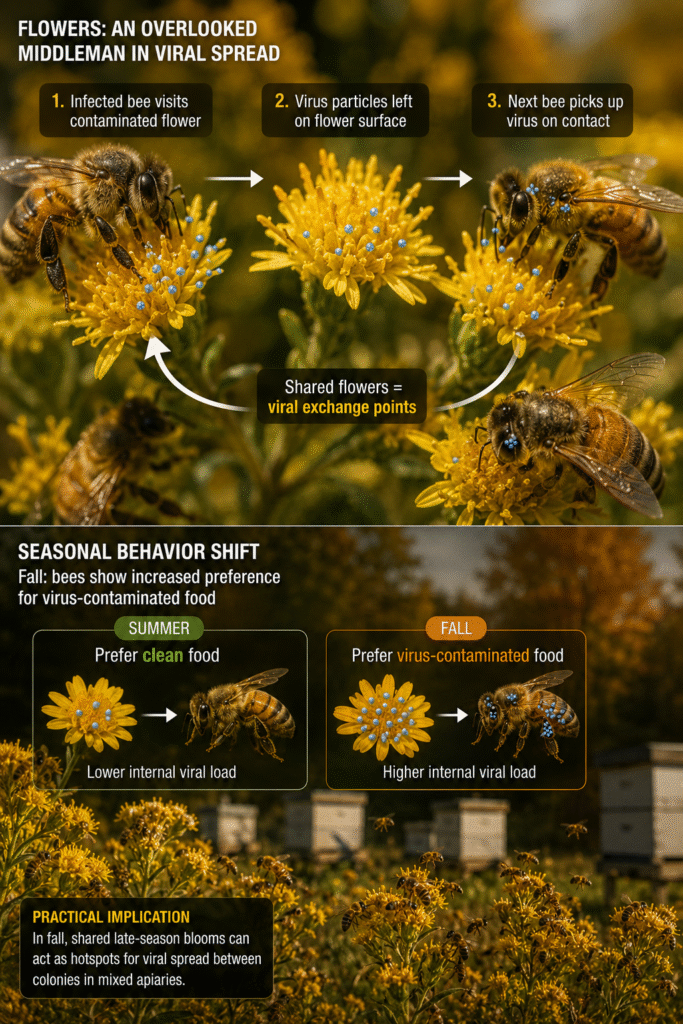
One detail from the research deserves its own attention: viruses like Deformed Wing Virus don’t just move through direct contact or mite bites. Contaminated flowers can act as a transfer point, picking up viral particles from an infected bee’s visit and passing them along to the next bee that lands there. It’s the same basic transmission logic as a shared drinking glass, except the “glass” is a blossom, and it’s sitting in a garden or field with foraging traffic all day long.
Combine that with the seasonal preference finding, and you get a slightly unsettling picture: in the fall, bees may not just be tolerating occasional exposure to viral particles on shared flowers — they may be more drawn to that exposure than usual. That’s the kind of detail that changes how I think about mixed apiaries in the fall, where multiple beekeepers’ colonies are working the same limited late-season bloom. A shared patch of goldenrod or aster in October isn’t just a food source colonies are competing over. It might be a viral exchange point that’s more active than it would be in June, precisely because of a behavioral shift nobody had documented before this study.
What I’m Actually Going to Do Differently
I don’t think this finding demands panic or a complete overhaul of fall management. But it has changed a few small things in how I think about the season.
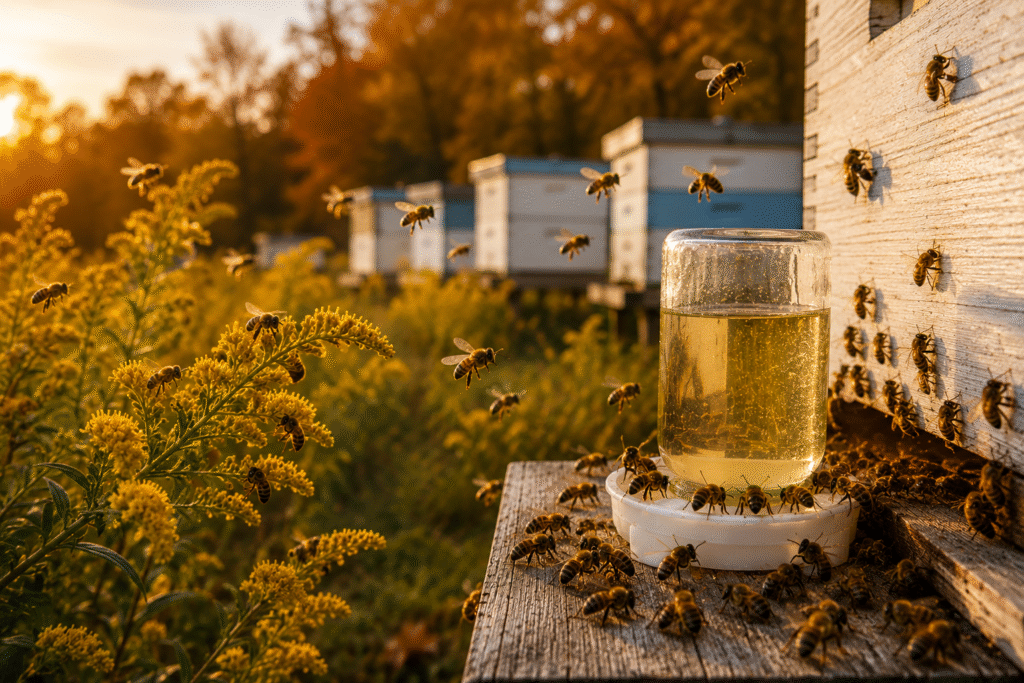
I’m paying closer attention to Varroa treatment timing relative to fall feeding, on the logic that keeping viral load down going into autumn matters more if bees are behaviorally leaning toward contaminated food sources rather than away from them. I’m also a little more cautious about placing feeders near dense late-season bloom where drifting and robbing pressure from neighboring, possibly weaker colonies is highest — not because I think one feeding will cause a disaster, but because this study gives me a concrete reason to treat fall as a season where pathogen exposure risk isn’t just about mite counts.
Mostly, though, this study earns a place on my shelf of “things that remind me how little we actually understand about bee behavior, even after all this time.” I’ve read a lot of papers over the years that confirm what experienced beekeepers already suspected. This one didn’t. It handed researchers — and now the rest of us — a genuinely new, testable idea about how disease moves through a colony, discovered almost by accident, by people who were honest enough to follow a surprising result instead of explaining it away.
That’s the kind of science worth watching closely as more research groups start testing whether this fall preference shows up in other regions, other virus combinations, and other bee subspecies. If it holds up broadly, “seasonal pathogen preference” might end up as its own line item in how we think about colony health management — right alongside mite counts and nosema loads, and just as invisible until someone bothers to look.
About the Study: Payne, A.N., McCarthy, J., Castillo, P., Diaz, A., Walsh, E.M., Simone-Finstrom, M. “Attraction versus avoidance: honeybees vary in response to virus-contaminated food.” Biology Letters, 22(4), 20250630 (2026). Research conducted by LSU AgCenter in collaboration with the USDA-ARS Honey Bee Breeding, Genetics & Physiology Research Unit, Baton Rouge, Louisiana.