
Found a swarm hanging in your yard? Here’s exactly how a 20-year beekeeper catches and rehives it safely — equipment, timing, and the mistakes that cost you the colony.
The first swarm I ever caught wasn’t even mine. It was a Saturday morning and my phone rang at 7 a.m. with a neighbor three streets over, half-whispering into the phone like the bees might overhear her, asking if I could “come get this thing off my fence before my husband sees it and loses his mind.” I grabbed an empty deep box, a bedsheet, and a pair of pruning shears, and twenty minutes later I was standing under a low hanging branch staring at roughly twenty thousand bees clustered into a single, surprisingly calm, football-shaped mass.
That calmness surprised me the most, and it surprises almost everyone the first time. A swarm in the open, with no hive to defend and no brood to protect, is one of the gentlest states a honey bee colony will ever be in. They’re full of honey from the trip, they have nothing to lose by being docile, and they’re essentially camping while scout bees go look for a permanent home. Knowing that changes how you approach the whole job.
Why Swarms Happen and What That Means for You
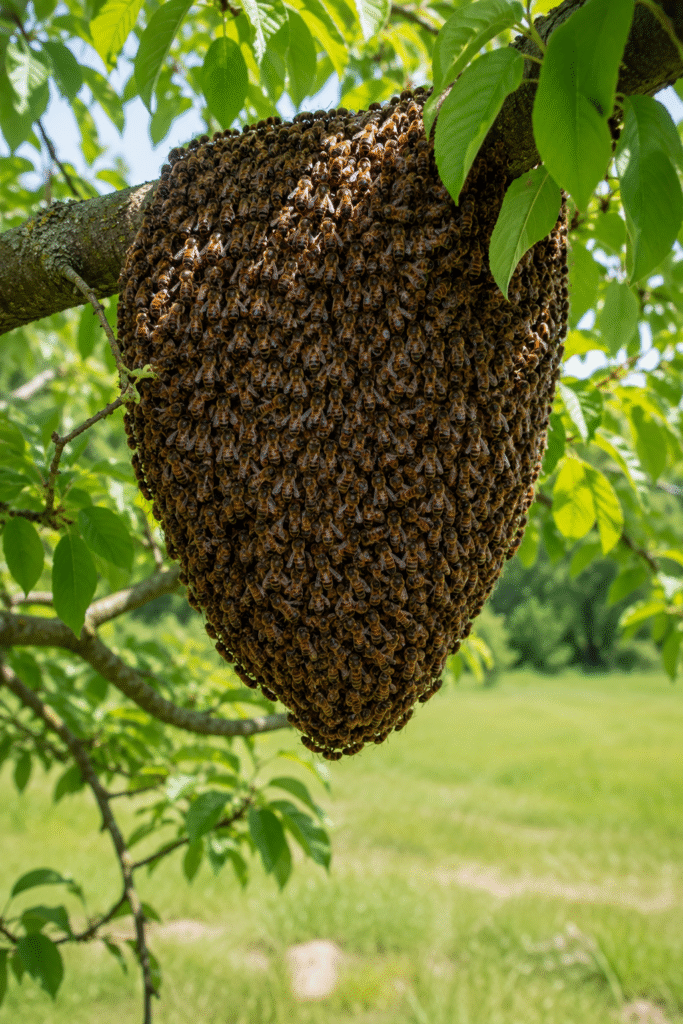
A swarm is a colony reproducing, not a colony failing. Somewhere nearby, there’s a parent hive that raised a new queen, and the old queen left with roughly half the workforce to go found a new colony elsewhere. That matters practically for two reasons. First, the swarm you’re looking at typically has a mated, laying queen already with it — she’s just not laying yet because there’s no comb to lay in. Second, the clock is running. Scout bees are actively searching for a cavity right now, and once they find one and reach consensus, the whole cluster can lift off and be gone in minutes. If you’ve found a swarm, you generally have somewhere between a few hours and two or three days before it relocates on its own, but you should never assume you have the longer end of that window.
What You Actually Need Before You Go
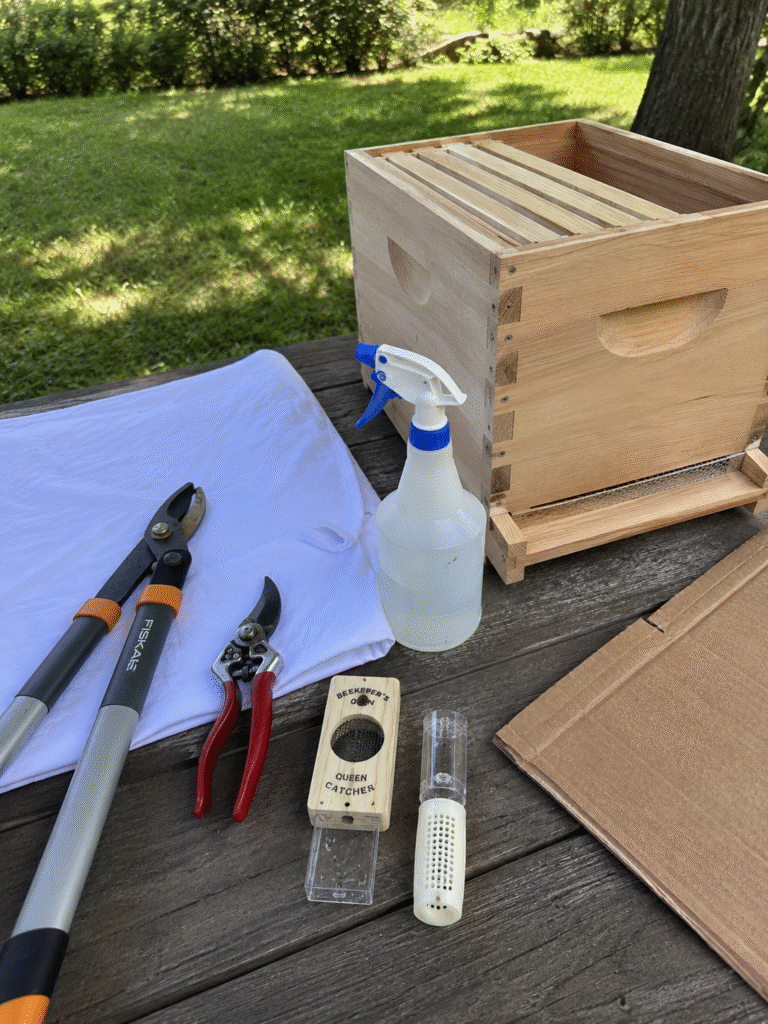
I’ve seen people try to improvise this with a cardboard box and a broom, and sometimes it works, but you’re playing the odds against yourself. Here’s the kit that’s worked for me on probably sixty captures over the years:
A cardboard nuc box or a five-frame deep works better than a full ten-frame box for the initial capture — it’s lighter, easier to position under a branch, and the bees seem to settle into a smaller dark space faster than a large empty one. A sturdy pruning shears or loppers, because you’ll often need to cut the branch the swarm is on rather than try to shake it loose. A spray bottle with plain water, which calms a cluster on contact far more reliably than smoke does for this particular job. A bedsheet or large piece of cardboard to lay underneath the cluster in case bees fall short of the box. And a queen catcher clip or a small travel cage, which isn’t strictly necessary but saves you a lot of grief if you do spot the queen and want to guarantee she goes in first.
Reading the Swarm Before You Touch It
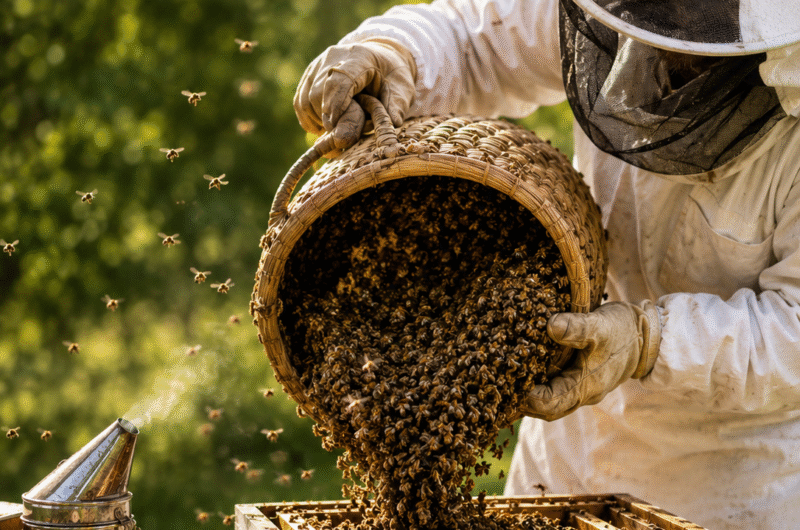
Not every swarm is positioned the same way, and the approach changes depending on where it’s landed. A cluster hanging from a low branch is the easiest scenario: position your box directly underneath, give the branch a single firm, sharp shake — not a series of gentle ones, which just agitates them without dislodging the cluster — and let the bulk of the mass drop straight into the box. A cluster on a fence post, wall, or other surface that can’t be shaken requires a different technique: brush the bees gently downward into the box with a bee brush or even a gloved hand, working from the top of the cluster down, which mimics the motion of bees naturally crawling rather than triggering a defensive scatter.
The hardest case, and one I’d honestly tell a first-timer to skip, is a swarm that’s already moved into a wall void, chimney, or other structural cavity. That’s not really a swarm capture at that point — it’s a cutout, and it requires opening up part of a structure, vacuum equipment built specifically for bees, and a level of comfort with property damage liability that most hobbyists shouldn’t take on without experience or a mentor present.
The Part Nobody Tells You: Getting the Queen In Matters More Than Getting the Bees In
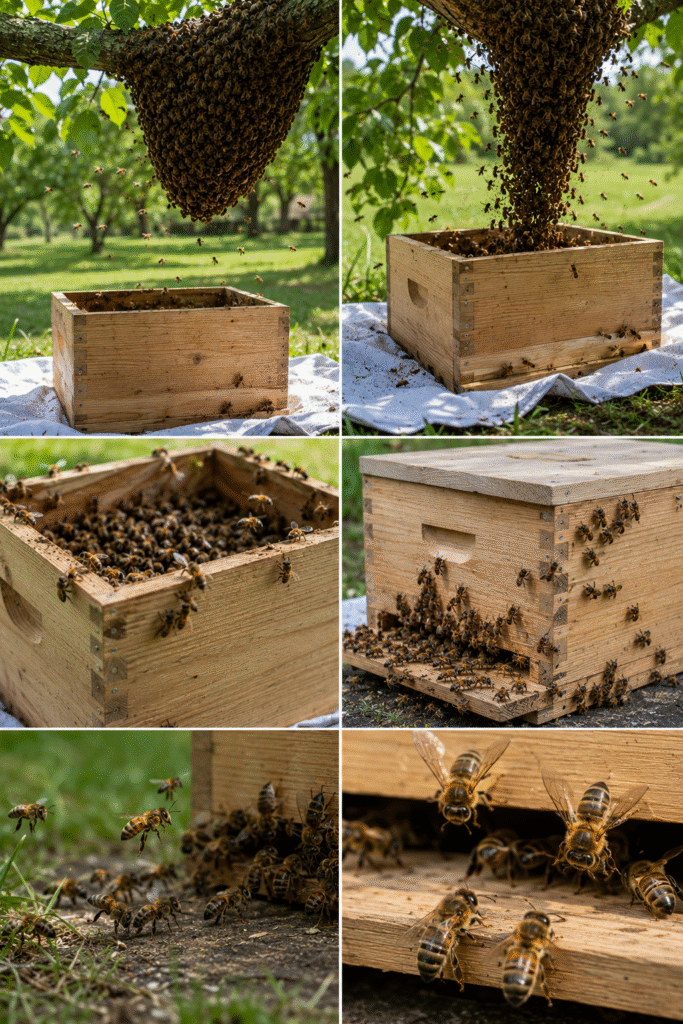
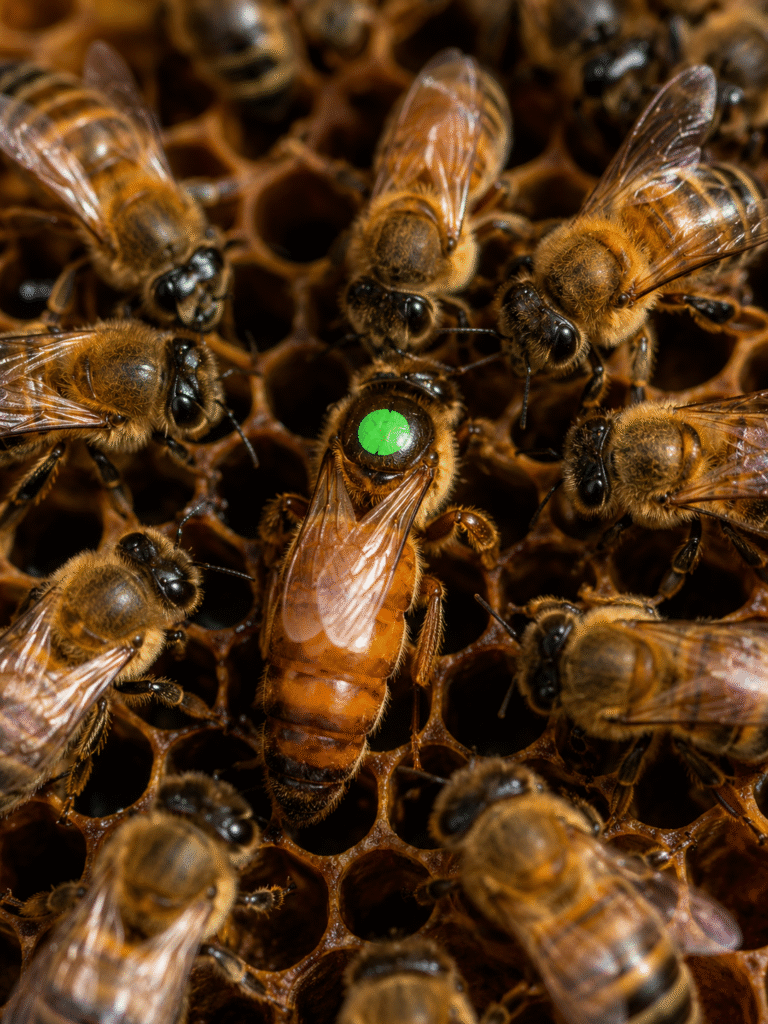
Here’s the single most useful thing I can tell you about swarm capture, and it’s something that took me two failed attempts to learn: the bees don’t matter nearly as much as the queen. If you get seventy percent of the cluster into your box but the queen stays on the branch, every single bee you collected will leave the box within the hour and fly straight back to her. Conversely, if the queen goes into the box, even a partial cluster, the rest of the swarm will reliably walk or fly in to join her over the following twenty to thirty minutes, drawn by her pheromone.
This is why the technique of placing your box directly beneath the cluster and letting gravity do the work is so much more reliable than trying to scoop bees by hand — a hard, single shake is far more likely to drop the queen along with the mass than slow, careful scooping is, which often disturbs the cluster enough that she retreats deeper inside it.
Once you think you’ve got a good portion of the cluster in the box, the tell that you succeeded is almost theatrical: bees on the ground or still on the branch will start walking purposefully toward the box entrance, fanning their wings and releasing a scent signal, rather than flying around aimlessly. That fanning behavior — workers standing at the entrance with their wings buzzing in place — is them broadcasting “the queen is here” to the rest of the colony. If you see consistent fanning at the box entrance within ten minutes, you’ve got her.
Transport and the First 24 Hours
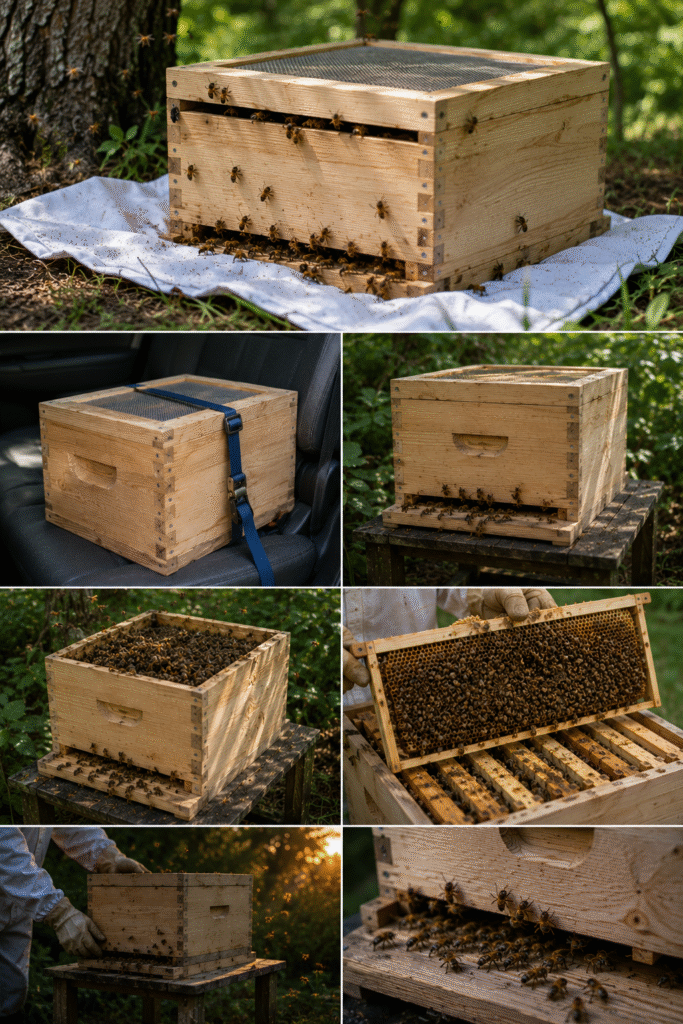
Once the bulk of the swarm is in the box, leave it in place, lid mostly closed but with a small gap for stragglers, for about twenty to thirty minutes before sealing it for transport. This lets the outliers walk in on their own rather than getting left behind. Seal the box securely with a screen or mesh panel for ventilation — never airtight, even for a short drive, since a sealed colony can overheat and die within an hour on a warm day.
Once home, the temptation is to dump them straight into a full hive setup, but I’d hold off for the first night. Let them sit in the nuc box, entrance cracked open, in a shaded spot until evening or the next morning. This gives any bees that didn’t make the initial transport — and there are almost always a few stragglers from the original site that find their way home later in the day if you leave the original spot marked — time to regroup, and it gives the colony a calmer transition than an immediate full hiving.
When you do move them into a permanent hive, do it at dusk if possible. Bees are far less likely to abscond — meaning the whole colony picks up and leaves again — when they’re settling into new comb as darkness falls rather than during active daylight flight hours. Give them a frame or two of drawn comb from another hive if you have it; it gives the queen somewhere to start laying immediately rather than waiting on them to draw fresh wax, which meaningfully reduces the odds of absconding in the first 48 hours.
Signs Something’s Gone Wrong
If, a day or two after hiving, you see bees clustering at the entrance again rather than going about normal traffic, or hear a higher, more agitated tone from inside the box, you may be dealing with an unmated or failed queen situation, which sometimes happens with smaller secondary swarms (called casts) thrown later in the season by a hive that already swarmed once. These casts often carry a virgin queen rather than a mated one, and they’re more prone to absconding or queen failure. If you suspect this, the fix is straightforward: requeen from a known source, or combine the small colony with an established nuc using a simple newspaper combine method, rather than waiting weeks to find out the hive has gone hopelessly queenless.
Why This Skill Is Worth Building, Even If You Already Have Hives
A lot of established beekeepers stop bothering with swarm calls once they’ve got enough colonies, and I understand the instinct — there’s real labor involved, and a swarm isn’t guaranteed to be healthy or mite-free just because it’s free. But I’d push back on skipping it entirely. Locally adapted, feral-origin genetics are some of the most valuable stock you can add to an apiary, precisely because that queen and her workforce survived long enough, unmanaged, to reproduce in your specific climate and forage conditions. I’ve had more than one swarm-caught colony outperform a purchased package in winter survival, simply because that bloodline had already been filtered by your local conditions before it ever reached your hands.
The Takeaway
Swarm capture rewards calm, deliberate movement far more than speed or force. Position the box, take the cluster down in one confident motion rather than several hesitant ones, and let the queen’s pheromone do the recruiting work for you. Get those two things right, and the rest of the process — transport, settling, hiving — is mostly just patience. Get them wrong, and you’ll end up with an empty box and a very confused colony back on the branch where you started.