
Walk into any grocery store and you’ll find an entire shelf of honey. Little bears, fancy jars, dark glass bottles with hand-written labels. Some say “pure.” Some say “natural.” Some say “raw.” A few say nothing at all except “honey.”
Most people grab whatever’s cheapest or whatever looks nicest and move on.
But here’s what nobody really talks about: most of the honey on that shelf has been processed in a way that changes it pretty fundamentally from what bees actually made. And the labels? They’re not exactly lying to you — they’re just not telling you the full story.
Let’s break down what’s actually different between raw honey and the regular stuff, and why it matters more than most people think.
What “Regular” Honey Actually Means
When honey gets collected commercially and sold at scale, it goes through two main processes before it hits the shelf: heating and ultrafiltration.
Heating makes honey easier to work with. It liquefies crystalized honey, makes it flow faster through equipment, and extends the time before it crystalizes again in the jar (because crystalized honey looks “bad” to a lot of consumers even though it’s completely normal). Commercial honey is typically heated to temperatures between 70°C and 78°C (around 160–172°F).
Ultrafiltration pushes the honey through very fine filters under high pressure. This removes pollen, wax particles, air bubbles — basically everything that isn’t pure liquid sugar. The result is a clear, perfectly uniform, beautiful-looking product with a very long shelf life.
The problem is that the heating and filtration also remove or destroy a lot of what makes honey interesting from a nutritional and biological standpoint: enzymes, antioxidants, propolis traces, and most of the pollen.
What “Raw” Actually Means — And What It Doesn’t
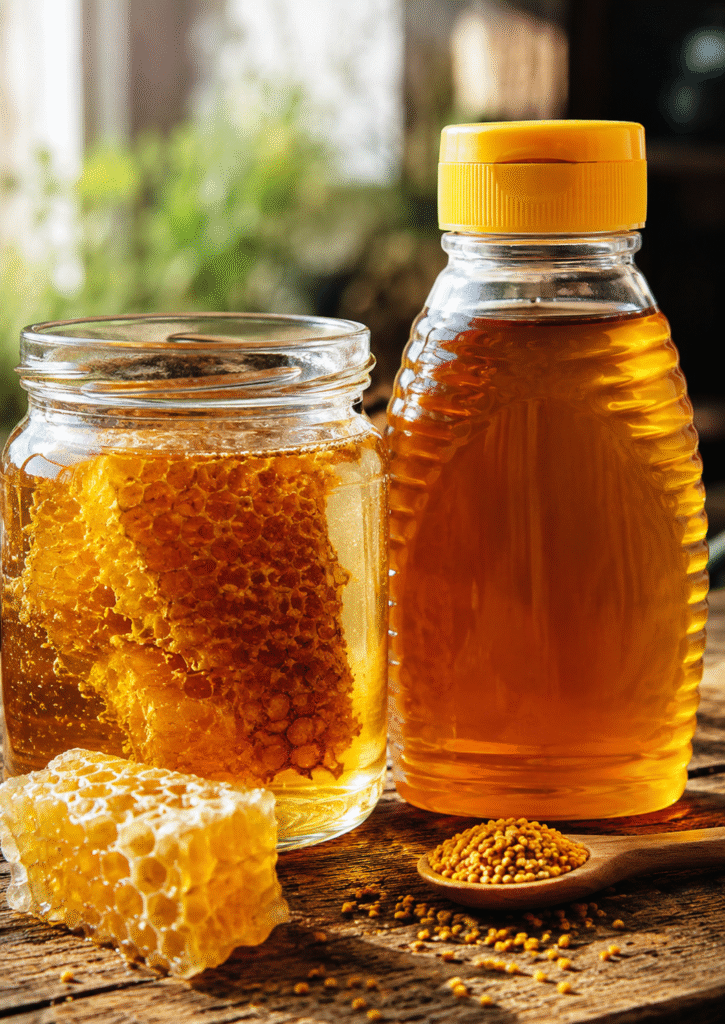
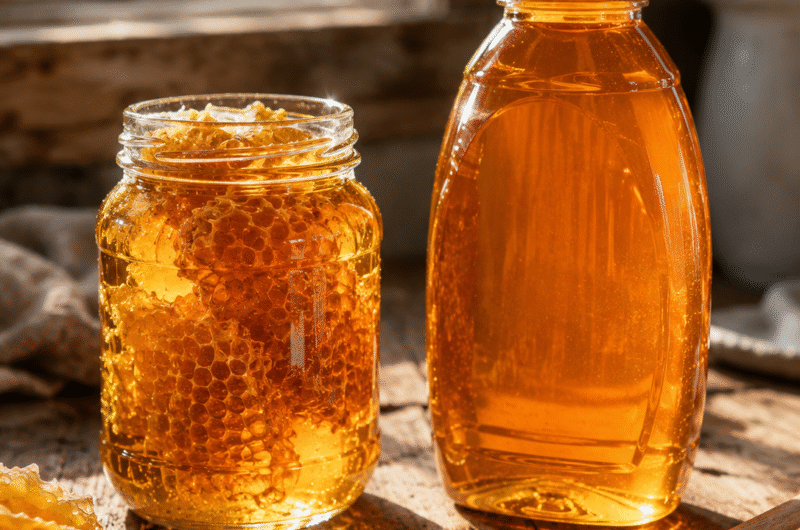
Raw honey is honey that hasn’t been heated above natural hive temperature (roughly 35–40°C / 95–104°F) and hasn’t been ultrafiltered. It gets strained to remove wax and bee parts, but the pollen, enzymes, and natural compounds stay in.
Here’s the catch: “raw” is not a regulated term in most countries.
In the United States, the FDA does not have an official definition for raw honey. In the UK and most of Europe, it’s the same story. Any producer can put “raw” on a label without meeting any specific legal standard. Some do it honestly. Some use it as a marketing word.
So when you see “raw honey” on a shelf, it’s worth doing a little more digging. Is it from a local beekeeper you can actually talk to? Does the company publish anything about their processing? Does it crystalize in the jar after a few months (which is a good sign — it means the pollen and natural sugars are still intact)?
The Pollen Question
This is where things get really interesting.
Pollen is naturally present in honey. Bees pick it up, it ends up in the honey, and it stays there. In raw honey, you can actually identify what plants the bees were foraging on by analyzing the pollen under a microscope. It’s called melissopalynology, and it’s a real field of study.
Here’s why that matters practically: pollen is the only way to verify where honey actually came from.
In 2011, a Food Safety News investigation tested honey from grocery stores across the United States. A significant portion of the major commercial brands had no pollen whatsoever — it had been completely removed by ultrafiltration. Food safety experts pointed out that without pollen, there’s no way to know the geographical origin of the honey. You can’t trace it back to a country, a region, or a hive.
This matters because honey fraud is a real and widespread problem globally. Honey is one of the most commonly adulterated food products in the world, sometimes cut with cheap sugar syrups that are nearly impossible to detect once the pollen is gone.
What’s Actually in Raw Honey That Regular Honey Lacks
Let’s be specific about what gets reduced or lost during heavy processing:
Enzymes — Bees add enzymes like diastase and invertase to honey during production. These enzymes play a role in the honey’s chemistry and are partially degraded by heat above 40°C.
Antioxidants — Raw honey contains flavonoids and phenolic acids. The antioxidant content varies a lot by floral source, but heating reduces it.
Propolis traces — Bees coat their hive with propolis, a resin with known antimicrobial properties. Small amounts end up in raw honey. Filtration removes most of it.
Pollen — As discussed above. Gone in ultrafiltered honey.
Beneficial yeasts and microorganisms — Raw honey from a healthy hive contains a complex microbiome. Heavy processing changes this.
To be fair: the research on whether these differences translate to meaningfully better health outcomes for people eating honey is still ongoing and sometimes mixed. Honey is still predominantly sugar. Eating a jar of raw honey every day is not a health plan. But if you’re going to eat honey anyway, the raw version keeps more of what the bees put into it.
So What Should You Actually Buy?
A few practical things to look for:
Buy local when you can. A local beekeeper at a farmers market can tell you exactly how their honey is processed. That conversation is worth more than any label.
Look for crystalization. If your honey has crystalized in the jar, that’s actually a good sign. It means the natural sugars and pollen are still present. You can gently warm it in a water bath to reliquefy it if you prefer — just don’t microwave it.
Check for pollen on the label. Some producers of raw honey specifically mention pollen content or have it independently tested. That’s a company that takes the raw claim seriously.
Be skeptical of very cheap “pure” honey. Cheap commercial honey isn’t necessarily fake, but the price point for genuine raw honey from small operations is almost always higher than what you find in a squeeze bear at the discount grocery store.
Ask questions. If you find a honey producer you like, ask them about their process. Most small-scale beekeepers are genuinely passionate about this stuff and happy to explain how they handle their honey from hive to jar.
The Bottom Line
Regular commercial honey isn’t dangerous. It’s not poison. It’s just honey that’s been processed for convenience, shelf life, and consistent appearance — and in the process, a lot of what makes honey interesting has been removed or reduced.
Raw honey is closer to what bees actually made. But “raw” on a label isn’t a guarantee, because nobody’s checking. Your best tool is knowing what to ask and who to buy from.
The bees did the hard part. It’s worth paying a little attention to what happens after they’re done.