
Found bees in your wall? Learn how to tell honey bees from wasps, why sealing the hole backfires, and your real removal options.
The first sign is usually a sound, not a bee. A low, steady hum coming from somewhere behind the drywall that you can’t quite place until you press your palm flat against the plaster and feel it vibrate. That’s how a homeowner in upstate Vermont described it to me last summer, three days before she called a local beekeeper in a mild panic, certain her house was somehow electrical-fire-adjacent. It wasn’t wiring. It was roughly 20,000 honey bees.
If you’re reading this because you just found the same thing — a hum, a handful of bees working an odd gap in your siding, or a full-blown cloud around a soffit vent — you don’t need a lecture on pollinator decline right now. You need to know what’s actually going on inside your wall and what to do about it before you make it worse.
How to Tell If It’s Really Honey Bees (Not Wasps or Bumblebees)
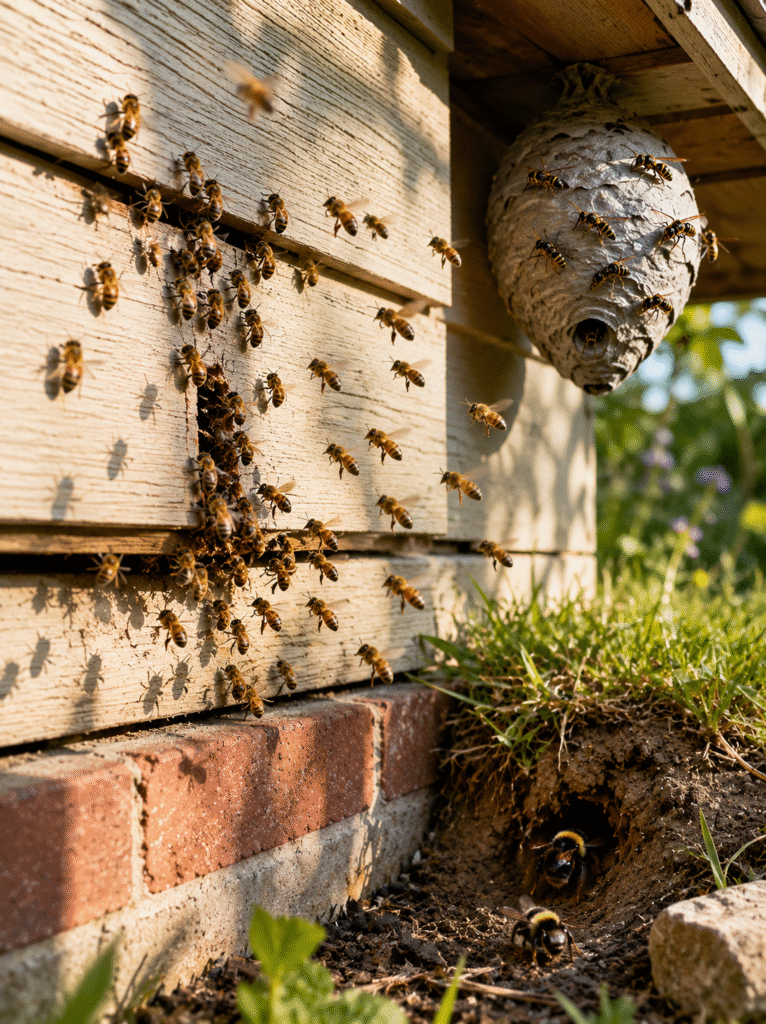
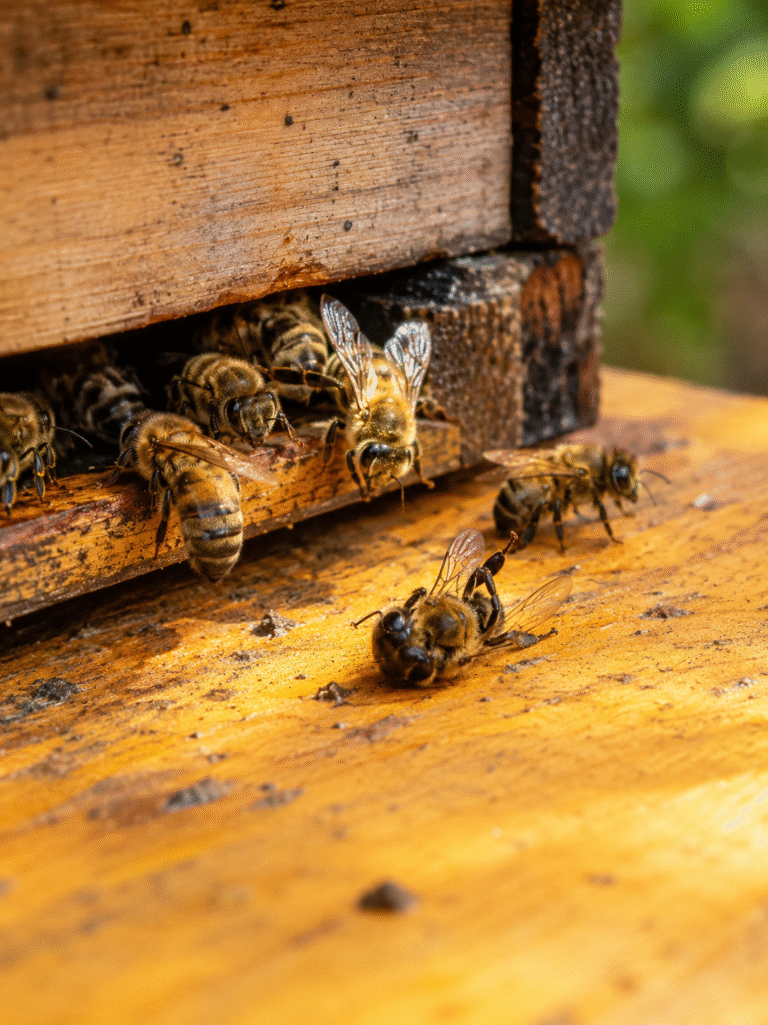
A colony of honey bees moving into a wall looks different from a wasp nest or a bumblebee burrow: honey bees enter and exit constantly through one small gap, in high numbers, throughout the day, and the activity persists for weeks rather than a single afternoon. Wasps tend to build an exposed papery nest you can often see directly, and bumblebees usually nest in small numbers underground or in low cavities, not inside exterior walls.
A few field markers I use when I get called out to look at one of these:
- Traffic pattern. Honey bees fly a steady, almost commuter-like line in and out of one entry point. Wasps are more erratic and often visible on the nest surface itself.
- Time of day. Honey bee activity peaks midday and tapers at dusk. If you’re seeing heavy traffic at 7 a.m. on a cool morning, that’s more consistent with a well-established colony that’s already built up internal heat.
- Sound. A honey bee colony behind drywall produces a low, continuous drone — almost mechanical. Paper wasp nests are usually silent unless disturbed.
- Longevity. If the activity has been going on for more than two or three weeks, you’re very likely dealing with an established colony with comb, brood, and stored honey — not a scouting swarm that might move on.
That last point matters more than people expect, because it changes everything about what happens next.
Why You Shouldn’t Just Seal the Entry Hole
The instinct is understandable. Bees are getting into the house, so the fix seems obvious: caulk the gap, done. I’ve seen this go wrong enough times that it’s worth stating plainly.
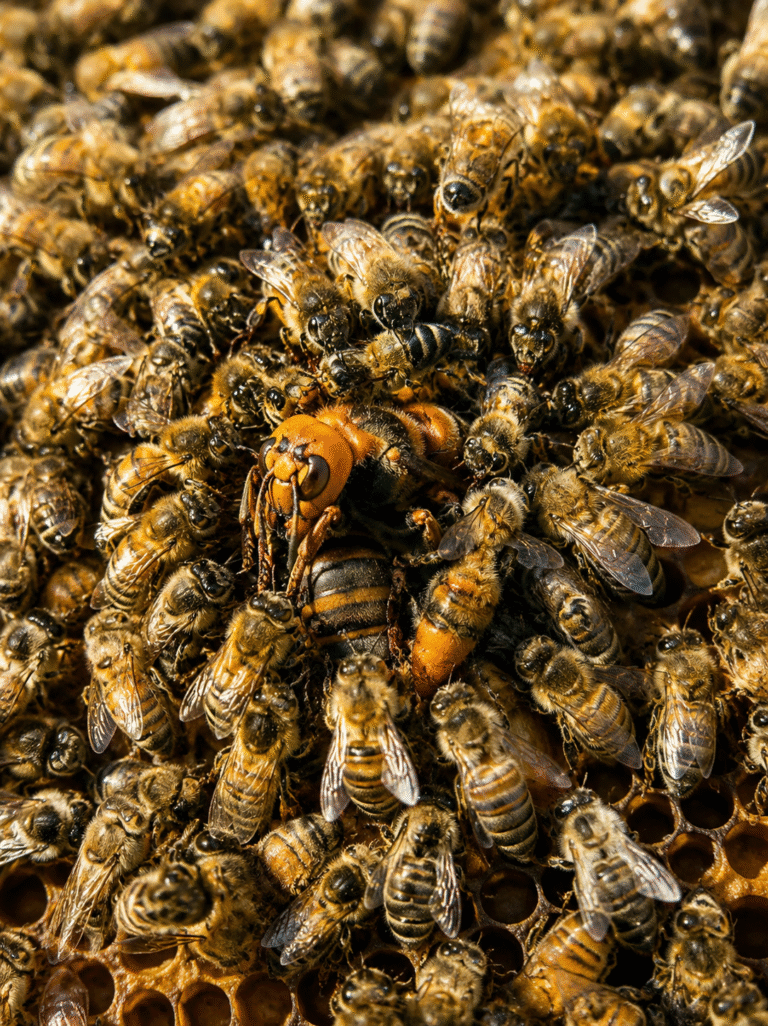
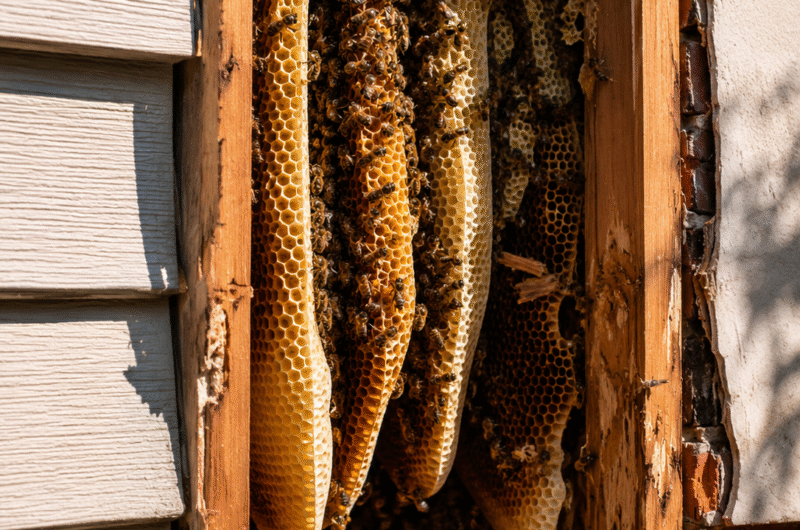
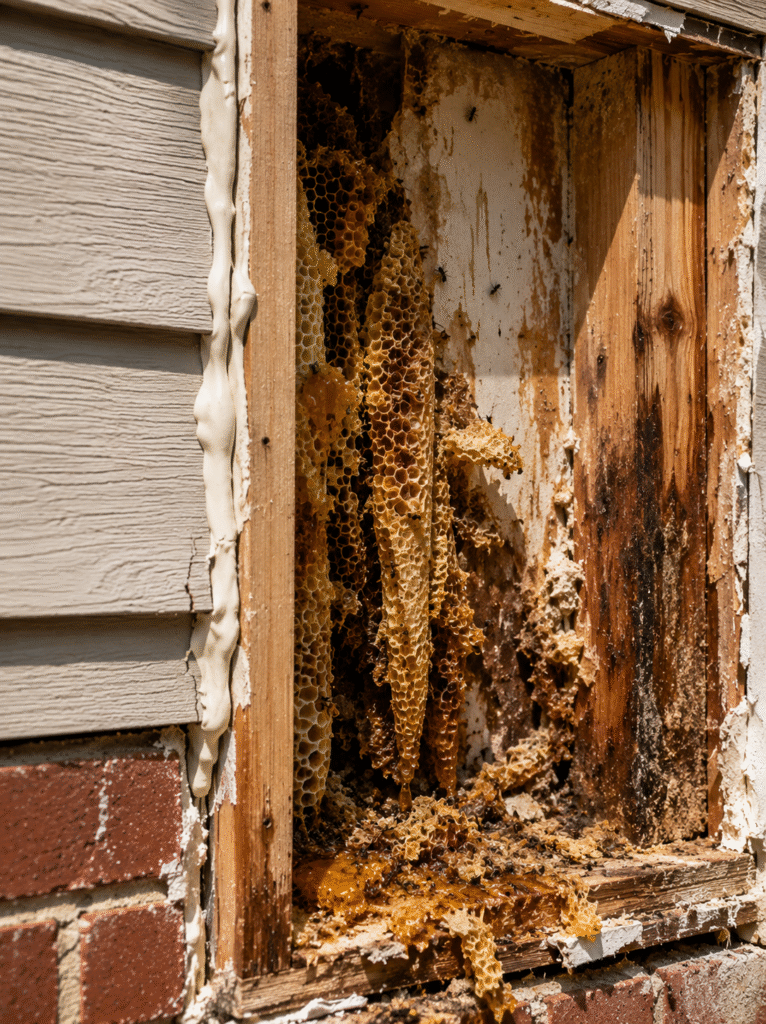
Sealing a wall entrance without removing the colony traps the bees inside, where they’ll either die and rot or find a new way into your living space — and the abandoned wax comb and honey left behind will ferment, attract pests, and can stain or even structurally soften drywall over time. A colony that’s been established for a season or more can have tens of pounds of comb and honey built into the cavity. None of that disappears when the bees do.
I’ve walked into a follow-up job where a homeowner had sealed a wall two years earlier after a “get rid of them” call to a pest control service that sprayed and left. What we found when we opened that wall wasn’t just dead bees — it was a slumped mass of old comb, a sticky stain migrating through the drywall, and a secondary ant infestation that had moved in to clean up the abandoned honey. The original problem had been small. The deferred one was not.
Your Three Real Options: Leave It, Relocate It, Remove It
There isn’t one universal right answer here — it depends on the colony’s size, location, how established it is, and your own tolerance for having bees as long-term neighbors. Here’s how I’d walk a homeowner through it.
| Option | Best when | What it involves | Rough cost range |
|---|---|---|---|
| Leave it in place | Colony is in an exterior wall not shared with living space, low nuisance risk, no allergy concerns in the household | Monitoring only; sometimes formalized with a beekeeper who “adopts” the colony for observation | $0 |
| Live relocation (cut-out) | Colony is established, accessible, and you want the bees preserved rather than killed | A beekeeper opens the wall, carefully removes comb and bees into a hive box, and relocates the whole colony | Moderate — typically several hundred dollars depending on wall access and colony size |
| Removal (extermination) | Structural constraints make cut-out impossible, severe allergy in the household, or the colony is inside a wall that can’t be safely opened | Pest control removes bees; comb and honey still need manual extraction afterward or the problem above repeats | Often similar to or higher than relocation once comb removal is factored in |
When It’s Safe to Leave a Colony in Place
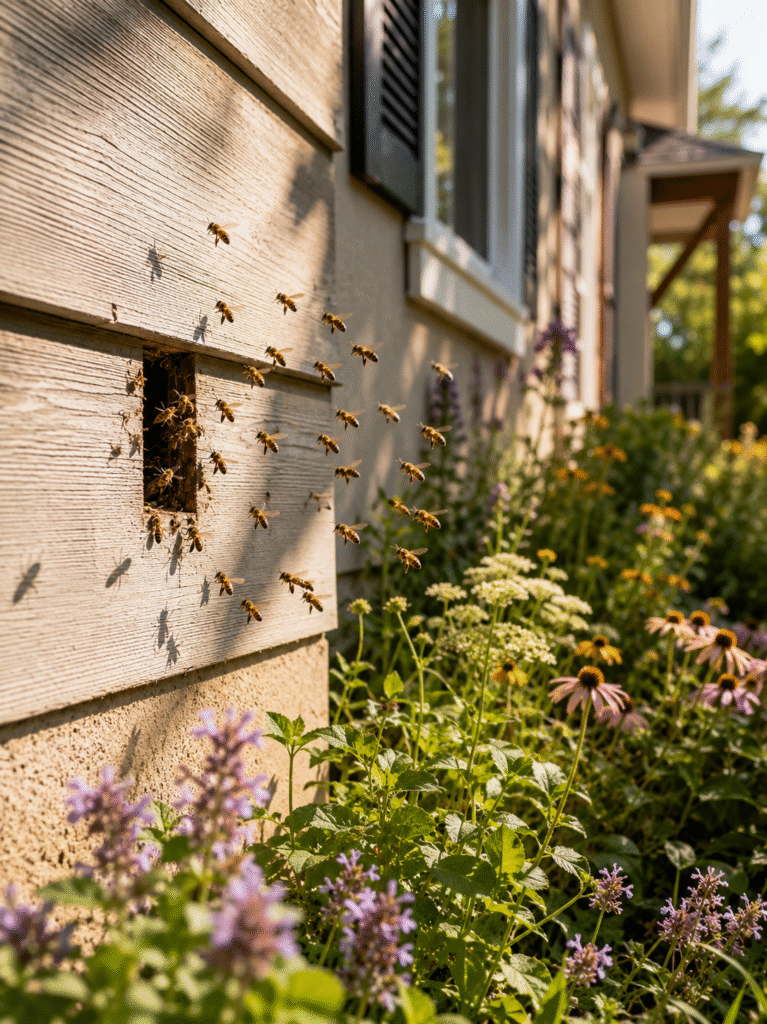
If the bees are tucked into an exterior wall cavity with no shared airspace to an interior room, and nobody in the household has a bee sting allergy, some homeowners simply let the colony stay — particularly if it was discovered late in the season when relocation success rates drop. It’s not the hands-off, zero-consequence option people sometimes assume, though: you’re accepting an ongoing structural presence of comb and honey in that wall indefinitely.
How Professional Cut-Out Relocation Works
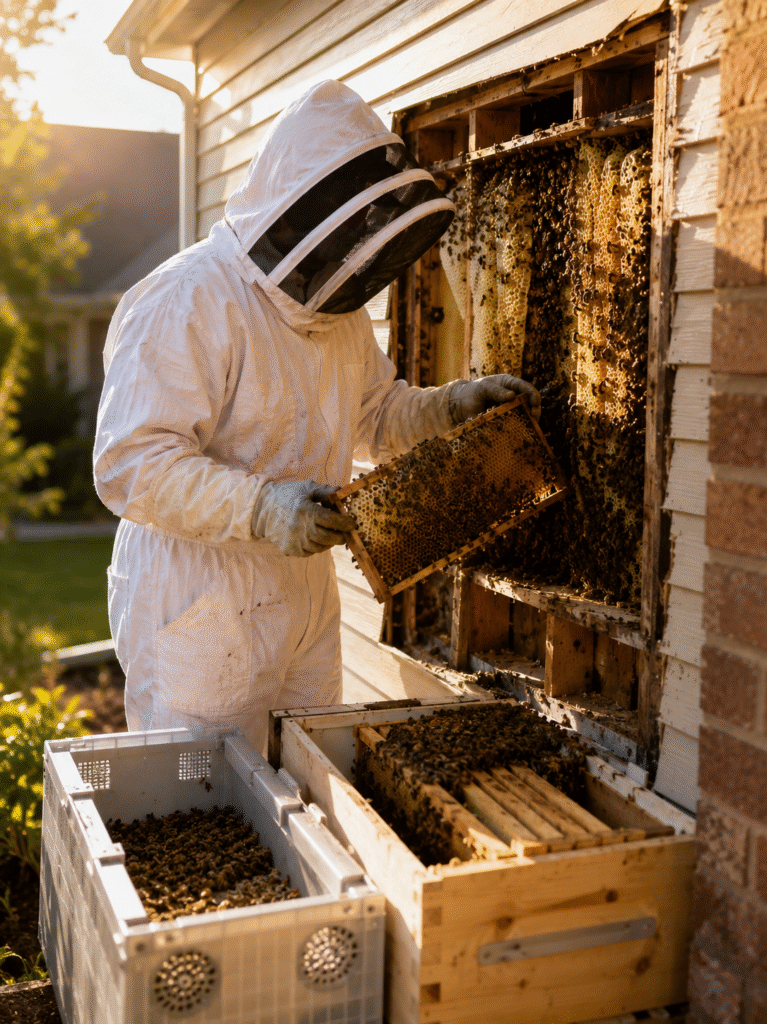
This is the option I recommend most often when it’s feasible. A beekeeper opens the wall cavity — sometimes from inside, sometimes from outside depending on construction — locates the comb, and transfers brood comb (with the queen, ideally) into frames that go into a standard hive box. The colony is then relocated to an apiary. It’s slow, deliberate work; a well-done cut-out on an established colony can take three to five hours.
When Removal (Not Relocation) Is the Only Option
Sometimes the wall genuinely can’t be opened safely — think masonry, a load-bearing cavity, or a colony positioned somewhere structurally inaccessible. In those cases, extermination becomes the realistic path, but it’s worth pressing any pest control company on their comb-removal plan before you agree to service. A treatment that kills the bees but leaves the comb and honey in the wall has not solved the underlying problem — it’s only removed the noise.
What It Costs (And Why “Just Spray Them” Backfires)
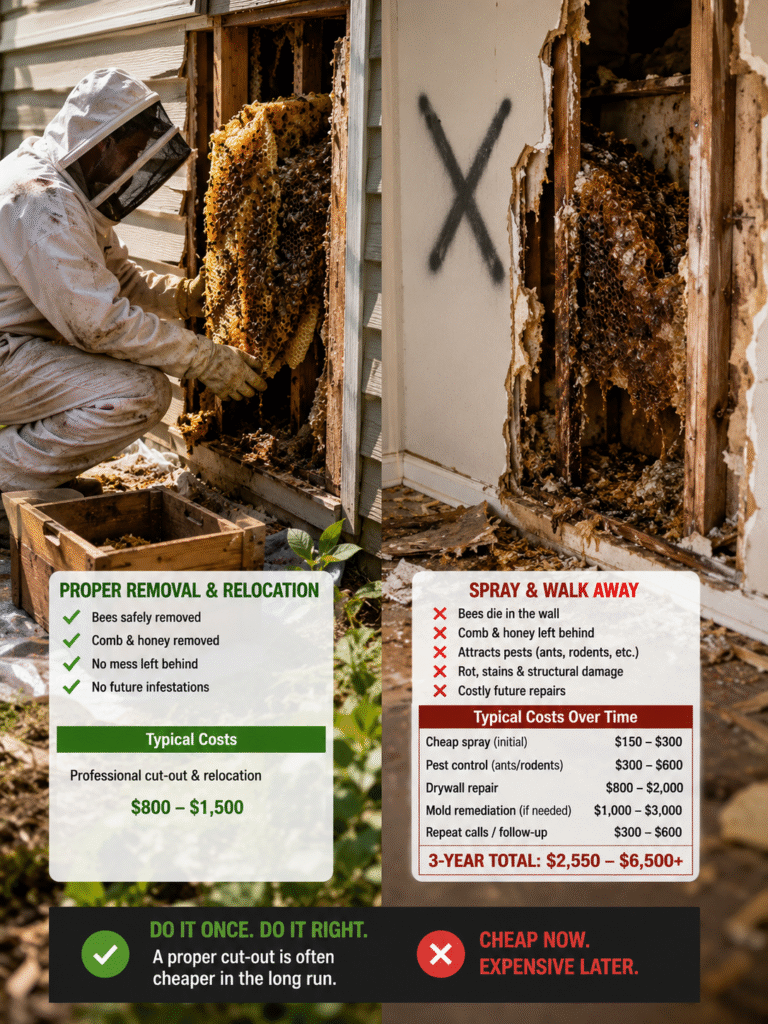
Homeowners are often surprised that professional removal or relocation isn’t cheap, and even more surprised when the cheap option ends up costing more. A quick spray treatment might run less than a full cut-out on paper, but if the comb and honey are left behind, you’re often looking at a second call a year or two later — drywall repair, pest control for the secondary infestation, and sometimes mold remediation if moisture from decomposing comb has worked into the wall cavity.
The honest math: a proper cut-out relocation, done once, is frequently cheaper over a three-year window than a cheap extermination followed by cleanup.
Finding a Beekeeper Who Does Removals Near You
Not every hobbyist beekeeper does cut-outs — it’s a specific skill set, and a badly executed one can be worse than doing nothing. Local beekeeping associations are usually your best starting point; many maintain a swarm-and-removal list of members experienced in wall extractions. If you’re just starting to explore what local beekeeping communities and support look like in your area, our guide to finding local beekeepers is a good next stop before you make any calls.
It’s also worth asking directly whether the colony you’re dealing with could be unusually defensive — in regions where Africanized honey bee hybridization has been documented, that changes the risk calculus for DIY inspection considerably. We’ve covered what makes these more defensive colonies different from a typical backyard hive if you want to understand that distinction before deciding how close you get.
And if the colony turns out to be unusually aggressive even after relocation — which does happen, particularly with wall colonies that inherited a poor-tempered queen line — a beekeeper may recommend requeening rather than simply rehousing them as-is. Here’s what that process actually involves if you end up adopting a relocated colony yourself and it doesn’t calm down over time.
If you’re at all tempted to take this on yourself because you’ve been curious about beekeeping anyway, it’s worth reading honestly about what a first season actually involves before your first hive experience is also an emergency wall extraction — our piece on what to know before opening your first hive is a more forgiving place to start.
The Bottom Line
If you’ve got bees in your wall, the sound isn’t the problem — the comb is. Sealing the entrance without addressing what’s built up inside almost always makes things worse, not better. Before you call anyone, spend five minutes watching the entry point: steady in-and-out traffic through one gap, sustained over multiple days, tells you you’re dealing with an established colony that deserves a proper relocation call, not a can of spray foam.
FAQ
Will bees leave my wall on their own? Rarely. Once a colony is established with comb, brood, and stored honey, it will typically persist in that location indefinitely unless removed — bees don’t abandon a productive nest site voluntarily.
How do I know if it’s honey bees or wasps in my wall? Look for steady, high-volume traffic through a single small entry point sustained over weeks, plus a continuous low hum from inside the wall. Wasps usually build a visible exposed nest and are more erratic in their flight pattern.
Is it illegal to kill honey bees? This varies significantly by region — some areas have specific protections for honey bees as managed pollinators, while others don’t distinguish them from any other stinging insect. Check local regulations before choosing extermination.
How much does it cost to remove bees from a wall? Costs vary widely by colony size and wall accessibility, but a professional live relocation (cut-out) is often comparable to or cheaper than extermination once you factor in the comb removal that has to happen either way.
What happens if you don’t remove bees from a wall? The colony continues to grow, building more comb and storing more honey over successive seasons, which increases both the eventual removal complexity and the risk of structural or moisture damage if the colony is ever abandoned or killed in place.