
An honest comparison of packages, nucs, and swarms — cost, risk, and timing — to help you choose how to get your first bees this spring.
The question I get asked more than almost any other, usually sometime around January, is some version of: “I’ve bought my hive, I’ve read the books — now how do I actually get bees?” It’s a fair question, because most beginner resources spend all their time on equipment and almost none on the decision that actually determines whether your first season goes well: how the colony in your box got started in the first place.
There are three ways to acquire honeybees, and they are not interchangeable. A package, a nuc, and a swarm can all end up producing a healthy colony by August — but they start from wildly different places, they demand different things from you in the first six weeks, and they carry different odds of making it through your first winter. I’ve installed all three over the years, on different sites and in different seasons, and the outcomes have taught me more about what “beginner-friendly” actually means than any book did.
The Three Ways Beekeepers Start a Colony, Explained Simply
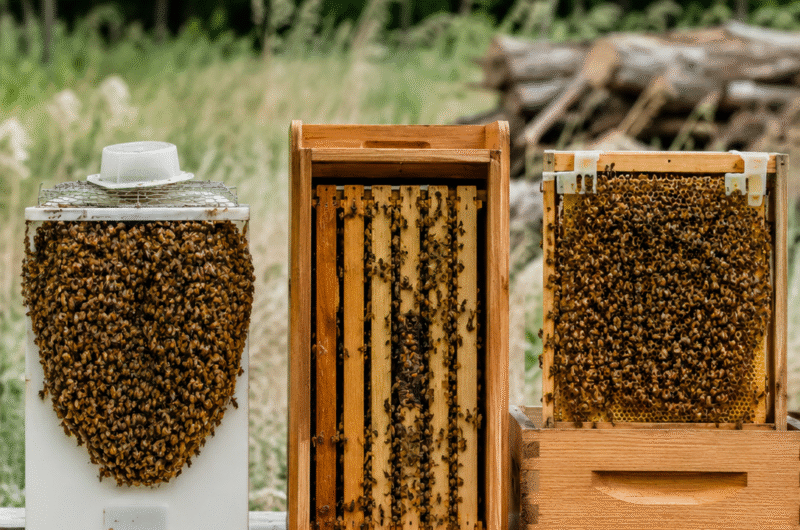
A package is roughly three pounds of unrelated adult bees and a caged, unmated-to-them queen, shipped or picked up with no comb, brood, or stores — essentially a simulated swarm. A nuc (nucleus colony) is an already-functioning mini-hive: a laying queen, workers, and 4–5 frames of drawn comb, brood, and food. A swarm is a wild, opportunistic colony fragment you catch yourself, with no guarantees attached.
Every other decision in this article branches off that one paragraph. A package starts a colony from zero. A nuc starts a colony already in motion. A swarm starts a colony you didn’t plan for and can’t schedule.
Package Bees — Cheapest, Most Available, Slowest Start
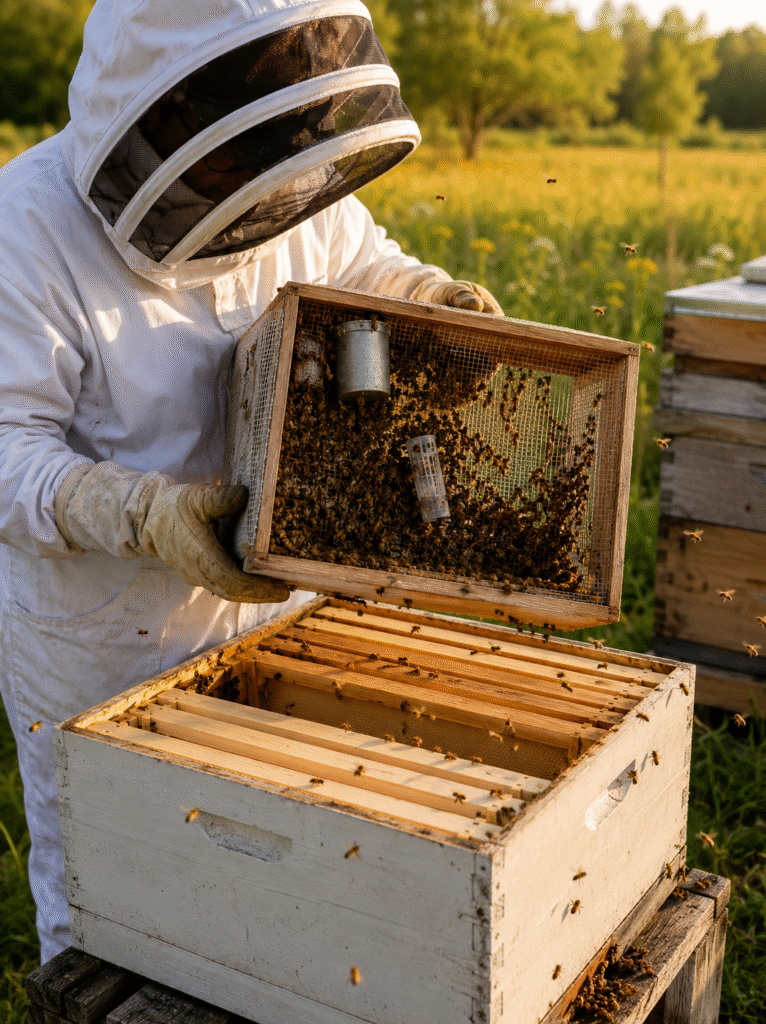
A package is exactly what it sounds like: a screened wooden-and-mesh box containing about three pounds of bees — somewhere around 10,000 to 12,000 individuals — a can of sugar syrup to keep them fed in transit, and a young mated queen sealed in her own small cage inside the box. Those bees were shaken from multiple donor hives at a commercial operation and have no prior relationship to each other or to the queen they’re being shipped with, which is why the queen travels separately in a cage — the workers need several days of slow acclimation, usually eating through a candy plug that releases her gradually, before they’ll accept her without killing her.
The appeal is straightforward: packages are the cheapest entry point, they’re the most widely available option every spring, and because they contain no comb or brood, they’re also the easiest way to start a colony with a genuinely low mite load — there’s no inherited brood cycle carrying an existing Varroa population into your equipment. I’ve started colonies this way twice, and both times the visible novelty of watching a queen get slowly accepted by a box full of strangers was, frankly, one of the more interesting things I’ve watched happen in a hive.
The tradeoff is time and effort. A package colony has to build comb from nothing before it can store food or raise brood, and drawing that comb is expensive in bee-energy — it takes roughly eight pounds of consumed honey to produce a single pound of wax. Until that comb exists, the queen has nowhere to lay, which means the worker population actually declines for the first two to three weeks as the original package bees age out and die before her first offspring reach adulthood. A package installed on empty foundation typically needs consistent syrup feeding for six to twelve weeks, and it’s genuinely more vulnerable during that startup window than a nuc would be in the same spot.
Field ID for decision-making: Choose a package if budget is your primary constraint, you want to watch a colony build from true scratch as a learning experience, and you’re prepared to feed diligently and patiently through a slow first month.
Nucs — The Head Start Most Experienced Beekeepers Recommend
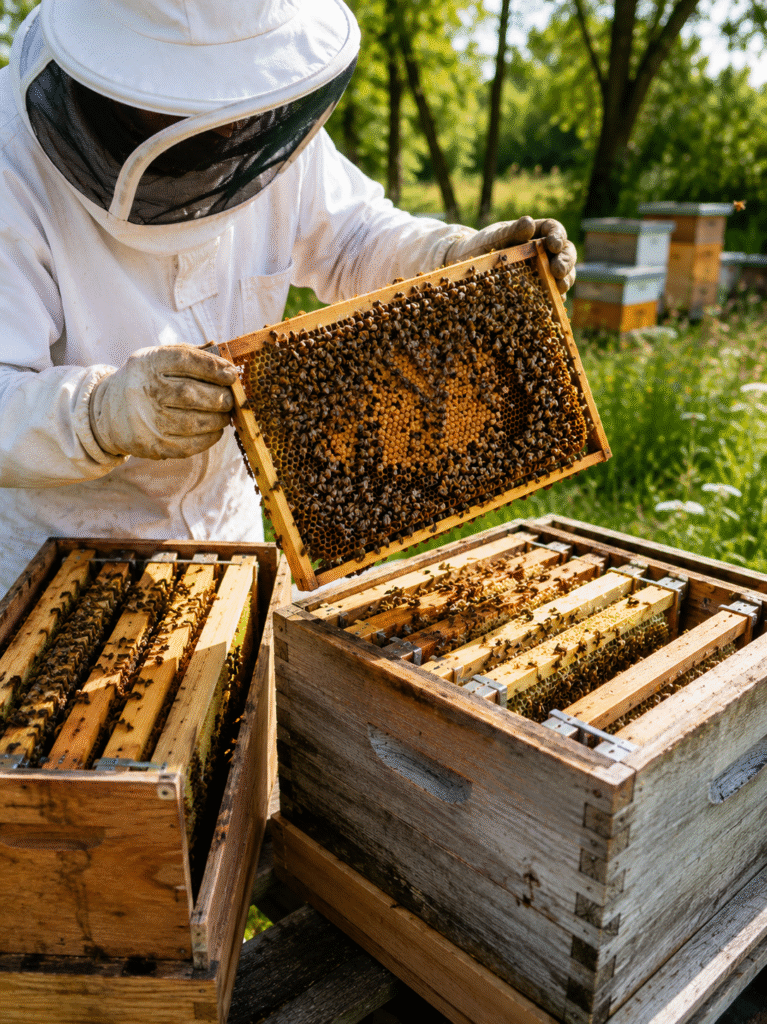
A nucleus colony, always shortened to “nuc,” is a small but complete, already-functioning colony — typically five frames of comb that already contain a laying queen, capped and open brood at multiple stages, food stores, and a working population of nurse and forager bees who already know each other and their queen. You’re not assembling a colony; you’re relocating one that’s already running.
That head start shows up almost immediately. In my experience, and consistently in what commercial producers report, nuc colonies build population faster, handle their first winter better, and need far less supplemental feeding than a package started on the same day in the same yard — often just a single round of syrup rather than weeks of it, especially if the nuc’s frames are installed into a hive that already has some drawn comb. The queen is a known quantity too: she’s already laying and already accepted, which removes the acceptance risk that occasionally sinks a package installation.
Nucs cost more — usually a meaningful premium over a package — and they come with one real downside packages don’t: because you’re bringing in existing comb and brood, you’re also potentially bringing in whatever pest or disease pressure was already present in the donor colony. A reputable producer manages that risk, but it’s worth asking directly whether the colonies have been treated for Varroa and how recently, what the queen’s origin is, and how the five frames break down between brood and stores before you commit to buying from them. Availability is also a real constraint: demand for nucs regularly outpaces supply, and in most regions you need to place an order in January or February for spring pickup — some producers sell out well before that.
Field ID for decision-making: Choose a nuc if you can absorb the higher upfront cost, you want better first-season odds and less feeding labor, and you’re willing to order early and vet your producer rather than buying reactively.
Swarms — Free, Opportunistic, Not a Reliable Beginner Plan
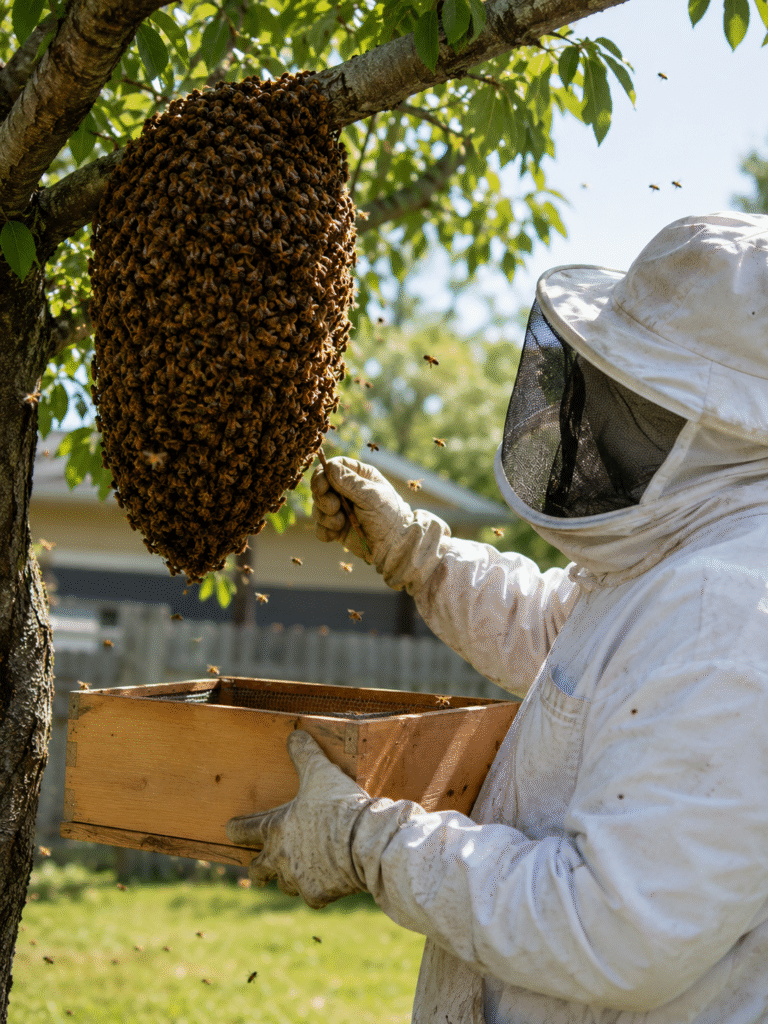
A swarm is a natural colony-reproduction event: a portion of an established colony, led by either the old queen or a virgin, leaves an overcrowded hive to found a new one elsewhere. Swarms cluster temporarily — often on a tree branch, fence post, or the side of a building — while scout bees search for a permanent cavity, and that clustering window is when a beekeeper can capture and hive them.
Free bees are genuinely appealing, and I won’t pretend otherwise — catching your first swarm is one of the more memorable experiences in beekeeping, and a swarm has a real biological advantage in that it’s often broodless at the moment of capture, which means no inherited Varroa population riding along in capped brood cells the way a nuc’s comb can carry one. But a swarm is not a plannable strategy for a first-year beekeeper. You can’t order one, you can’t schedule its arrival around your calendar or your equipment readiness, and its genetics, temperament, and disease history are complete unknowns. A swarm can absolutely turn into a thriving colony — I’ve had that happen — but treating “I’ll just catch a swarm” as your primary plan to start beekeeping is a good way to end April with an empty hive and no bees at all.
Field ID for decision-making: Treat a swarm as a welcome bonus if one turns up near you, not as your primary acquisition plan, unless you already have a mentor, a local swarm-call network, and genuine flexibility in your schedule.
Which One Actually Fits a First-Year Beekeeper?
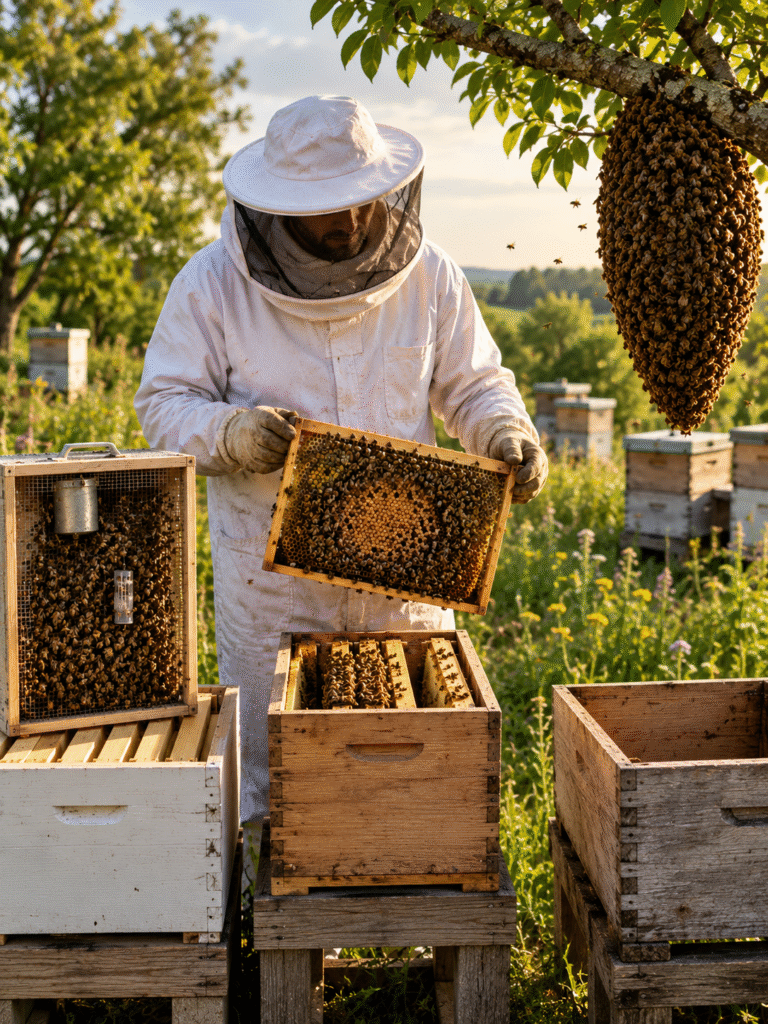
There’s no single right answer here, and I’d be lying if I claimed otherwise — it depends on your budget, your patience for feeding, and how much you’re willing to pay to reduce risk. But after watching this decision play out across a lot of beginners, a rough framework holds up:
- Tightest budget, willing to feed diligently and learn from a slower buildup: package bees.
- Willing to pay more for a meaningfully better shot at surviving winter one, with less hand-feeding: a nuc, ordered early.
- Already have a hive ready, a mentor nearby, and don’t mind uncertainty: stay alert for a local swarm, but don’t rely on it exclusively.
If cost is the deciding factor, it’s worth reading my full first-year cost breakdown before choosing — the price gap between a package and a nuc is smaller in the context of total first-season spending than it looks in isolation, once you factor in feed, treatments, and the cost of potentially having to restart a failed colony.
When and How to Order
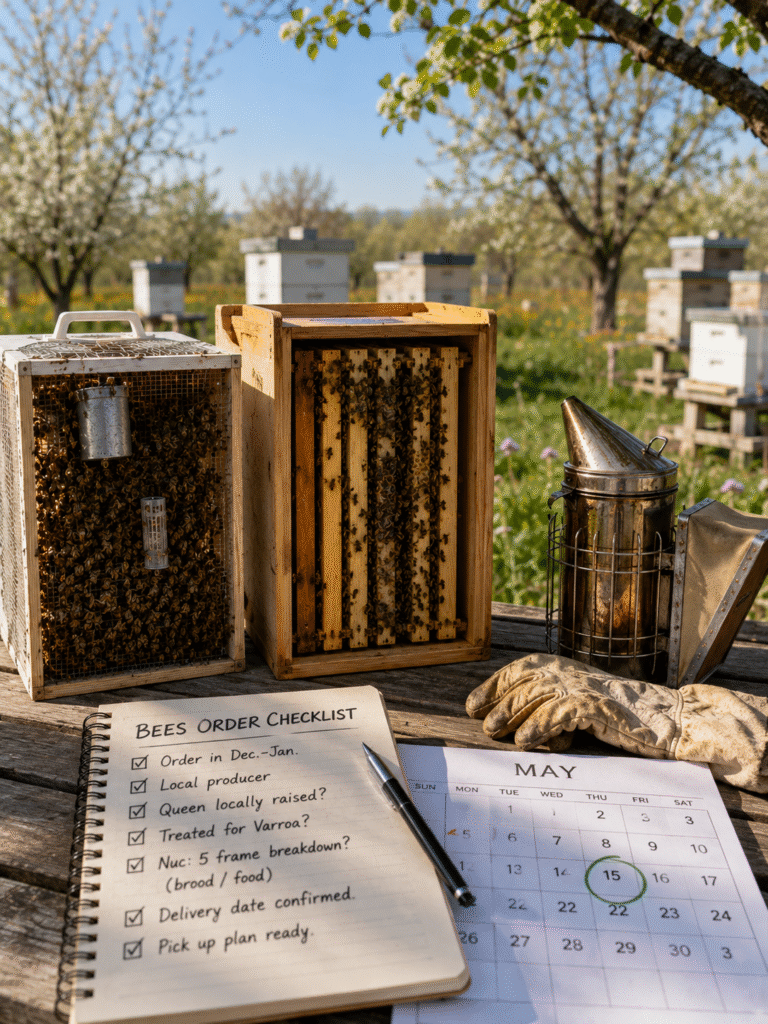
Timing matters more than most new beekeepers expect. In most of North America, both package and nuc producers open ordering in December and take their last reservations by January or February for spring delivery — waiting until March “because that’s when I decided to start beekeeping” is one of the most common and avoidable mistakes I see. Nuc season itself typically runs from late April through June, peaking in May, timed to align with the main regional nectar flow so a young colony has the best possible conditions to build comb and stores quickly.
Local sourcing matters too, particularly for nucs. A five-frame nuc full of active brood is not built for long-distance shipping the way a package is — it’s a colony in progress, and the shorter the trip from producer to your hive, the less stress the bees and the brood experience. Contacting a regional beekeeping association or your county extension office is usually the fastest way to find legitimate local producers, and a good local club often keeps a running list. Packages, by contrast, are the one method that reliably ships nationally, which is worth remembering if there’s no producer within reasonable driving distance of you.
Before committing to any seller — package or nuc — ask directly: are the bees and queen locally raised or imported from another region, has the colony been treated for Varroa and with what, and for a nuc specifically, how do the five frames break down between brood and food stores? A producer who can’t answer clearly is not one I’d buy from.
Installation Day: What’s Actually Different Between the Three
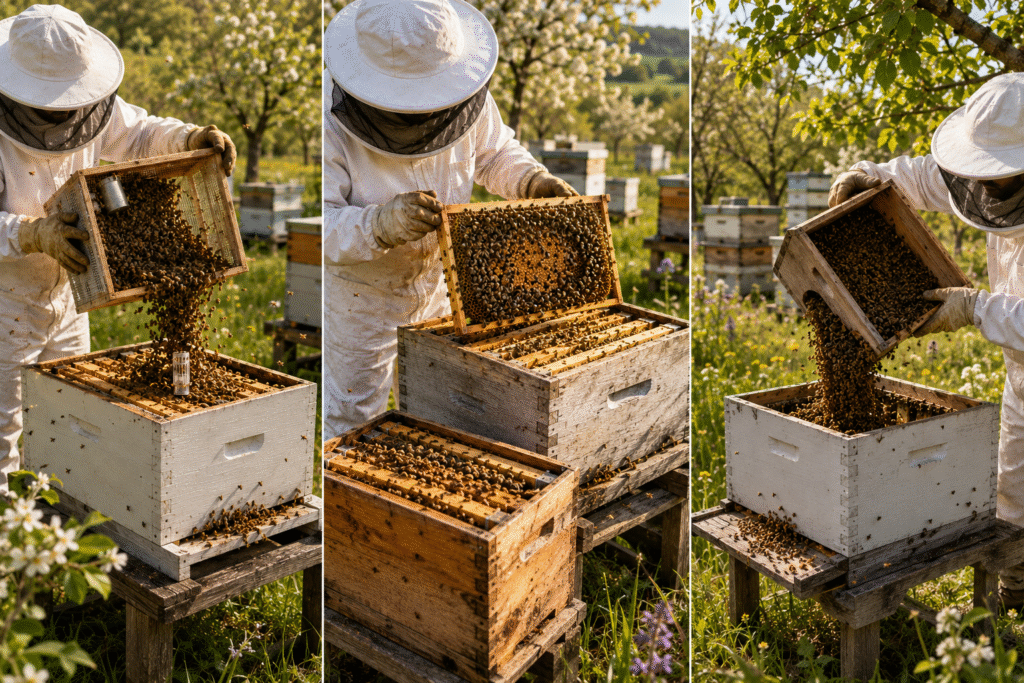
Installing a package means shaking or pouring the bees directly into the hive body, hanging the queen’s cage between two frames with the candy plug facing up so workers can chew through and release her over several days, and closing the hive with minimal disturbance for about a week before your first check. It’s fast, a little chaotic, and genuinely satisfying to watch — thousands of disoriented bees reorganizing themselves around a queen they don’t know yet.
Installing a nuc is far more procedural and, in my experience, more forgiving for someone who’s never handled bees before: you’re transferring existing frames — bees, brood, food, and all — directly into your hive body in the same order they were arranged in the nuc box, disturbing the colony as little as possible in the process. There’s no queen-cage waiting period because she’s already laying and accepted. Done carefully, it can be finished in under fifteen minutes.
Installing a swarm depends entirely on how you captured it — shaking a clustered swarm from a branch into a box, or coaxing it out of a wall cavity — but once it’s in your hands, the actual hiving process resembles a package installation more than a nuc: you’re introducing a group of bees to fresh equipment and giving them time to settle, though a genuine swarm typically settles in faster than package bees because the colony, queen included, already has an existing working relationship. If you catch one, my step-by-step guide on how to safely catch and rehive a swarm walks through the capture side of this in detail — and if you want to understand where swarms come from in the first place, the signs a colony is about to swarm is worth reading, both for catching your own bees’ swarms before they leave and for recognizing a capture opportunity elsewhere.
Whichever method you choose, the real work is what happens over the following weeks and months. My beekeeping for beginners piece covers what I wish someone had told me about that stretch, and once your colony is established, winterizing your hive is the next major decision point worth planning for well before the cold arrives — regardless of which of these three paths got you there.
The Takeaway
If you only remember one thing from this comparison, make it this: a package is the cheapest way to start a colony from nothing, a nuc is the more expensive way to start a colony that’s already halfway built, and a swarm is a genuine gift you should never plan your whole season around. Order early, ask your producer direct questions before you pay, and choose based on how much risk you’re actually willing to manage in your first six weeks — not just on sticker price.
FAQ
Is a nuc or a package better for a first-year beekeeper?
A nuc generally gives first-year beekeepers better odds — faster buildup, less feeding, and a known, already-laying queen — but it costs more and requires ordering earlier due to limited supply. A package is cheaper and more available but demands more feeding and patience through a slower start.
When should I order bees for spring delivery?
Most package and nuc producers open orders in December and are often sold out by January or February for spring pickup. Ordering in March, when many new beekeepers first commit to the hobby, is frequently too late for local nuc availability.
Can a beginner start with a swarm instead of buying bees?
It’s possible, but not advisable as a primary plan, since swarms can’t be scheduled and their genetics, temperament, and disease history are unknown. A swarm is best treated as a welcome bonus alongside a purchased package or nuc, not a guaranteed starting method.
Why are nucs more expensive than packages?
A nuc includes an already-laying, accepted queen along with drawn comb, brood, and food stores — essentially a colony that’s already weeks ahead in development. That head start requires more labor and resources from the producer, which is reflected in the higher price.
Do I need drawn comb before installing a package?
No, but having some drawn comb available significantly speeds up a package colony’s buildup, since bees won’t need to spend as much energy building new wax before the queen can begin laying at full pace.
How do I find a local nuc producer?
Contact a regional or state beekeeping association or your county extension office, both of which typically maintain lists of local producers. Local beekeeping clubs are also a strong resource and sometimes maintain waiting lists for member-produced nucs suited to your specific climate.
What questions should I ask a bee seller before buying?
Ask whether the bees and queen are locally raised or imported, whether the colony has been treated for Varroa and with what, and for nucs specifically, how the frames break down between brood and food stores. A producer who can’t answer these clearly is a warning sign.