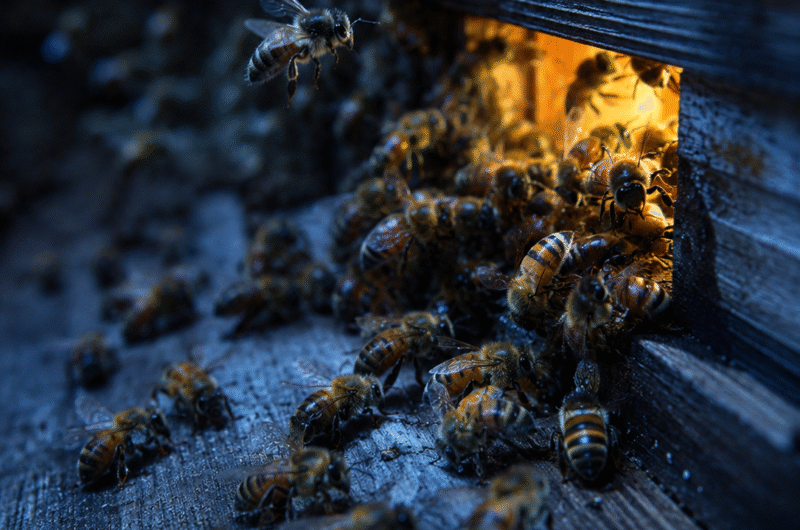

Honey bees do not fly at night. That’s not a soft rule of thumb, it’s close to a biological law — their eyes aren’t built for it, and a colony that behaved otherwise would lose workers to cold and disorientation fast. So when a beekeeper starts finding live bees on the ground under a porch light at 11 p.m., stumbling in circles instead of flying, something has gone wrong at a level deeper than weather or a bad queen.
That “something” has a name now, and it’s a parasite most beekeepers had never heard of until fairly recently.
A Discovery That Started With a Dying Streetlight
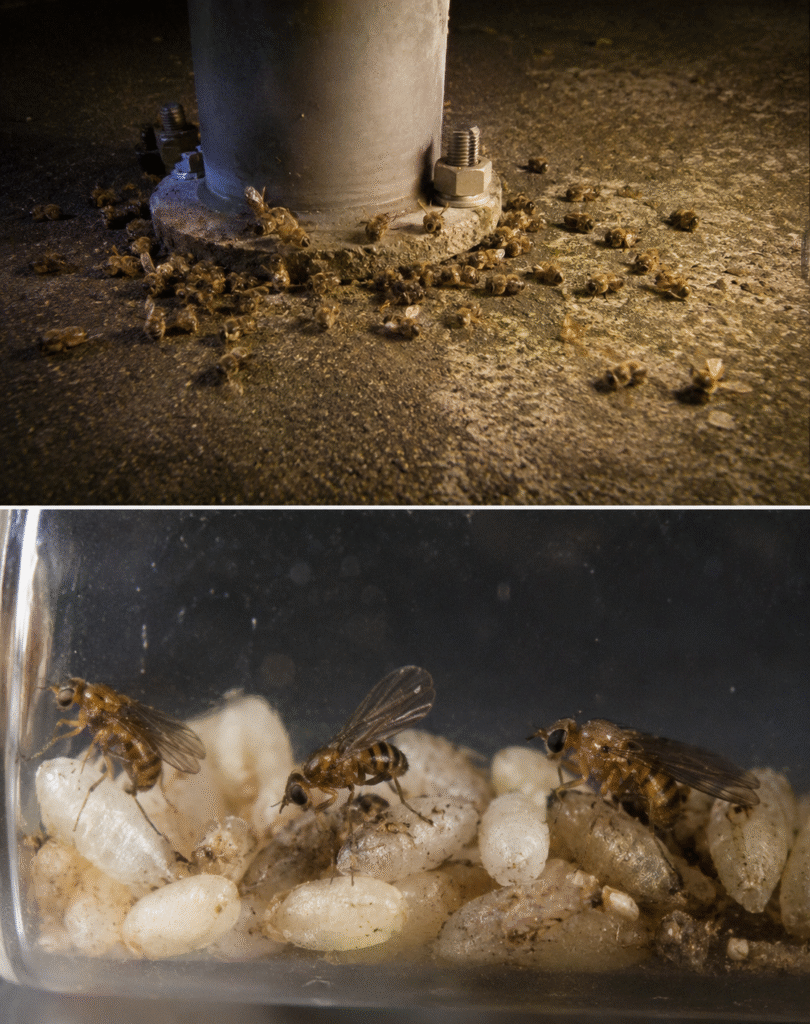
The story behind this one is unusually specific for a scientific discovery, and I think that’s part of why it’s stuck with me. In June 2010, a biology professor at San Francisco State University named John Hafernik was walking across campus and noticed a cluster of dead and dying honey bees collected under a streetlight. Curious, he scooped some into a vial and left it on his desk, mostly out of habit rather than expecting anything remarkable.
A week or two later, he found small pupae in the vial. Then, adult flies emerged. Not something a honey bee should be producing. He brought the specimens to a phorid fly specialist at the Los Angeles County Museum of Natural History, who identified them as Apocephalus borealis — a native North American parasitoid fly previously known to attack bumble bees and paper wasps, never documented in honey bees before that vial.
That’s a detail worth sitting with: a parasite that had presumably been co-existing with bumble bees for a very long time had, at some point, started attacking a completely different, economically vital species, and nobody had caught it happening until a professor happened to notice a few dead bees under a light on his walk to work.
What Actually Happens Inside a Parasitized Bee
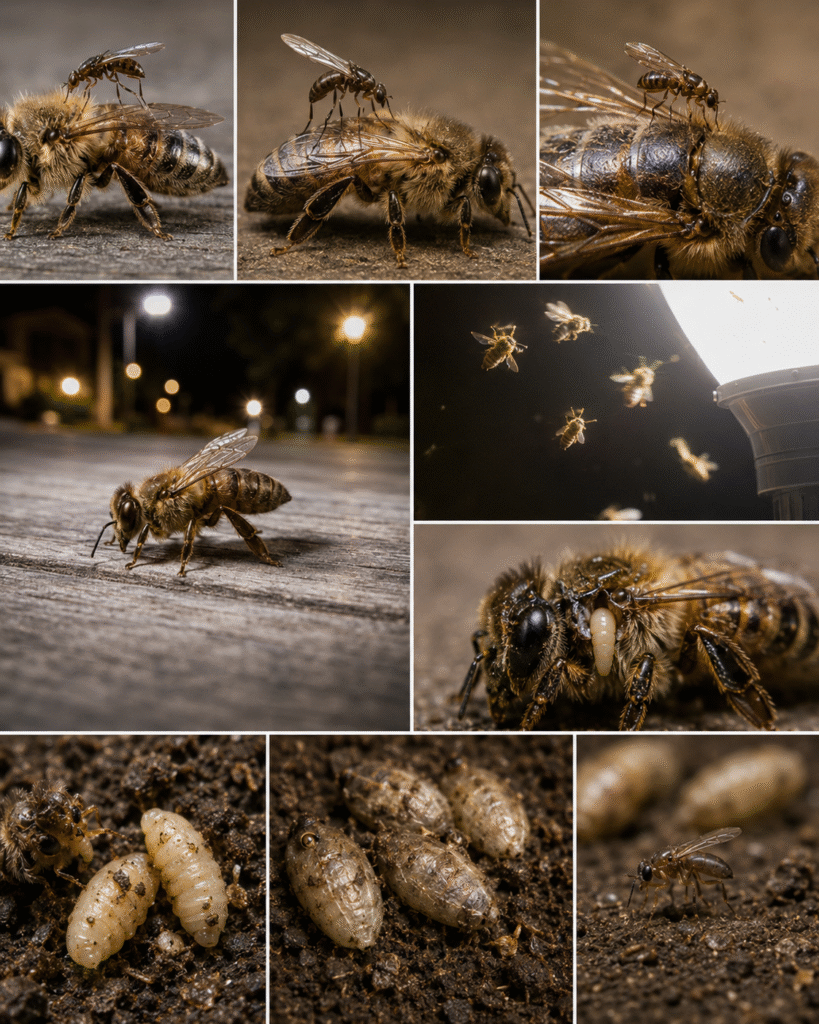
The mechanics of this are genuinely unpleasant, and I’ll describe them plainly because understanding the life cycle is the only way the behavior makes sense.
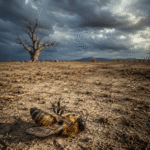
A female Apocephalus borealis fly lands on a honey bee’s abdomen and uses a needle-like egg-laying organ to inject eggs directly into the bee’s body, a process that takes only a few seconds. The bee generally carries on with normal life for a while afterward, which is part of what makes this parasite so hard to detect early. As the eggs develop into larvae inside her, though, something shifts in the bee’s behavior. She starts leaving the hive after dark and flying toward light sources — porch lights, streetlights, security lighting — in erratic, disoriented patterns completely unlike normal flight. Eventually she drops and can’t right herself, walking in circles rather than flying.
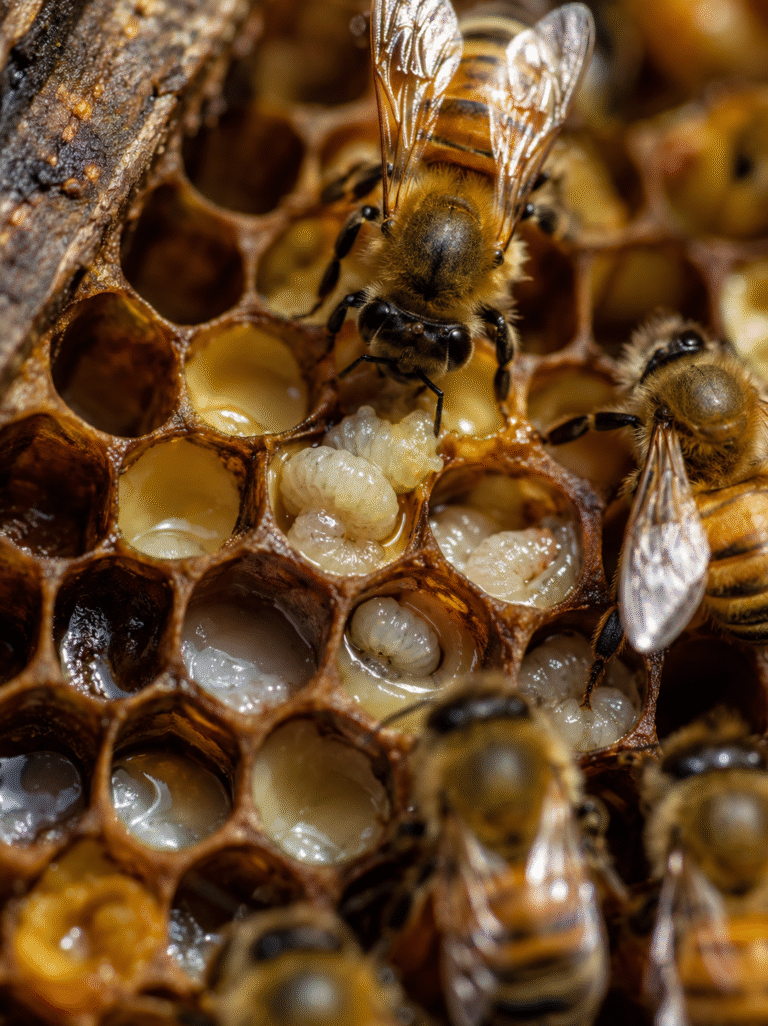
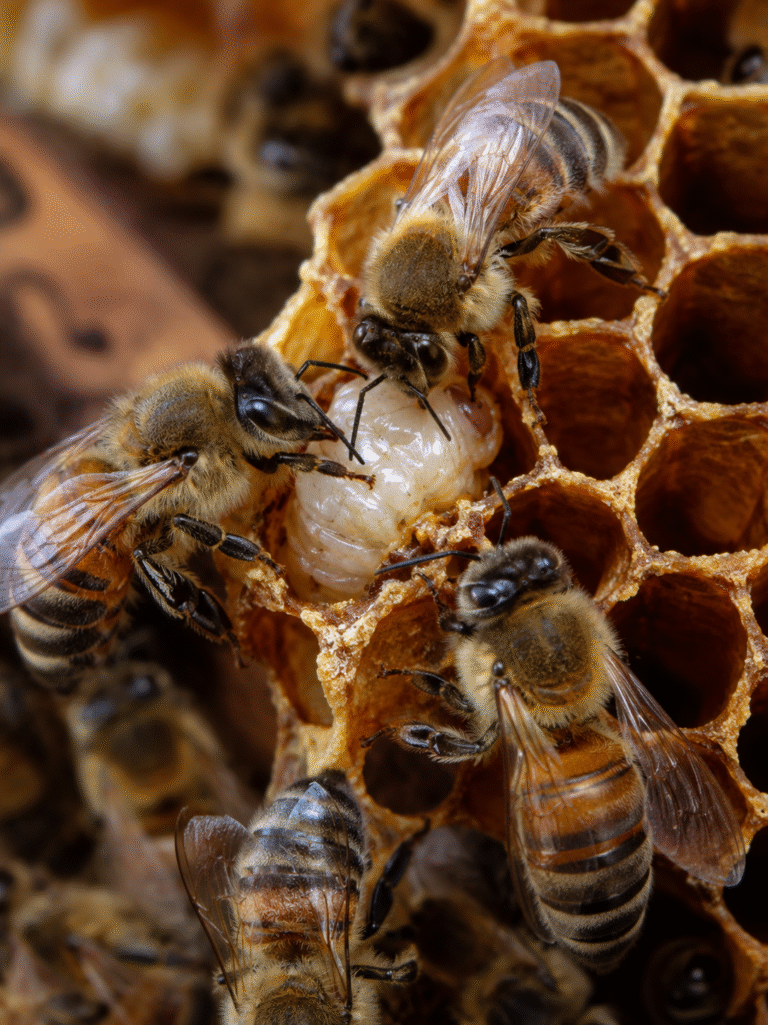
Within roughly a week to ten days, the larvae finish developing, exit the bee’s body at the junction between her head and thorax, and pupate nearby. The bee doesn’t survive the process.
Researchers studying the affected bees have found some, though not all, test positive for deformed wing virus and Nosema, two other significant honey bee pathogens, which raises an open question about whether parasitism by this fly makes bees more vulnerable to picking up additional infections, or whether already-weakened bees are simply easier targets for the fly in the first place. Nobody has fully settled which direction that relationship runs.
Why Beekeepers Should Actually Care About This
I want to be careful here, because it would be easy to read all this and panic, and that’s not the useful reaction. Apocephalus borealis infection in honey bees has been documented mainly in specific regions — California, South Dakota, Oregon, Washington, Vancouver Island, and Vermont, based on records compiled so far. It is not currently understood to be a primary driver of large-scale colony losses the way Varroa mites are. Most beekeepers, in most regions, will never encounter it.
But here’s the part that actually matters for anyone running hives: this parasite is a genuinely useful diagnostic signal precisely because the behavior it causes is so distinctive. Bees don’t fly at night under normal circumstances. If you’re doing an evening walk past your apiary and see bees gathered at a light source nearby, walking in disoriented circles on the ground, that is not normal seasonal behavior, not robbing behavior, not a queenless hive acting strangely. It’s worth collecting a few specimens in a container and watching for a couple of weeks to see whether anything emerges, which is exactly the citizen-science method a project called ZomBee Watch has organized for beekeepers and the general public to help track how far this parasite has actually spread since its discovery.
That kind of low-effort, high-value monitoring is something I’d encourage any beekeeper in an affected region to build into their routine, the same way you’d keep an eye out for chalkbrood or check sticky boards for mites. It costs almost nothing and it contributes to a genuinely incomplete scientific picture.
The Bigger Pattern This Fits Into
What I find most interesting about this story isn’t the parasite itself, it’s the timing of its discovery. Hafernik found his first infected bees in 2010, in the middle of the period when Colony Collapse Disorder was dominating headlines and confusing researchers who couldn’t pin the losses on a single clean cause. His own reaction, by his account, was to wonder whether this newly identified parasite might be a contributing factor in colonies that were mysteriously emptying out, worker bees vanishing while a queen and some stores remained behind.
That connection turned out to be more complicated than a straight cause-and-effect story. But I think the instinct behind asking the question was right, and it’s the same instinct any experienced beekeeper develops after a few bad seasons: colony losses are rarely explained by one tidy villain. They’re usually the result of several stressors compounding — a mite load here, a pesticide exposure there, a rough winter, and now, in specific regions, a parasitic fly nobody had connected to honey bees until someone happened to look closely at a handful of dead bees under a streetlight.
What I’d Tell a Beekeeper Finding This for the First Time
Don’t panic, and don’t assume every bee acting strangely near a light is infected — plenty of ordinary explanations exist for bees behaving oddly, from pesticide exposure to simple exhaustion. But do pay attention to genuinely nighttime activity specifically, since that single behavior is about as clear a red flag as this parasite produces. Collect a few specimens if you see it. Report what you find. And if nothing ever turns up in your area, consider that a reasonably good sign rather than evidence the questions weren’t worth asking.
Fifteen years after that first vial on a desk in San Francisco, researchers still don’t have a complete map of how far this fly has spread or how much impact it’s really having on managed colonies. That gap in knowledge exists largely because beekeepers, not just entomologists, kept watching and reporting what they saw. It’s a reminder that a lot of what we know about honey bee health didn’t come from a lab first. It came from someone paying close attention to something that looked slightly off.