
Why Nosema is called the “silent killer” of hives — how to catch spring dwindle before it’s too late, and what treatment actually still works.
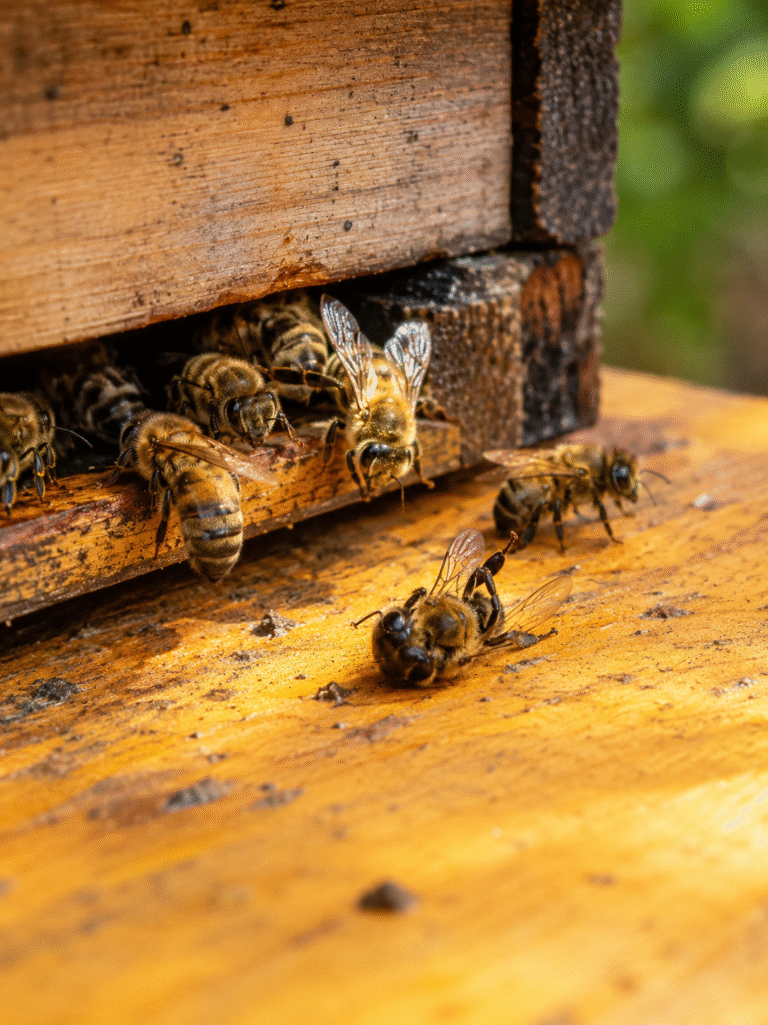
A beekeeper I know in upstate New York went into a mild March convinced his strongest colony from the year before was about to have its best spring yet. Heavy stores, good fall buildup, no obvious Varroa pressure the previous autumn. By late April, that same hive had maybe a third of the bees it should have had, and no clear reason why. No dead bees piled at the entrance. No smell. No visible mites. Just… fewer bees than there should have been, week after week, with nothing dramatic ever announcing itself. That’s Nosema, more often than not — a disease that rarely gives you a single obvious moment to point to.
Nosema disease, or nosemosis, is a gut infection in adult honey bees caused by microsporidian fungi — Nosema apis or the more common Nosema ceranae — that damages the bee’s digestive lining, shortens its lifespan, and can cause a colony to shrink dramatically in spring without any single dramatic symptom to flag it early. It’s one of the more common causes of what beekeepers call “spring dwindle,” and it’s frequently misdiagnosed as something else entirely.
What Nosema actually is
Nosema isn’t a bacteria and it isn’t a virus — it’s a microsporidian, a type of spore-forming fungus that requires a living host to complete its life cycle. The spores get consumed, usually from contaminated comb, water, or feces from other infected bees, and once inside the bee they invade the cells lining the midgut. From there, the infection interferes with the bee’s ability to digest food and absorb nutrients properly. An infected bee isn’t starving in the sense of having no food available — it’s starving in the sense that its gut can no longer process what it eats efficiently, which is worth sitting with if you’ve ever looked into what actually lives inside a healthy bee’s gut — Nosema isn’t attacking the bee from outside, it’s hijacking the same digestive real estate that a healthy microbiome depends on.
This matters for how you think about prevention. You can’t feed your way out of a nutrition problem that’s actually a Nosema problem, and you can’t treat your way out of a Nosema problem with better nutrition alone, even though the two often get tangled together in symptom presentation.
The two strains — Nosema apis vs. the newer, more aggressive Nosema ceranae
Nosema apis is the older, classically studied strain that tends to cause visible dysentery and is strongly linked to cold, wet spring weather, while Nosema ceranae is a newer strain — first documented spreading into European honey bees in the mid-2000s — that’s active year-round, more heat-tolerant, and frequently produces no visible external symptoms at all.
This distinction is the single most important thing to understand before you go looking for symptoms, because it changes what you’re even looking for.
| Nosema apis | Nosema ceranae | |
|---|---|---|
| First documented in A. mellifera | 1909 | Mid-2000s (originally in Apis cerana) |
| Seasonal pattern | Strongly linked to cold, wet spring | Active year-round |
| Visible dysentery | Common | Often absent |
| Current prevalence in U.S. colonies | Declining | Now the dominant strain in most regions |
| Typical presentation | Fecal streaking, crawling bees | Quiet population decline, no obvious sign |
N. ceranae has largely displaced N. apis as the dominant strain across most of the U.S. and much of the world over the past two decades, according to USDA-ARS research — which is part of why “watch for the yellow streaking” advice, while still valid, misses a lot of real infections that never produce it.
Symptoms you can actually see in the field
Dysentery streaking — what it looks like, and what it doesn’t mean
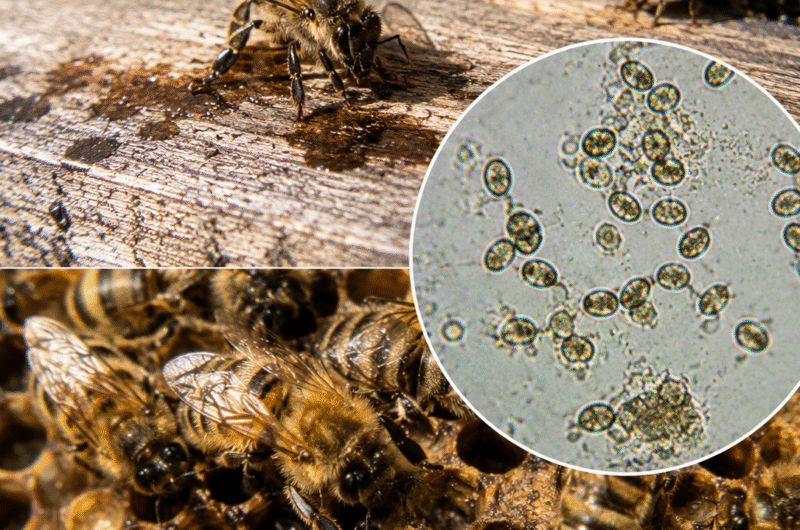
Dysentery — brown or yellowish streaking on the front of the hive, on frames, or on the inner cover — is the classic visible symptom of Nosema apis infection, but its absence does not rule out Nosema, since the now-dominant Nosema ceranae strain frequently causes no external staining at all.
I want to flag this clearly because it’s the mistake I see repeated most often in beginner beekeeping forums: someone inspects a hive, sees no streaking, and concludes Nosema isn’t the issue. That logic worked reasonably well twenty years ago when N. apis was the dominant strain. It doesn’t hold up as well now.
When dysentery does show up, it’s genuinely distinctive — not to be confused with normal cleansing-flight spotting, which is scattered and modest. Nosema-driven dysentery tends to be heavier, more concentrated, and can appear inside the hive on the top bars and inner cover, which normal cleansing flights don’t produce.
Crawling bees, spring dwindle, and colonies that “won’t build up”
The most common real-world presentation of Nosema is a colony that came through winter looking reasonably strong, then fails to build population through March and April the way a healthy colony should — losing workers faster than the queen can replace them, without any single obvious cause.
This is the harder pattern to catch, because it looks a lot like several other things: a failing queen, pesticide exposure, or simply a colony that came out of winter with less than you thought. I’ve learned to treat unexplained spring dwindle as a short list of suspects rather than jumping straight to any one diagnosis — Nosema is on that list, but so are queen problems and lingering Varroa damage from the previous fall.
Bees unable to fly properly, sometimes called “crawling bees,” found on the ground in front of the hive on an otherwise normal day, are another signal worth noting, though this symptom overlaps with several other stressors too and isn’t Nosema-specific on its own.
Why Nosema is so easy to misdiagnose
Nosema shares overlapping symptoms with chalkbrood, pesticide exposure, and simple poor nutrition — and because N. ceranae often produces no distinctive external sign, a beekeeper working from visual inspection alone can reasonably suspect several different problems and be wrong about all of them. This is genuinely one of the harder calls in practical beekeeping, and I don’t think it’s honest to pretend a field inspection alone gets you a confident answer most of the time.
There’s also a stress-compounding factor worth naming clearly: Nosema infections tend to hit hardest in colonies already dealing with something else — Varroa pressure, poor forage, or a rough winter. Researchers describe Nosema as often functioning as a “stress disease,” where the underlying infection may be present at low, manageable levels for a long time before some other stressor tips it into an outbreak. That’s part of why two colonies in the same apiary, exposed to roughly the same spore load, can have completely different outcomes.
Confirming it — the microscope method, explained plainly
The only reliable way to confirm a Nosema infection is microscopic examination — collecting a sample of older forager bees, crushing the abdomens in water, and looking for the rice-shaped spores under roughly 400x magnification.
This sounds more intimidating than it is, and you don’t need a lab. A basic compound microscope, available for a reasonable cost through most beekeeping supply catalogs, is enough to see spores if they’re present in meaningful numbers. What you’re looking for is a field of small, oval, rice-grain-shaped particles — a heavily infected sample will show them in dense numbers, while a lightly infected or clean sample will show few or none.
If you don’t want to do this yourself, several state agricultural extension labs and university bee programs (Penn State’s among them) offer sample testing services, often at low or no cost to beekeepers, particularly useful if you’re trying to confirm whether a suspicious colony is worth treating versus simply monitoring.
Treatment and prevention
Fumagilin-B, an antibiotic derived from a related fungus, was historically the standard chemical treatment for Nosema, but its use has been declining in recent years, and modern management leans more heavily on prevention through colony strength, sanitation, and nutrition rather than routine medication.
A few things worth being direct about here, because I think overpromising on treatment does beekeepers a disservice:
- Fumagilin-B suppresses the vegetative stage of the infection rather than eliminating spores outright, and its effectiveness against N. ceranae specifically has been questioned in more recent research compared to its historically stronger track record against N. apis.
- Prevention is doing more of the real work in modern Nosema management than treatment is. That means keeping colonies well-fed and not nutritionally stressed, avoiding overcrowding, ensuring good ventilation to reduce excess moisture (which favors spore survival), and requeening colonies that show chronic, unexplained weakness.
- Comb sanitation matters more than most beekeepers assume. Spores can persist on old comb for extended periods and survive freezing, so a colony that dies out from suspected Nosema shouldn’t simply have its equipment handed straight to a new package without at least considering replacement of the oldest, darkest brood comb. Acetic acid fumigation of empty equipment is one option some beekeepers use to reduce spore load on reused comb, though it requires careful handling.
- Strong colonies tolerate Nosema better than weak ones. This isn’t a treatment exactly, but it’s the single most consistent piece of advice across the research I’ve read and the beekeepers I’ve talked to: a well-fed, well-managed colony can carry a Nosema infection at low levels without much visible impact, while the same infection in an already-stressed colony can be the thing that finally tips it over. This is the same logic behind the updated pest management guidance that’s reshaped how a lot of us approach Varroa — treat the colony’s overall condition as the first line of defense, not just the specific pathogen in front of you.
If you’ve already read through what happened during the record colony losses of the past two seasons, disease pressure — not just Varroa — is a recurring thread in why those losses were as severe as they were. Nosema rarely makes headlines the way Varroa does, but it’s frequently present as a compounding factor rather than the sole cause.
Myth vs. Fact
Myth: “No dysentery streaking means no Nosema.” Fact: This was reasonably reliable when N. apis was the dominant strain. It’s no longer safe advice, since N. ceranae — now the more common strain across most U.S. and European colonies — frequently produces no visible external symptoms at all.
Myth: “Nosema is basically the same thing as Colony Collapse.” Fact: Nosema can contribute to colony decline and has been associated with cases resembling Colony Collapse Disorder, but it’s a specific, identifiable pathogen with its own diagnostic method — not a catch-all term. Treating every unexplained decline as “probably CCD” skips the step of actually checking for Nosema, which is one of the few causes of unexplained decline you can actually confirm with a microscope.
FAQ
What are the first signs of Nosema in bees? The earliest reliable sign is often not a visible symptom at all, but a colony that fails to build population normally through early spring despite coming through winter with adequate stores. Visible dysentery streaking can appear with the Nosema apis strain, but the now-more-common Nosema ceranae strain often shows no external sign.
Is Nosema the same as dysentery in bees? No. Dysentery is one possible symptom of a Nosema apis infection specifically, not a separate condition, and not a reliable indicator of Nosema ceranae, which frequently causes no visible dysentery at all.
Can Nosema kill a whole hive? Yes, particularly when it combines with other stressors like poor nutrition, Varroa pressure, or a hard winter. Nosema is often described by researchers as a “stress disease” — a colony can carry a low-level infection without collapsing until something else tips the balance.
How is Nosema diagnosed without a microscope? It genuinely can’t be confirmed without one. Field symptoms like dysentery or spring dwindle can suggest Nosema, but they overlap heavily with other issues. A crushed-abdomen sample examined under roughly 400x magnification, or a sample sent to a university extension lab, is the only reliable confirmation method.
What’s the difference between Nosema apis and Nosema ceranae? Nosema apis is the older, classically studied strain, strongly linked to cold, wet spring weather and visible dysentery. Nosema ceranae is newer to Western honey bees, active year-round, more heat-tolerant, and now the dominant strain in most regions — frequently without visible symptoms.
Is there a treatment for Nosema, or just prevention? Fumagilin-B is the historical chemical treatment, though its use has declined and its effectiveness against Nosema ceranae specifically is debated. In practice, most modern management leans on prevention — strong, well-fed colonies, good ventilation, and comb sanitation — rather than routine medication.
Does Nosema cause colony collapse? Nosema can be a contributing factor in colony decline and has been found in colonies matching Colony Collapse Disorder patterns, but it’s a distinct, testable pathogen rather than a synonym for CCD. It’s worth ruling in or out specifically rather than assuming.