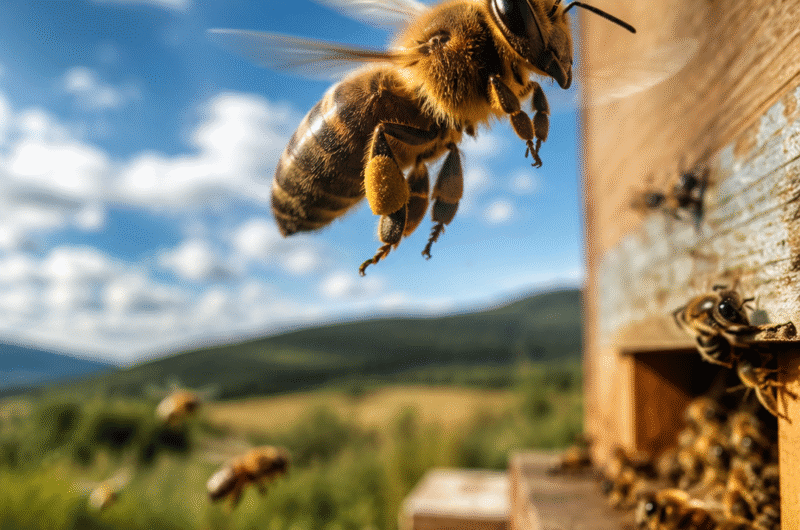

The bee-flight myth started with a 1934 miscalculation. Here’s the real 90-year science story of how bees actually fly.
Do Bees Really Break the Laws of Physics?
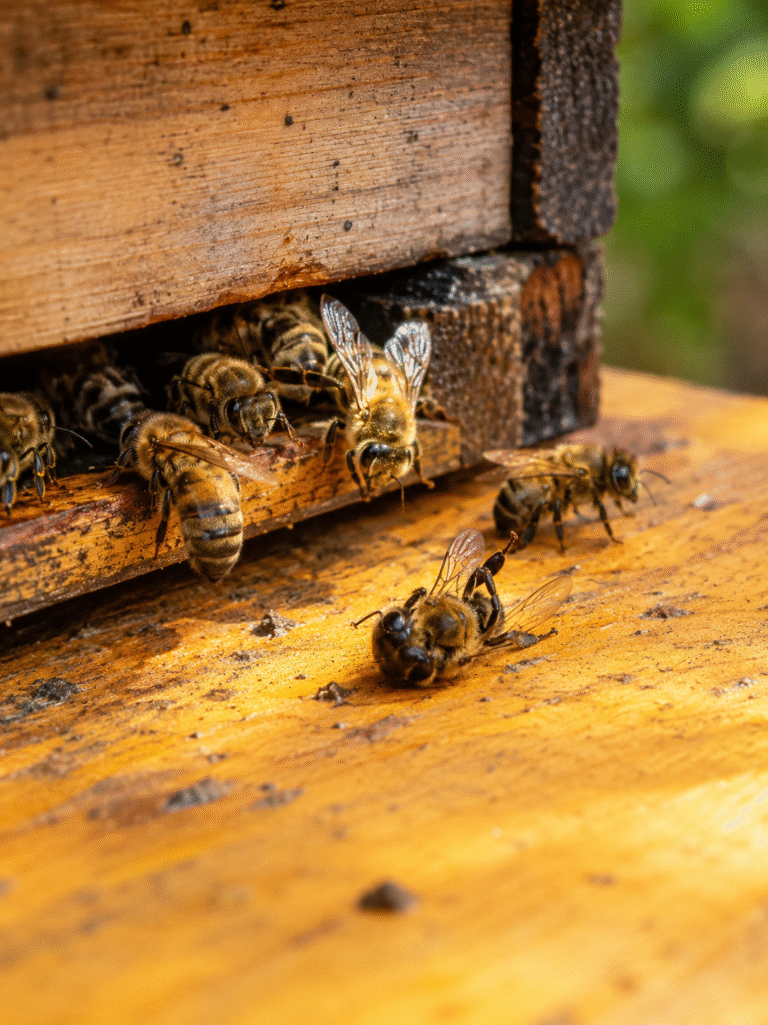
I was leaning against a fence post one August afternoon, watching a forager labor out of the hive entrance with a pollen load so heavy she looked like she’d overpacked for a trip she wasn’t built for. She wobbled, dropped a few inches, caught herself, and climbed. My neighbor, watching over the fence, laughed and said what people always say when they see a bee working that hard: “Shouldn’t be possible, should it? Everyone knows bees can’t really fly.”
I hear some version of that line more than almost anything else in this job. It’s become one of those facts everybody “knows” — repeated at barbecues, printed on coffee mugs, even opening the Bee Movie script. And like a lot of things everybody knows, it isn’t true. What’s actually true is more interesting than the myth, and it says a lot about how quickly a good story can outrun good science.
The Short Answer
Bees do not defy physics. The myth traces back to a 1934 calculation that applied fixed-wing airplane math to a bee’s body and wing size, and concluded flight was impossible. The math wasn’t wrong — the assumption was. Bees don’t fly like airplanes. Once researchers studied bee wings as flexible, rotating structures rather than rigid airfoils, the “impossible” problem disappeared. Modern high-speed imaging fully explains bee flight, and has for more than two decades.
Where the Myth Actually Came From
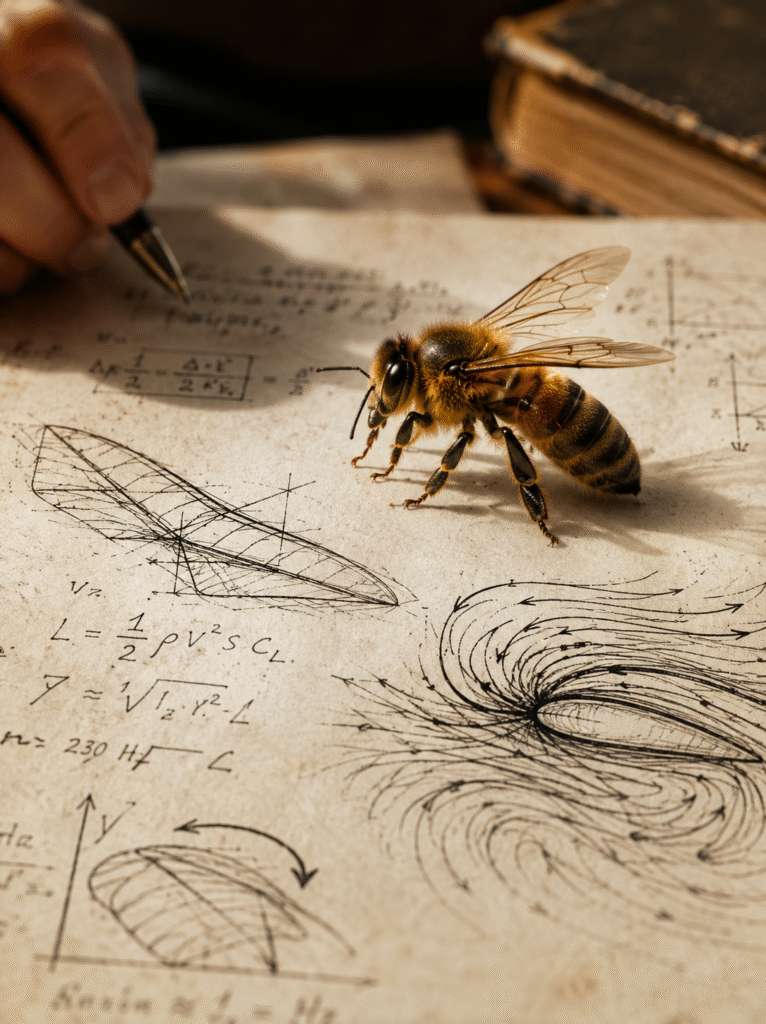
The story usually gets told as an urban legend — some unnamed engineer at a dinner party, asked by a biologist how bees fly, ran the numbers on a napkin and declared it impossible. The real origin is a bit more specific. In the 1930s, a French zoologist named Antoine Magnan, working with a colleague, ran calculations treating bee wings the way you’d analyze a small, fixed airplane wing: a rigid surface pushing air downward for lift. Under that model, a bee’s wing area was far too small, relative to its body weight, to generate enough lift to get off the ground.
The problem is that bees aren’t tiny airplanes. Airplane wings work because a steady stream of air flows over a curved, unmoving surface — faster over the top, slower underneath, creating a pressure difference that lifts the plane. A bee’s wing does nothing like that. It doesn’t glide through steady air; it flaps back and forth in short, rapid strokes, roughly 230 times a second for a honeybee, generating turbulence rather than avoiding it. Applying airplane math to that kind of motion was always going to produce nonsense, the same way calculating a hummingbird’s flight using a jumbo jet’s specs would.
What Actually Keeps a Bee in the Air
It took until the late 1990s for researchers to fully map out what’s really happening, and the answer turned out to be more sophisticated than anyone expected — not despite the small size of a bee’s brain, but almost in spite of it.
The leading-edge vortex. As a bee’s wing sweeps forward, air rolling over its leading edge spins into a small, tight vortex — essentially a miniature, controlled hurricane sitting just above the wing surface. That low-pressure vortex pulls the wing (and the bee) upward. It’s an unsteady effect, meaning it only works because the wing keeps moving and changing angle constantly — the opposite of how an airplane wing behaves.
Wing rotation. Unlike a bird’s wing, which mostly moves up and down, a bee’s wing rotates at the end of each stroke, flipping to generate lift on both the forward and backward pass. That rotation is why a bee’s wingbeat looks less like flapping and more like a rapid figure-eight when filmed in slow motion.
Wake capture. As the wing reverses direction, it re-enters turbulent air it just created on the previous stroke, effectively recycling energy that would otherwise be wasted. Combined, these three mechanisms generate far more lift than steady-flow aerodynamics would predict — enough to explain, cleanly, how a bee gets airborne and stays there while hauling a payload close to her own body weight.
Researchers at Caltech confirmed this experimentally by building a scaled-up robotic bee wing, submerging it in mineral oil to slow the motion down to something a camera could track, and measuring the forces at every point in the stroke. The physics scaled correctly — the robot wing behaved exactly as the underlying math predicted a real bee wing should, closing the loop on a question that had lingered, unresolved in the popular imagination, for roughly seventy years.
Airplane Wings vs. Bee Wings, Side by Side
| Airplane Wing | Bee Wing | |
|---|---|---|
| Shape | Rigid, cambered (curved) | Flat, flexible |
| Airflow | Steady, continuous | Unsteady, turbulent by design |
| Motion | Fixed in place | Flaps ~230 times/second |
| Lift source | Pressure difference over a curved surface | Leading-edge vortex + rotation + wake capture |
| Efficiency at scale | Optimized for large, fast vehicles | Optimized for small, agile, hovering flight |
What This Means If You Actually Keep Bees
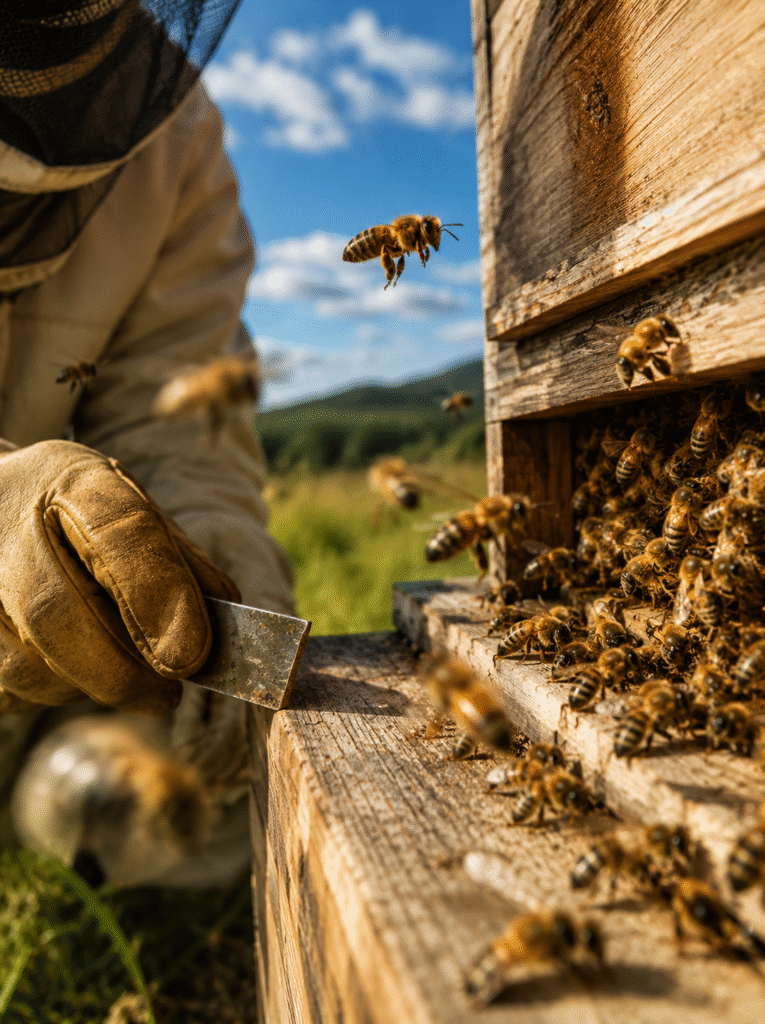
None of this is just trivia if you spend time around live colonies. Wing condition is one of the quietest indicators of hive health I check for, and it’s easy to miss if you’re only looking at brood pattern and stores. A forager returning with tattered or asymmetrically worn wing edges — common toward the end of a long nectar flow, or in a colony working hard through a drought — isn’t flying with the same efficiency as a fresh young bee. Wing wear reduces the leading-edge vortex’s effectiveness, which is part of why older foragers noticeably struggle more on windy days or with heavier loads, something you can watch happen in real time at the entrance board on a rough afternoon.
It’s also worth remembering the next time you watch a queen’s mating flight, or a swarm lift off in a loose, chaotic cloud: every single bee in that mess of motion is running three separate, precisely timed aerodynamic tricks, dozens of times a second, coordinated by a brain smaller than a grain of rice. Bee cognition keeps surprising researchers in exactly this way — the more closely you look at what a tiny nervous system can pull off, the less “simple” these insects start to seem.
A Physics Puzzle Bees Aren’t the Only Ones to Solve
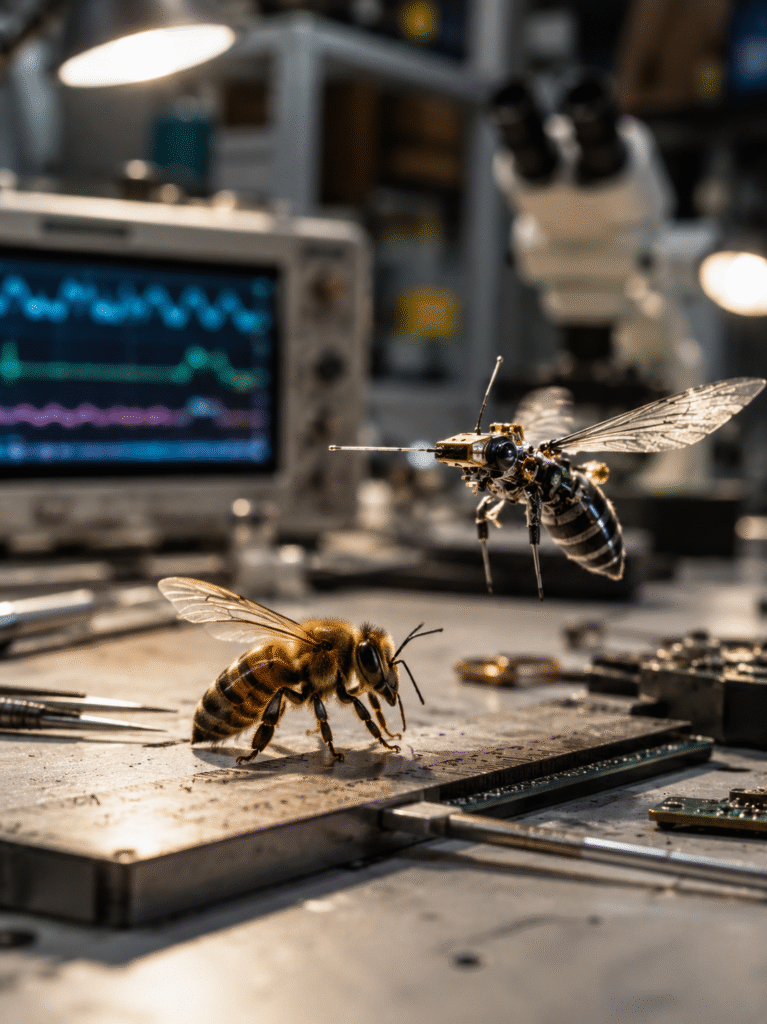
Bees aren’t unique in relying on unsteady aerodynamics — hummingbirds and fruit flies use overlapping tricks — but bees are unusual in how much power they generate relative to their wing area, which is exactly why aerospace engineers keep coming back to them. Teams at Harvard and elsewhere have spent years building bee-sized flapping-wing drones, chasing the same efficiency bees manage with a few hundred thousand neurons. It’s a strange kind of compliment: nearly a century after a scientist decided bee flight was impossible, engineers are now trying, and mostly failing, to replicate it in hardware.
It’s a reminder of something else worth sitting with, too — the same instinct that produces honeycomb’s perfect hexagons is running the show here as well: bees aren’t consciously solving equations, but evolution has quietly engineered solutions that took human science decades to catch up to.
FAQ
Is it true bees shouldn’t be able to fly?
No — that’s a myth. It comes from a 1934 calculation that mistakenly applied airplane-style, fixed-wing aerodynamics to bees. Once scientists studied bee wings as flexible, rotating structures instead, the physics worked out completely.
Who said bees can’t fly, according to physics?
The claim traces back to French zoologist Antoine Magnan and a colleague, who calculated in the 1930s that a bee’s wing area was too small for its body weight — a conclusion based on a flawed model, not bad math.
How do bees fly with such small wings?
Bees compensate for small wing size with speed and rotation. Rapid, short wingbeats combined with wing rotation create a leading-edge vortex that generates far more lift than a steady airflow model would predict.
How fast do bees flap their wings?
A honeybee beats its wings roughly 230 times per second while hovering — fast enough to produce the audible buzz, and central to how it generates lift through unsteady aerodynamics.
Do bees fly like airplanes?
No. Airplanes rely on steady airflow over a fixed, curved wing. Bees rely on constantly changing, turbulent airflow generated by rapid flapping and wing rotation — a completely different physical mechanism.
Why did engineers think bee flight was impossible?
Because they modeled bee wings the way they modeled airplane wings — as rigid surfaces moving through steady air. Bee wings are flexible and in constant, complex motion, which the original model didn’t account for.