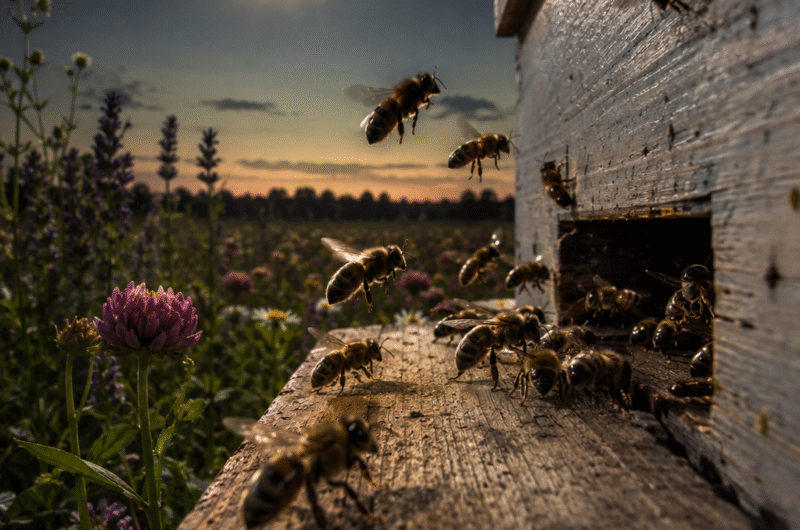

Bees go eerily quiet during a total solar eclipse, acting as if night has fallen. Here’s the real science behind it — ahead of Aug 12, 2026.
What Happens to Bees During a Total Solar Eclipse
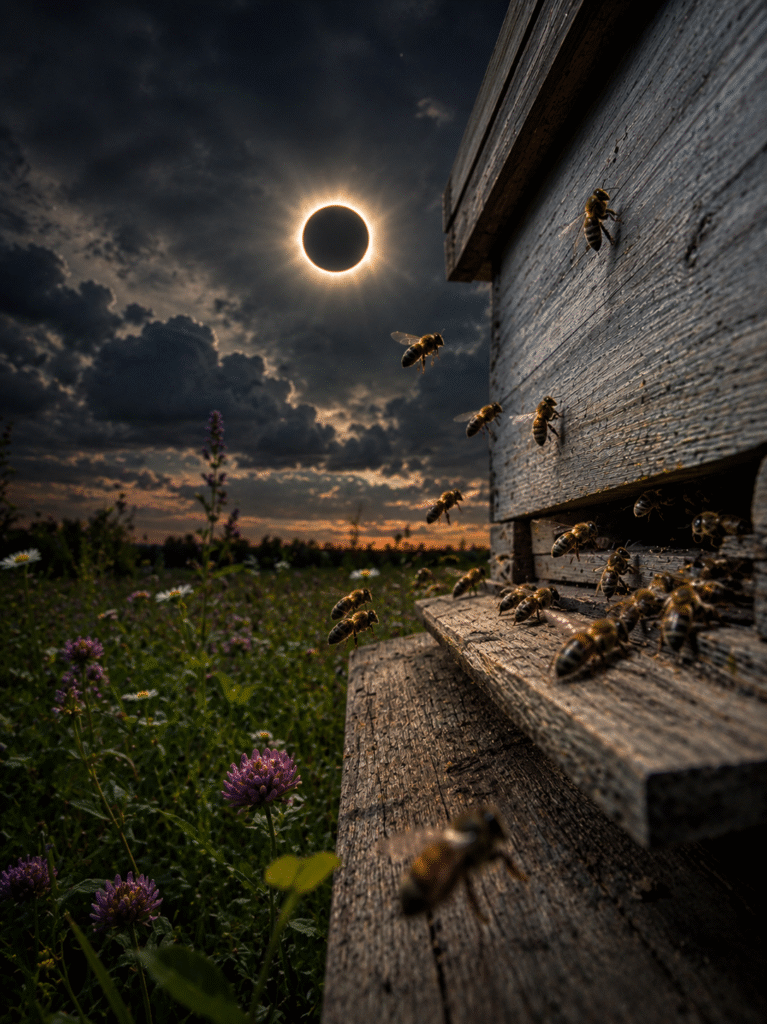
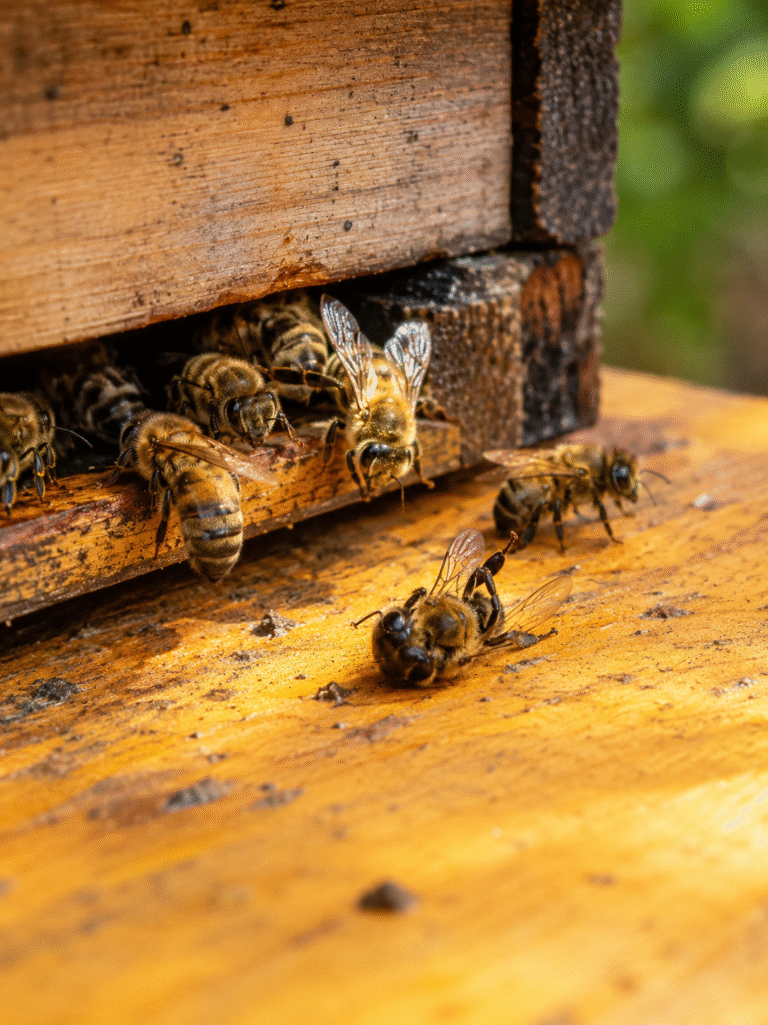
I was standing at the fence line of my own apiary during a partial eclipse a few years back, expecting more or less nothing. Bees don’t care about the sun dimming a little, I figured — they care about temperature, wind, rain. I was wrong within about four minutes. The foraging traffic at the entrance of my strongest hive didn’t slow down. It stopped. Not gradually — stopped, the way a faucet stops when you turn the handle. Bees that were mid-flight seemed to reroute straight back to the box. By the time the sky had dimmed to that strange, flat, pewter-grey light eclipses produce, my hive sounded like it does at nine at night in October.
On August 12, 2026, a total solar eclipse will sweep across the Arctic, Greenland, Iceland, and northern Spain — the first total eclipse visible from mainland Europe since 1999 — with a partial eclipse visible across much of the rest of Europe, parts of North America, and northwestern Africa. If you keep bees anywhere in that broad shadow path, or you’re just curious what’s about to happen in every garden and meadow near you, here’s what actually occurs inside a colony when the sky goes dark in the middle of the day.
The Science: Why Sudden Darkness Confuses a Hive
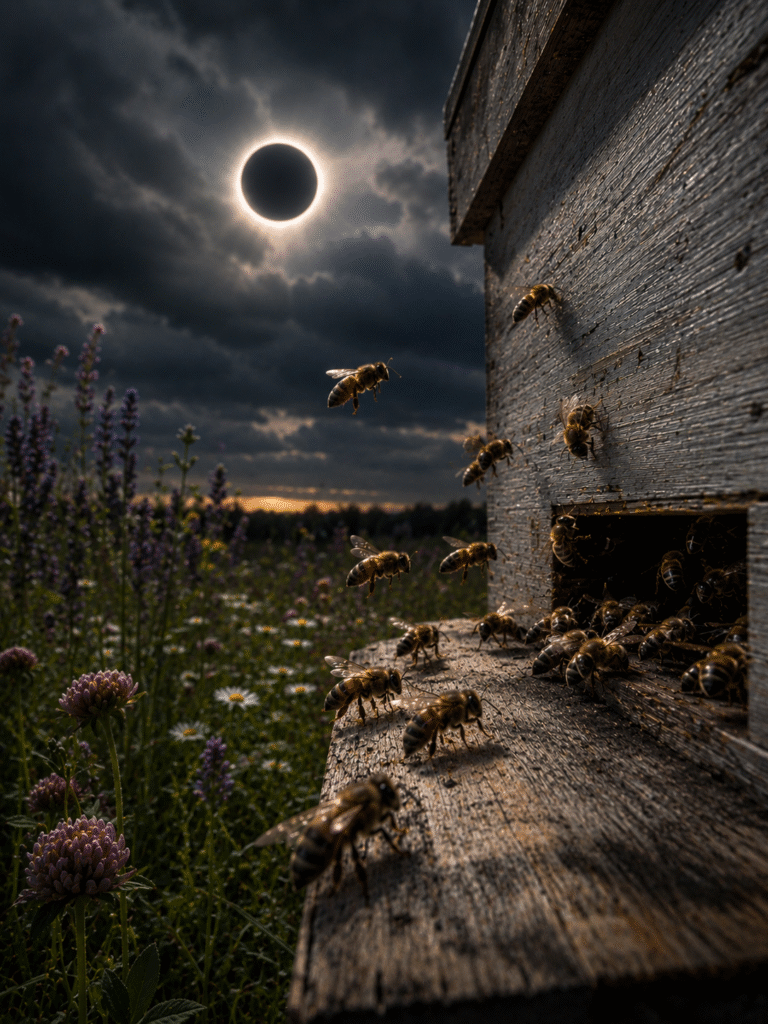
Honey bees navigate almost entirely by light — the position of the sun, the polarization pattern of the sky, and the intensity of ambient light all feed into how a forager finds her way home and how the colony as a whole regulates its daily rhythm. When that light drops sharply and unnaturally fast, a bee’s internal systems read it the same way they’d read the onset of dusk, triggering the same return-to-hive behavior that happens every evening.
This isn’t a bee being “fooled” in some simplistic sense. It’s her biology working exactly as designed, just responding to an input — total darkness inside twenty minutes — that essentially never happens under natural conditions outside of an eclipse. A cloud passing over the sun doesn’t do this. Even a fast-moving storm front dims things over a longer stretch and rarely to full darkness. An eclipse compresses an entire day’s light curve into less than an hour, and a bee’s internal clock has nothing in its toolkit for that except “it’s night.”
What Beekeepers Observed During Past Eclipses
The 2017 total solar eclipse across the continental United States produced one of the largest citizen-science datasets on animal behavior during totality ever collected, with observers stationed at hives, farms, and nature reserves along the path recording exactly this kind of shift — foraging traffic dropping off sharply in the minutes leading into totality, and cicadas and crickets starting up as if evening had arrived. Beekeepers along the path reported the same pattern I saw years later on a much smaller scale: a rapid, unmistakable return-to-hive surge, not a gradual slowdown.
The “False Dusk” Return-to-Hive Behavior
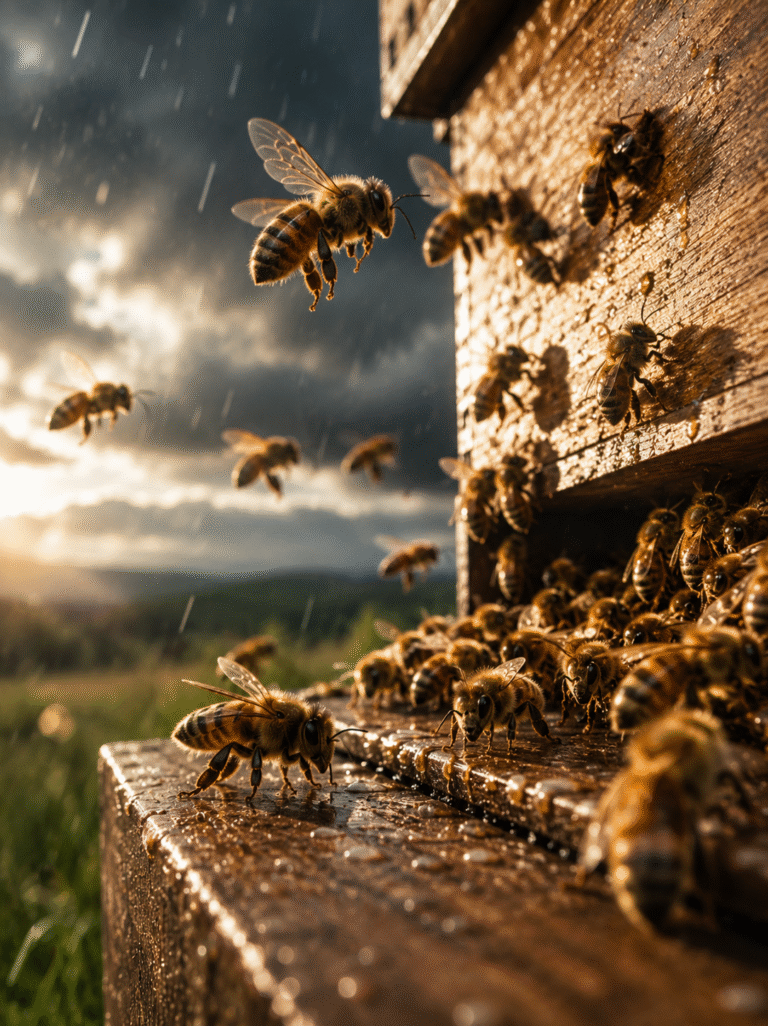
What’s genuinely interesting is how fast it happens. Bees don’t wait for full darkness to decide it’s time to head home — the drop-off in outbound traffic tends to start well before totality, once light levels cross whatever threshold a given colony’s foragers are tuned to. Older, more experienced foragers seem to react first, based on informal observations from eclipse-day hive watches; younger bees and those already deep in a foraging trip sometimes get caught out and have to navigate the return in dimmer light than they’re used to.
What Happens the Moment Totality Ends
The reversal is just as abrupt. As soon as sunlight returns — even the thin sliver right after totality — foraging traffic typically resumes within a few minutes, not the slow ramp-up you’d see at actual sunrise. It’s one of the more compelling pieces of evidence that this is a pure light-triggered response rather than anything resembling a “day” being mentally reset and restarted.
Will Your Bees React on August 12, 2026?
If you’re anywhere near Iceland, northern Spain, or the northeastern tip of Portugal, you’ll be in or close to the path of totality, and the “false dusk” effect should be dramatic and unmistakable. Totality there lasts up to about two minutes and eighteen seconds at maximum — short, but apparently enough time to trigger the full return-to-hive response, based on prior total eclipses of similar duration.
Everyone else in the broader partial-eclipse zone — most of Europe, parts of North America, and northwestern Africa — will see a less dramatic version. The degree of hive reaction during a partial eclipse tends to scale with how much of the sun gets covered; if less than about 80–90% of the disk is obscured, many colonies show only a mild dip in activity rather than a full shutdown. This is genuinely a case where local conditions vary and nobody should expect uniform results — I’d treat any single observation, including my own, as anecdotal rather than a hard rule.
How to Safely Observe Your Hive During the Eclipse
You don’t need special equipment to watch bee behavior — just don’t watch the eclipse itself without certified solar filters, and keep the same rule in mind if you’re photographing your hive with the sun anywhere in frame. A few practical notes for eclipse-day hive watching:
- Position yourself at a safe distance from the entrance so you’re not blocking flight paths during the pre-totality rush
- Note the time foraging traffic first drops — it’s usually earlier than people expect
- Watch for any bees caught outside at totality; they often cluster on nearby vegetation rather than attempting a long return flight in near-darkness, similar to <a href=”https://beekeeperscorner.com/do-bees-sleep/”>how bees normally wind down at night</a>
- If you keep smart hive monitoring gear, this is a rare chance to see acoustic or vibration sensors register a sharp, clean data spike — a genuinely useful real-world test of <a href=”https://beekeeperscorner.com/how-to-keep-your-bees-cool-in-a-summer-heatwave-before-its-too-late/”>how bees respond to sudden environmental shifts</a> more broadly, even outside the heat-stress context that gear is usually marketed for
It’s also worth remembering just how precise <a href=”https://beekeeperscorner.com/scientists-just-discovered-bees-have-their-own-personal-gps-and-it-changes-how-i-think-about-foraging/”>bees’ internal navigation system</a> normally is under full daylight — which is part of what makes the eclipse such a clean natural experiment. You’re briefly watching that system get an input it was never built to handle, and watching it default, cleanly and immediately, to the one behavior that makes sense: go home.
FAQ
Do bees stop flying during a solar eclipse? Yes — most foraging bees stop flying and return to the hive as light levels drop, behaving as though dusk has arrived rather than continuing normal daytime activity.
What time is the August 12, 2026 solar eclipse? Totality sweeps through the Arctic, Greenland, Iceland, and northern Spain in the late afternoon to early evening local time, with a partial eclipse visible across much of Europe and parts of North America and Africa earlier or later in the day depending on location.
Do animals act differently during an eclipse? Yes, and bees are one of the more consistently documented examples — along with crickets and cicadas starting up as if evening has arrived, based on citizen-science observations from the 2017 U.S. eclipse.
Why do bees go quiet during darkness? Honey bee activity is governed largely by light levels and the sun’s position, so a sharp, unnatural drop in light — like the kind an eclipse produces in minutes rather than hours — triggers the same return-to-hive response bees use every evening at dusk.
Will my hive react to the eclipse? If you’re near or within the path of totality, very likely yes. Outside that path, the reaction tends to depend on how much of the sun gets covered — reactions are milder when coverage stays well under 80–90%.
Is it safe to watch bees during an eclipse? Yes, as long as you follow standard eclipse eye-safety rules for looking at the sun itself — bees themselves pose no additional risk, and most will be heading calmly back to the hive rather than behaving defensively.